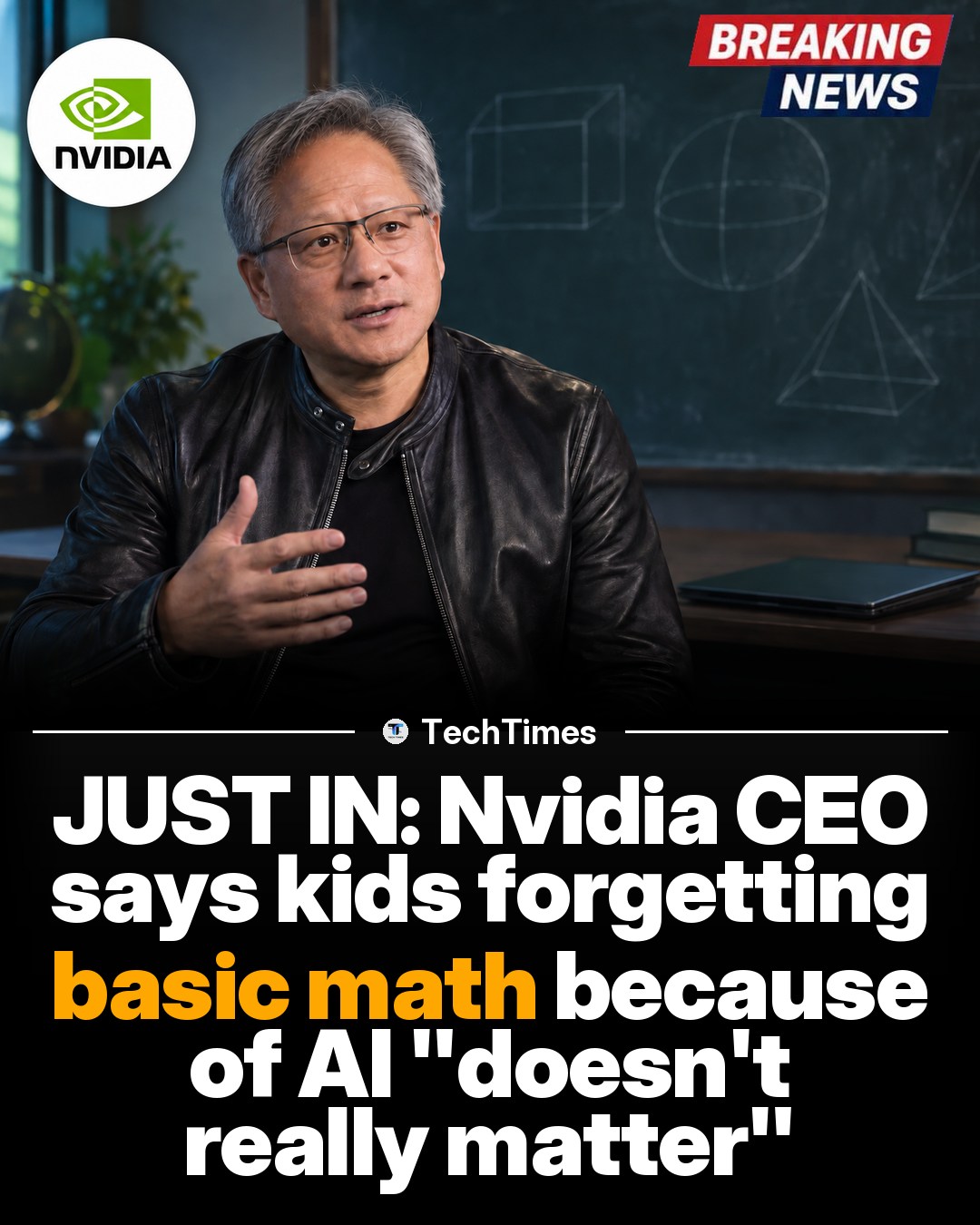
Did an AI explosion kill childhood arithmetic?
Nvidia CEO Jensen Huang made headlines with a dismissive statement to TechTimes, saying “kids forgetting basic math because of AI” is nothing to worry about. This was unusual because experts are beginning to weigh in on AI’s profound impacts. Huang’s comments sparked a media firestorm — but what’s the story behind the headlines?
The background — the evolving role of AI in education
AI is a hot topic in education. It's not just about math, but math has been a flashpoint because a central debate is about whether AI can, or should, do all the calculations. Huang’s comment kickstarted a fresh debate about the role of rote computation in a time — maybe no longer far away, if Huang is right — when AI can do it all. The CEO’s challenge came after he was asked whether AI will harm teachers' role in teaching math. "Kids forget basic math" because AIs do the math, he said. So what? In his view, kids can always regain that knowledge. Armed with AI assistance, they can do math problems anytime, anywhere, as he noted. And playing with AI does not distract from learning math: the two happen at the same time. Yet his perspective is far from universal. Inside debates within many educational communities are being disrupted by dramatic new AI tools — with no playbook for navigating them. Students in some schools already learn how to write with AI. The AI revolution could be revamping how math is taught, too. But how this happens is at the mercy of millions of teachers, parents, and administrators.
Why tech leaders are cheering AI in education
AI is already here in classrooms. The question now is how it's used. Critics point to Huang’s comment as evidence that AI could reduce students’ abilities in basic arithmetic. But before these lessons are drawn, it's valuable to see what Huang sees in AI's use in education. He wouldn’t have been mocking the importance of rote memorization if he wasn’t aware of how crucial AI is to both basic and higher math. “AI can do all the rote stuff,” said Huang, who is putting his money where his mouth is. His company, Nvidia, makes GPUs — the kind of hardware AI dreams are made of. He thinks AI should handle the computational heavy lifting, like solving equations and plotting functions. When students have AI to do the time-consuming tasks, they can focus on the big and beautiful ideas of mathematics. That could include visualization, innovation, and problem-hunting. Tech leaders like Huang want teachers to focus on showing students how AI can solve problems and do calculations. They also want students to use AI to create problems and learn to think mathematically. So all the while, students are still learning “basic math.” That means they are using AI to augment, not replace, traditional methods. Huang sees it as more effective for students to draw on their understanding to ground AI findings, rather than rely on rote memorization.
The Peebo Optimization Problem
Practice makes perfect. But what is the purpose of math? Is it to memorize formulas? Or is it to solve problems? Huang believes that AI can do the computations and leave teachers to focus on giving students the context and tools to learn. One teacher asked Huang, “What if students don't get it?” The details don’t matter, replied Huang. If students don’t get it, the AI will. Here, the issue was that AI could distract from math teaching. Huang’s counterpoint was that it can't be distracting: teachers should not teach computation to students, but teach them how to use computation tools and AI. For some, “basic math” is a form of mental gymnastics: a platform for developing problem-solving skills and logical thinking. For others, like Huang, it is a tool, a means to an end rather than an end in itself. The easier a tool is to use, the more economically it can be harnessed in the furtherance of higher goals. People who understand math can empower themselves in practical ways to achieve real-world results. However, AI could indelibly change how math is learned. Instead of mindlessly practicing arithmetic, students can focus on learning how to apply math to reality.
Consulting with an on-demand algorithm
How does it work in practice? Huang has a vision of schools having AI tutors. These tutors would not be programmed to know the answers to students’ questions — they would know how to find those answers. This echoes a dichotomy seen between formal and informal learning. For instance, students use Google to find information, but they still need to know how to verify that information. This would remain the same in math: students would still be required to learn how to verify AI’s answers, but AI would make the learning more interactive, more hands-on.
Making sense of the march of AI
Evidence of this move can be seen in the classroom. It is where educators often find themselves at odds with tech leaders over what students should learn. That’s where Huang’s comments enter the debate. But it isn’t the whole story. Apple CEO Tim Cook, for example, sees how AI is disrupting traditional educational methods. Cook sees the flip side of using AI in education. He has expressed that AI can make students lose critical analog thinking skills. Huang sees things differently. When AI creates a problem, students don’t try to figure out what to do. They just ask it to solve it. Critically, he doesn’t place the focus on AI’s ability to solve problems. It’s more about how AI's problem-creation abilities can foster students’ creative thinking skills.
Ready to integrate AI into the classroom?
AI tutors are already available, but they are in use a lot more outside of schools. Students can use tools like Khan Academy or Photomath to solve equations, whether in or out of a classroom. Huang would likely encourage this. His sentiment echoes sentiments of educators who believe that AI will make students’ lives easier, both in and out of school. There are many tools available to educators. In fact, Huang wouldn’t even need to “recommend” anything to educators. However, he likely would want to see more hands-on learning in schools.
The end of math as we know it?
Huang’s comments open the door to a new era in math education. This era would see students less focused on rote memorization and more focused on understanding mathematical principles. This would be a dramatic shift in the way many schools teach mathematics. But it’s taking place right now. Statistics professors are already using AI to create and solve problems. Students are already using AI-enabled calculators on their homework. As this trend gains momentum, it will be crucial to remember that AI isn’t going to replace math education. Instead, it's poised to redefine it in ways that were unthinkable just a few years ago.
Questions readers ask
What exactly did Jensen Huang mean when he said 'kids forgetting basic math because of AI' is nothing to worry about?
Jensen Huang believes that even if children rely on AI for basic math computations, they can always relearn that knowledge when needed. He thinks that the real value lies in using AI to focus on more complex, creative, and conceptual aspects of mathematics. In his view, AI doesn't distract from learning but rather augments it, allowing students to engage with math in a more meaningful way.
How is AI currently being integrated into math education, according to the article?
AI is being used to handle the computational heavy lifting, like solving equations and plotting functions. This frees up time for students to focus on more conceptual aspects of mathematics, such as visualization, innovation, and problem-solving. Teachers are encouraged to use AI as a tool to enhance learning, rather than replace traditional methods.
What is the Peebo Optimization Problem, and why is it mentioned in relation to AI and math education?
The Peebo Optimization Problem is not explicitly defined in the article, but it seems to refer to a debate about the purpose of math education—whether it's about memorizing formulas or solving problems. Jensen Huang believes AI can handle the computations, allowing teachers to focus on helping students understand and apply mathematical concepts, which is a more effective approach.
What are some of the concerns educators and tech leaders have about AI in education?
Educators and tech leaders are concerned about the impact of AI on basic arithmetic skills and the role of rote memorization in learning. There is also a debate about how AI should be integrated into the curriculum and whether it will replace traditional teaching methods. Some worry that AI might reduce students' abilities in basic arithmetic, while others see it as a tool to augment learning.
What is the role of Nvidia in the integration of AI in education?
Nvidia, led by Jensen Huang, plays a significant role in the integration of AI in education by providing the hardware, specifically GPUs, that power AI applications. Huang advocates for using AI to handle the computational aspects of math, allowing students and teachers to focus on more conceptual and creative aspects of the subject. Nvidia's involvement highlights the tech industry's interest in leveraging AI to enhance educational outcomes.
How do tech leaders like Jensen Huang view the future of math education with AI?
Tech leaders like Jensen Huang see AI as a tool to augment rather than replace traditional math education. They believe AI can handle routine calculations, freeing up time for students to engage with the more conceptual and creative aspects of mathematics. This shift allows teachers to focus on helping students think mathematically and solve problems, rather than just memorizing formulas.
Related deep dives
Similar reads based on topic and creator.


Recent articles
Fresh deep dives from the latest Reels we unpacked.

Comments
Be the first to comment.