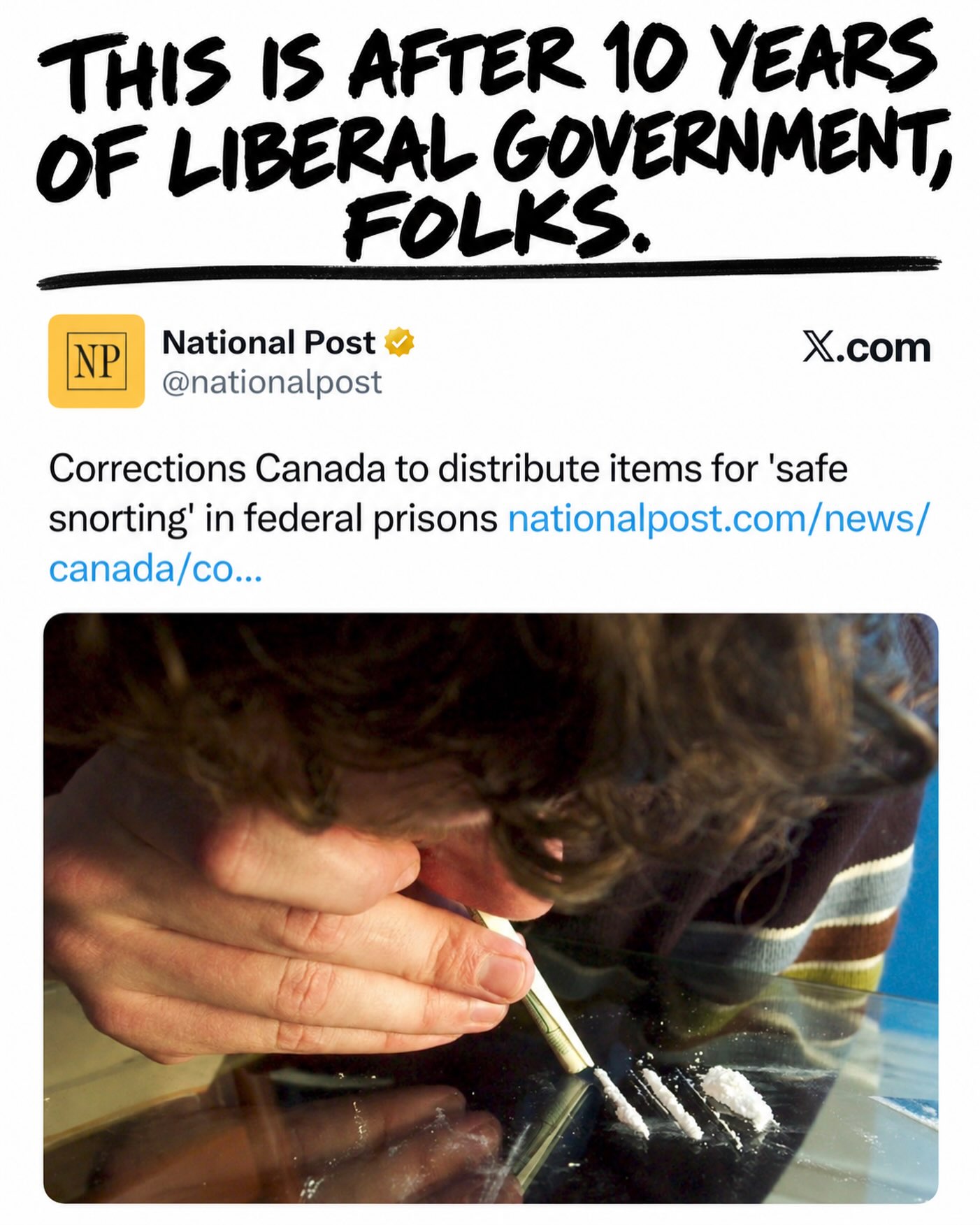
This text overlay on the National Post’s Instagram is a political commentary, Directing viewers to a report on Corrections Canada’s decision. The text begins with a headline grabbing statement about the state of the country after a decade of liberal government.
Safe snorting in federal prisons
The phrase "safe snorting" is Corrections Canada's euphemism for distributing sterile kits in federal prisons. It's a controversial policy with clear guidelines to reduce harm to inmates and reduce the risk of infection. The equipment includes a sterile straw, filter, mirror, razor, and small spoon, all contained in a single-use package. This is not a new idea in Canada, but it marks the first time the federal prison system will oversee direct distribution. Corrections services will be selling the kits at $1 each, which can be used by the prisoners to buy them over time. The National Post’s reported change isn't the full story of course. This shift is just one piece of a broader discussion around harm reduction policies in Canada. Liberal legislators are facing criticism for not doing enough to control the illegal drugs market, while simultaneously being accused of creating a system that is too lenient and is effectively accepting criminal behavior. These contradications are part of a larger strategy of harm reduction in Canada. In 2011, the federal government became the first of its kind for the Harm Reduction Policy. It was a commitment to ensuring that the "public health response to any problem, including HIV/AIDS, recognizes the reality that people will engage in high-risk behaviors, including substance use". This led to public health organizations developing tools designed to reduce the negative impacts of problematic substance use. The intention was to create an environment that minimizes harm to both individuals and society.
The controversy surrounding harm reduction
As the federal government plans to distribute items for "safe snorting" in federal prisons, the move has sparked heated discussion. Political critics argue that the policy sends a lenient message to prisoners. Conversely, public health advocates emphasize the importance of harm reduction in keeping prisoners safe. Prisoners imprisoned for drug-related offenses are often recognized as vulnerable to substance abuse. There is a higher risk of sharing needles or drug paraphernalia, which can increase the risk of the potential transmission of bloodborne diseases. Therefore, providing sterile items for "safe snorting" is a proactive approach to addressing public health concerns within the prison setting. Along with hypertensive emergencies, prisoners are also more susceptible to developing HIV, hepatitis C, and other infectious diseases. The primary goal of providing harm reduction tools is not to promote drug use but to mitigate the risks associated with it.
Some numbers from the National Post
The National Post’s article isn’t without numbers: Before the pandemic, 81% of prisons reported a higher rate of HIV infection. 81% of prisoners reported to have uncovered needles while in prison. 14% of prisoners reported using intravenous drugs in the previous year. Recent figures in the article show that Canada witnessed an increase in the use of harmful substances among its prison population.
A specific look at federal prisoners in Canada
The majority of these prisoners are between the ages of 25 to 34, and a significant proportion are repeat offenders. In 2020, there were 190 cases of tubulin-exposure, and of these, 28 involved prisoners who were HIV-positive. The average cost of treating an HIV-positive prisoner is $1,000 per year. It is a very sensitive matter. Given the costs of treatment, the harm reduction approach is viable in the long run. The current criminal justice system in Canada has become more rigid, but the correctional system is evolving to adapt to different situations.
Imagining harm reduction in federal prisons
To understand harm reduction in a broader sense, consider two approaches: There is harm reduction for a population. This is a proactive approach that implements harm reduction policies in targeted populations such as prisons. And harm reduction within a population, which means we aim to reduce the spread of harmful behaviors within a community. These two approaches aren’t mutually exclusive. They are two complementary approaches that can be employed to target and solve issues. Taking steps to mitigate risks amongst prisoners is moving in the right direction and it could save lives in the long term.
What you need to know
- Read the full article: For more insights, visit the link on the National Post’s Instagram post that offers a comprehensive look at the issue.
- Engage with experts: Seek out experts in public health and criminal justice for more detailed perspectives. It’s a complex issue with many facets.
- Join the conversation: There's a lot to unpack. Talk to your peers, friends, and family about harm reduction and the repercussions for prison inmates.
Questions readers ask
What exactly are the ‘sterile kits’ that Corrections Canada is distributing in federal prisons?
The sterile kits, referred to as 'safe snorting' kits, include items like a sterile straw, filter, mirror, razor, and small spoon. These are packaged in a single-use container and are designed to reduce the risk of infection among inmates who use drugs. The kits are sold to prisoners at $1 each, allowing them to purchase them over time.
Why is the National Post criticizing the Liberal government's decision to distribute these kits?
The National Post argues that this policy sends a lenient message to prisoners and contradicts efforts to control the illegal drugs market. The newspaper suggests that the government is effectively accepting criminal behavior by providing tools for safe drug use. This criticism is part of a broader debate around the government's approach to prison policy and harm reduction.
How does the harm reduction policy in Canada work, and why is it controversial?
Canada's harm reduction policy aims to minimize the negative impacts of substance use by providing tools and resources to reduce risks. This includes distributing sterile kits in prisons to prevent the spread of diseases like HIV and hepatitis C. The controversy arises from the perception that this policy is too lenient and may encourage drug use, while critics argue that it is a necessary public health measure to keep prisoners safe. The policy is rooted in the recognition that people will engage in high-risk behaviors, and the government's commitment to a public health response to these issues.
How does the distribution of these kits fit into the broader discussion around harm reduction in Canada?
The distribution of sterile kits in federal prisons is one aspect of Canada's broader harm reduction strategy, which has been in place since 2011. This strategy focuses on creating an environment that minimizes harm to both individuals and society by providing resources and tools to reduce the risks associated with substance use. The kits are part of a larger effort to address public health concerns within the prison setting, where prisoners are at a higher risk of contracting infectious diseases.
Are there any statistics that support the need for harm reduction policies in federal prisons?
The National Post article mentions several statistics that highlight the need for harm reduction policies. For instance, before the pandemic, 81% of prisons reported a higher rate of HIV infection, and 81% of prisoners reported finding uncovered needles. Additionally, 14% of prisoners reported using intravenous drugs in the previous year, underscoring the significant health risks within the prison population. These figures emphasize the importance of providing sterile kits to mitigate these risks.
What are the potential benefits and drawbacks of distributing sterile kits in federal prisons, according to the article?
The potential benefits include reducing the risk of infectious diseases like HIV and hepatitis C by preventing the sharing of needles and drug paraphernalia. The primary goal is to mitigate the risks associated with drug use, not to promote it. However, the drawbacks, as highlighted by critics, include the perception that this policy is too lenient and may send the wrong message to prisoners, potentially encouraging drug use. The controversy reflects a broader debate about the effectiveness and ethics of harm reduction strategies.
Recent articles
Fresh deep dives from the latest Reels we unpacked.




Comments
Be the first to comment.