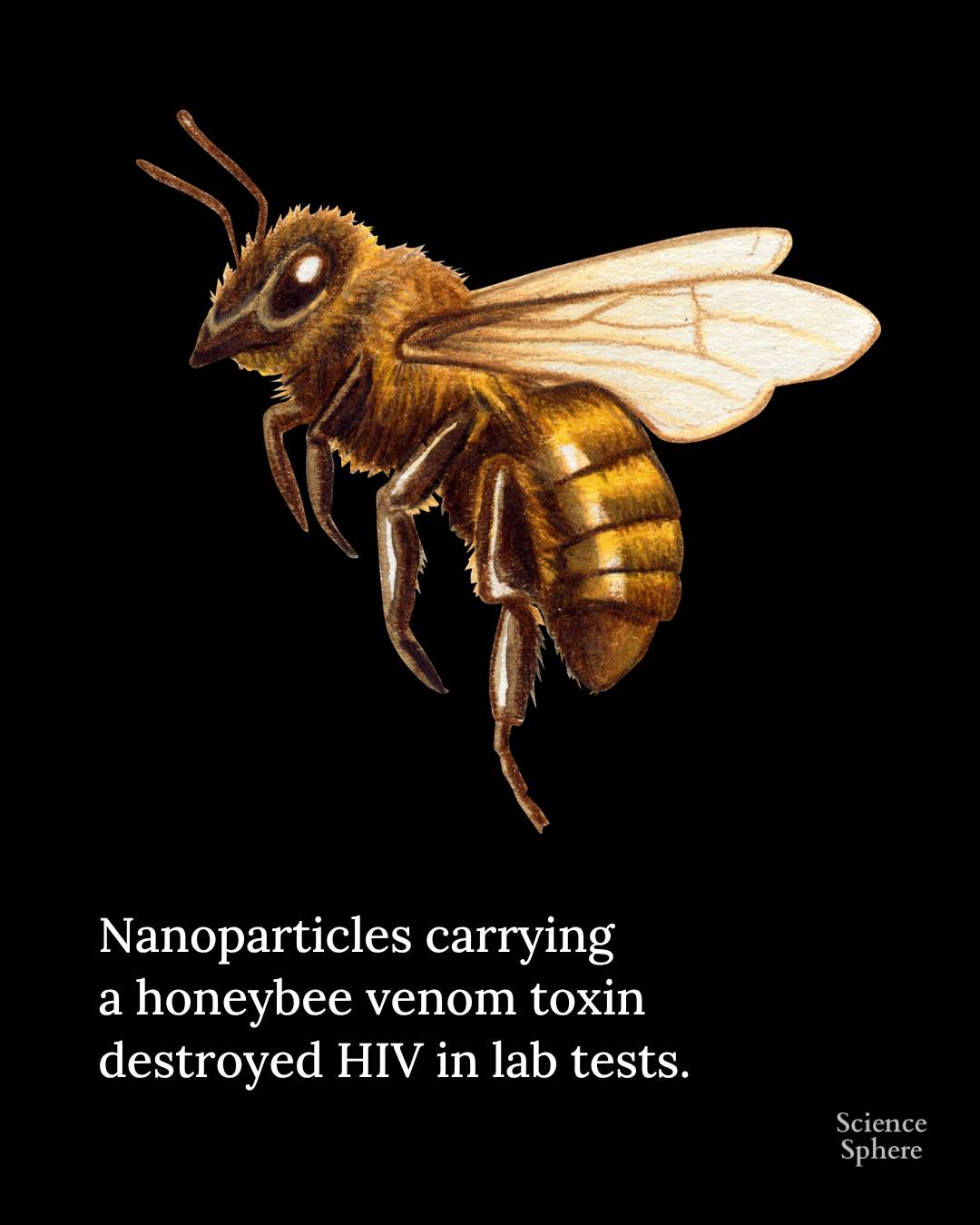
Nanoparticles and bee venom sound odd together. The former seems more likely to be a part of your tech device, while the latter is potentially a dangerous irritant from a summer day outdoors. But aside from the fact that they are entirely unrelated, what's truly remarkable is that Science Sphere is using nanoparticles to carry a honeybee venom toxin that seems to be able to destroy HIV in lab tests.
Stinging HIV with Nanotechnology
The nanotechnology that Science Sphere has been studying involves a rather unconventional mechanism. The nanoparticles themselves are tiny particles that can carry substances, like medicine, into specific parts of the body. To achieve this, the substance (a toxin in this case) is often attached to the surface of a nanoparticle. These are so small that they can easily slip into tissues and cells, and can even deliver medicines beyond the blood-brain barrier. Medicine is injected with nanoparticles that can deliver it directly to the target. The toxin that Science Sphere is using is melittin, which is derived from the venom of honeybees, and typically used to cause pain and immune response in the body when delivered through a sting. It seems to be a different story for HIV, however, with lab tests showing it to be a promising antiretroviral. Its strongest effect against HIV infected cells was with high concentrations, where melittin caused the death of HIV-infected T cells, and protected healthy cells from HIV infection.
Breaking New Ground in HIV Research
According to the World Health Organization, HIV treatment relies on antiretroviral therapy (ART), which reduces the amount of HIV in the body, but does not kill the virus. Current treatments require patients to take a combination of medications every day for life. There are also side effects and drug resistance over time. However, there is also a problem with how medicine is delivered to the specific targets in the body, such as the brain and blood. Broadly, the world's attention is on antiviral treatments, and this is why Science Sphere's research is a significant development. It can be difficult to deliver HIV treatments directly to the brain due to the blood-brain barrier, which is a protective shield that blocks potentially harmful substances. This means that medications must be dosed more frequently and in much higher concentrations, leading to harmful side effects. Researchers are constantly looking for ways to carry medicine to specific targets in the body, such as HIV-infected cells, through nanoparticle delivery, allowing patients to receive treatments without making them sick. Science Sphere's research breaks new ground by developing a nano delivery system that allows melittin to reach the specific HIV-infected cells. Melittin is a peptide toxin found in honeybee venom, with potent antiviral properties. When combined with nanoparticles, the results have been incredible, with promising antiviral effects in lab tests. It is able to kill HIV-infected cells, and also protects healthy cells from becoming HIV infected. Although researchers are still working to determine the best formulation of melittin and nanoparticle, the results so far have been promising.
Why Science Sphere's Research is Different
Nanotechnology is a Delivery System
This new research uses nanotech and nanoparticles to make HIV treatments specifically target only the HIV-infected cells in the body. Even more impressive, the nanoparticle is able to cross the blood-brain barrier and deliver the medicine directly to the brain, which is often difficult to reach in HIV patients. This is an entirely new way of delivering medicine and providing treatment. Science Sphere's research is essentially a delivery system for the melittin toxin, which is delivered to the specific targets – the HIV-infected cells. The particles are coated with melittin, and once they reach the HIV target, the toxin is released and the infected cell dies. Nanoparticle delivery allows the attacker to stay on the HIV virus, rather than the host cell.
Melittin's Delicious Design
Melittin is the major component of honeybee venom, and it is responsible for the painful sensation of a bee sting. However, it has also been shown to have strong antiviral properties in lab tests. It is able to destroy HIV-infected T cells, and even protect healthy cells from infection. When administered intravenously, it also does not cause side effects as seen with traditional chemotherapy. The way this works is that the melittin binds to the HIV-infected cell, and then perforates it until it is destroyed. A toxin like this is an important development in HIV research, because unlike traditional chemotherapeutics, it does not cause any side effects. It is able to be administered intravenously, through direct injection, or even orally. This is a very promising development in HIV research, because it means that the infections can be targeted and treated more efficiently, with less severe side effects, and better patient outcomes.
Nanotechnology and HIV
The combination of known ingredients like melittin, with modern technology, is a fresh approach to HIV research. Nanoparticles are used for their ability to deliver substances, like medicine, directly to the target, rather than flooding the body with potentially harmful substances that can cause side effects. Nanoparticle delivery systems have been used in other areas of medicine, such as cancer treatment, but this is an entirely new application. HMs been tested in lab environments, but the combination of a honeybee venom toxin and nanotechnology to treat HIV has not, and this is where Science Sphere's research shines. They are the pioneers in this area of research, and the future of HIV research now lies in the power of nanoparticles.
Big Plans for the Future
We don't have anywhere near enough information to give serious guidance on trying to do this yourself, but if your interest in this intriguing combination of nanotechnology and bee venom has piqued the curiosity of a budding scientist like yourself, here are some tips to get started:
- Get into the lab: This approach leverages lab tests, start by reflecting on how something like melittin can be handled and examined.
- Make your own nanoparticles: To create your own nanoparticles, you need to make sure that they are capable of carrying substances, like medicine.
- Study the science of nanoparticles: Make sure to study the physics behind them, and their role in modern medicine. This will help you to know how to construct them, their potential side effects, and how to incorporate them into your research.
The Stinger of the Future
The promise of nanoparticles in treatments like Science Sphere's research is immense. They could use nanoparticles to deliver medicine to the specific targets in your body, and allow the rest of the body to remain healthy. This is already being utilized in other areas of medicine, and could be a future breakthrough in HIV research as well.
Questions readers ask
What exactly is melittin and how does it work against HIV?
Melittin is a peptide toxin found in honeybee venom. In the context of HIV treatment, it's showing promise as an antiretroviral. Lab tests indicate that high concentrations of melittin can kill HIV-infected T cells and protect healthy cells from infection, making it a potential weapon against the virus.
How do nanoparticles help in delivering melittin to HIV-infected cells?
Nanoparticles act as tiny carriers that can transport melittin directly to HIV-infected cells. Their small size allows them to penetrate tissues and cells, even crossing the blood-brain barrier, which is a significant advantage for targeting HIV in the brain and other hard-to-reach areas.
What makes this approach different from current HIV treatments?
Current HIV treatments primarily rely on antiretroviral therapy (ART), which reduces viral load but doesn’t kill the virus. Unlike ART, which requires daily medication and can lead to side effects and drug resistance, the nanoparticle-melittin approach aims to directly target and kill HIV-infected cells, potentially offering a more effective and less burdensome treatment.
How does the nanoparticle-melittin combination address the blood-brain barrier issue?
The blood-brain barrier is a protective shield that can block many medications. Nanoparticles, being extremely small, can slip through this barrier. When combined with melittin, they can deliver the toxin directly to HIV-infected cells in the brain, potentially reducing the need for high doses and frequent treatments that cause harmful side effects.
Are there any potential risks or side effects associated with using honeybee venom for HIV treatment?
While melittin shows promise, it's important to note that it is a toxin and can cause pain and immune responses when delivered through a sting. The nanoparticle delivery system aims to mitigate these risks by targeting the toxin directly to HIV-infected cells, but more research is needed to determine the safety and potential side effects of this approach in humans.
What are the next steps for Science Sphere's research on this nanoparticle-melittin treatment?
Science Sphere is continuing to refine the formulation of melittin and nanoparticles to optimize their effectiveness. Future research will likely focus on testing this approach in clinical trials to determine its safety and efficacy in humans, as well as exploring how it can be integrated into existing HIV treatment regimens.
How does melittin protect healthy cells from HIV infection?
In lab tests, melittin has shown the ability to not only kill HIV-infected cells but also to protect healthy cells from becoming infected. This dual action suggests that melittin could potentially reduce the spread of the virus within the body, offering a more comprehensive approach to HIV treatment.
Related deep dives
Similar reads based on topic and creator.




Recent articles
Fresh deep dives from the latest Reels we unpacked.




Comments
Be the first to comment.