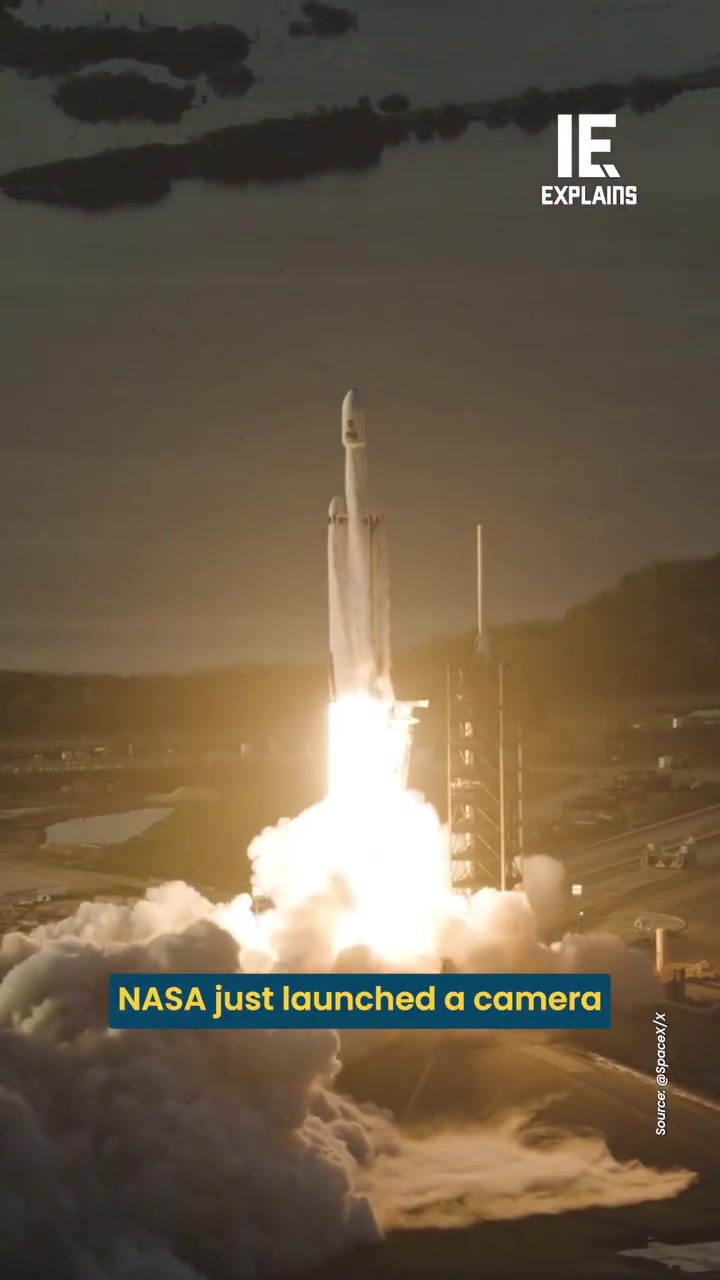
NASA just launched the Nancy Grace Roman Space Telescope on a SpaceX Falcon Heavy rocket, a mission that carries the largest infrared camera ever sent into space. The telescope uses a 300-megapixel infrared camera that can see a swatch of sky that is 100 times larger than Hubble and a sharpness identical to Hubble.
The Nancy Grace Roman Space Telescope: Sight and Scale
The Roman Space Telescope’s Wide Field Instrument, a 300 megapixel infrared camera built from 18 detectors, each about the size of a cracker, provides Hubble-sharp images. It can survey the universe roughly a thousand times faster because of its field of view, which covers an expanse of sky 100 times larger than what Hubble could image in one shot. For a single shot Hubble needs 100 frames to capture, the Roman telescope can capture it in a single frame. The Roman Space Telescope's mission is to explore wide orbits as well as 100,000 transiting planets, including rogue planets drifting through the galaxy with no star at all, in addition to searching dark energy. The Roman Space Telescope also has a coronagraph, which is a starlight blocker. The coronagraph is sharp enough to photograph Jupiter-sized planets directly. The Roman Space Telescope is on a three-month cruise to the second Lagrange point.
NASA’s Race to Understand the Cosmos
The stars are only part of the story. The Nancy Grace Roman Space Telescope’s first hunt is Dark Energy. According to the framework of our knowledge, 70% of the universe is made up of dark energy, yet nobody knows what it is. "I'm looking forward to the excitement and new discoveries that this mission will bring,” Ajibola Abayomi-Oke, an associate professor of physics at the University of the Virgin Islands, studying the cosmos with the Roman Space Telescope, said. “NASA is committed to sending the Hubble Telescope its replacement because planetary astronomy cannot wait."
Speed, Size, and Sensitivity
The Roman Space Telescope has a much larger field of view than Hubble, allowing it to observe 100 times more sky at once. The Roman Space Telescope measures 2.4 meters in diameter, the same as Hubble. Roman’s Widefield instrument is 300 megapixel infrared camera built from 18 detectors. The Nancy Grace Roman telescope can photograph Jupiter-sized planets directly.
One instrument, Many targets
The Roman Space Telescope hunts Dark Energy. The universe is both 13.8 billion years old and rapidly expanding. It is a mystery that astrophysicists greatly desire to solve. It also hunts for planets. The Roman Space Telescope will survey the galactic bulge in the center of the Milky Way Galaxy and observe the stars as they flicker and dim. The subtle shift in starlight would indicate the presence of a planet. Located in the galactic center are many stars and planets, and it’s easier to spot a planet that is closer to its star. Our view of exoplanets has been hampered by Hubble and other telescopes because of the limits of the equipment. The Nancy Grace Roman telescope will produce a massive amount of data. It will relay back 1.4 terabytes of data every single day, the highest of any mission. NASA will produce approximately 1,600 exoplanet discoveries.
A Mission to Find Rogue Planets
A telescope will be able to detect over 100,000 planets using transit measurements, which are planets that cross paths with their parent stars from our perspective and block a small part of their light. The Roman Space Telescope also can pick up smaller transits that reveal the presence of worlds at far-out orbits. It will also find rogue planets, which are drifting through the galaxy on their own, and can spot planets a few times the mass of the moon. These exoplanets do not orbit a star and are much smaller than any exoplanet discovered to date. There is a possibility of millions of undiscovered rogue planets. They are the dark matter of the planets.
NASA’s Next Steps
NASA announced on January 25, 2024 that they're planning to launch the Nancy Grace Roman Space Telescope on the second half of 2027. In order to maximize the capacity of the Roman Space Telescope, it will take off on a SpaceX heavy rocket. SpaceX’s Falcon Heavy rocket will use a million pounds of thrust to launch the telescope with ease. It will be calibrated and tested at the second Lagrange point, about a million miles out. The Nancy Grace Roman Space Telescope will begin its five year long survey in the early 2027. As the telescope travels to the second Lagrange point, it is expected to be on a three-month sojourn for calibration and testing.
For aspiring scientists
NASA’s Nancy Grace Roman Space Telescope is designed to give ordinary people the chance to participate in NASA’s efforts to look beyond our solar system. In order to participate, NASA is asking for research ideas from all over the world. NASA is open to collaboration with people who want to conduct experiments on the Roman Space Telescope.
Questions readers ask
What makes the Nancy Grace Roman Space Telescope's infrared camera so significant?
The Nancy Grace Roman Space Telescope's infrared camera is significant because it is the largest ever launched into space. With 300 megapixels, it can capture images with a field of view 100 times larger than Hubble's, allowing it to survey the universe much faster and in greater detail.
How does the Roman Space Telescope's coronagraph work and what can it achieve?
The coronagraph on the Roman Space Telescope is designed to block out starlight, allowing it to directly photograph Jupiter-sized planets. This is a significant advancement because it enables the telescope to study exoplanets in ways that previous telescopes, like Hubble, could not.
What is the significance of the Roman Space Telescope's mission to study dark energy?
Studying dark energy is crucial because it makes up about 70% of the universe, yet its nature remains unknown. The Roman Space Telescope's mission to explore dark energy aims to shed light on this mysterious component of the cosmos, potentially revolutionizing our understanding of the universe's expansion and structure.
Can the Nancy Grace Roman Space Telescope observe planets outside our solar system?
Yes, the Roman Space Telescope is equipped to observe exoplanets, including those in the galactic bulge of the Milky Way. Its advanced instruments allow it to detect planets by observing the subtle shifts in starlight caused by their presence, which was challenging for previous telescopes like Hubble.
How does the Roman Space Telescope's data collection compare to other missions?
The Roman Space Telescope is set to relay back 1.4 terabytes of data every day, making it the highest data-producing mission to date. This vast amount of data will provide unprecedented insights into the universe, but it also poses challenges in terms of storage, processing, and analysis.
What is the Roman Space Telescope's mission duration and primary targets?
The Roman Space Telescope is on a three-month cruise to the second Lagrange point. Its primary targets include studying dark energy, surveying the galactic bulge for exoplanets, and observing rogue planets drifting through the galaxy without a star.
Related deep dives
Similar reads based on topic and creator.



Recent articles
Fresh deep dives from the latest Reels we unpacked.



Comments
Be the first to comment.