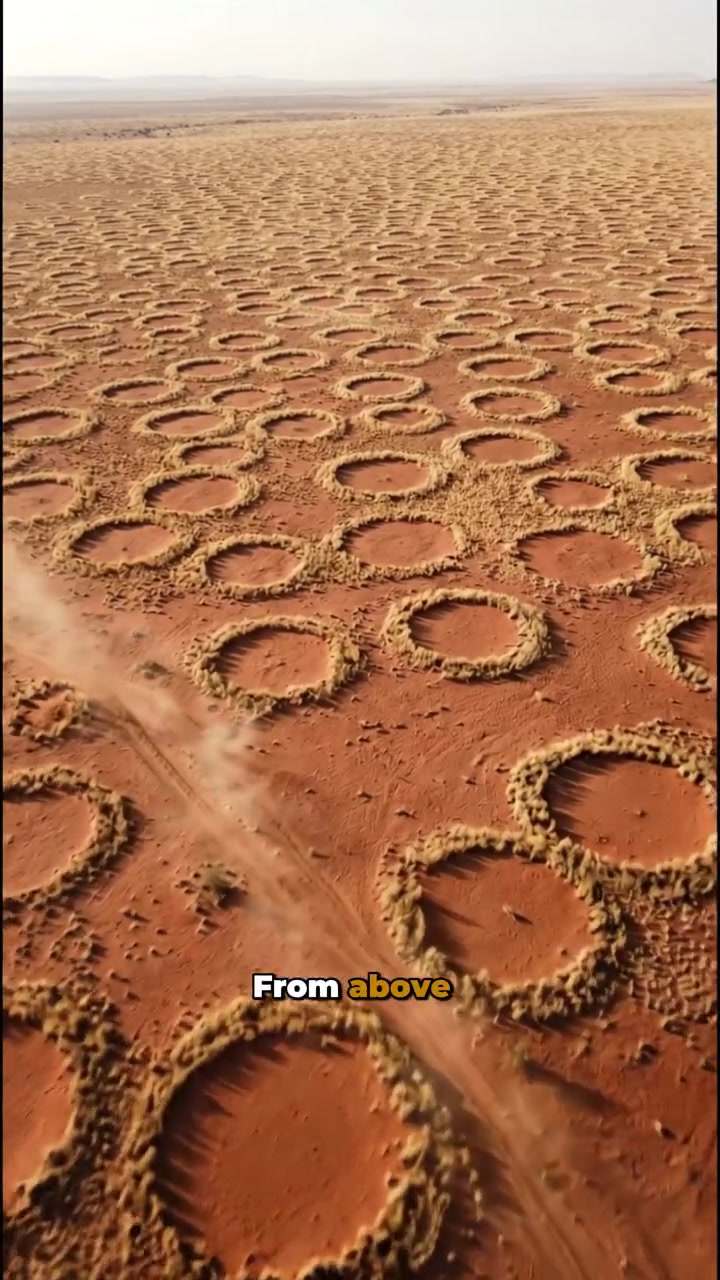
Stretching across the Namib Desert, the dunes of Namibia are broken by millions of mysteriously perfect circles. Each ring of bare soil – jargon-named "fairy circles" – measures about 2 meters across, and they stretch, almost perfectly evenly, for miles. At their core is the question: what makes them? For over three decades, scientists have proposed explanations from competing sides: Sand termites eating roots or plants self-organizing to survive drought.
What are Fairy Circles?
These fairy circles are circular patches of ground left bare by vegetation. Each is about 2 meters in diameter, ringed by a band of taller grass. What sets it apart is its distinct shape and how they're scattered across the landscape, uniformly spaced. Although both tiny and vast, the circles have distinct features. They are all packed tightly to each other, leaving no gaps, while even the circles themselves are neatly aligned in an almost hexagonal pattern. The circles are truly alive in their own way, too. Like animals, they too have birth, life, and death phases. They grow and shrink with time, as scientists have discovered after examining them for several decades. The circles start emerging when the plants die out of an overcrowded area. The sand then traps the nutrient water, making it ideal for flora to grow around it in a ring. With time, the ring grows stronger as the plants struggle to survive in an ever-changing environment, and it leads to the circle migrating, leaving the central spot barren. The Namib Desert’s fairy circles can be classified as a unique ecosystem. It isn't just one anomaly but a phenomenon that occurs in other deserts around the world, including Australia. Seeing fairy circles is like seeing footprints of a giant. All the more mysterious is the uniform shape of these rings.
Battling Desert Wildlife for Survival
Deserts are harsh on all forms of life, and the competition for resources between different lifeforms is extreme. One theory about the fairy circles is that sand termites are eating away at the roots of plants in the center, thus making it a bare patch of sand. The termites are said to be responsible for this ecological phenomenon, likely acting as "ecosystem engineers." This means they alter the environment, supporting the growth of different species - in this case, grass. Another competing hypothesis is that fairy circles are created when plants fight to survive in arid conditions. Each fairy circle acts like an "individual water-catching unit." These plants, competing for limited resources, self-organize to optimize growth around the ring.
What’s the Origin Story?
For years, scientists could not agree on the origins of these circles. However, in 2016, the same circles were discovered in Australia, making it clear that this phenomenon is not limited to the Namib. The fairy circles found in Australia display similar properties. The latter regions, however, showed different mechanisms of circle formation. In Namibia, the grass grows a second root, spread horizontally in the sandy soil and extracts moisture from the surrounding bodies. The roots in Australia, however, have a secondary root that grows vertically and draws moisture from deeper into the soil. The ring process itself could come from termites at work. The theory states that these termites chew through the roots of the plants on the central patch of land, leaving it bare. This naturally rings the perimeter of the circles in grass while the circles themselves grow and shrink accordingly.
How Humans Study The Circles
There are multiple ways in which humans study the circles. The first is through satellite imagery and fieldwork. Satellite images are helpful in detecting these patterns and observing the fairy circles from a height. Fieldwork is undoubtedly one of the best approaches to study these circles. The evidence of fairy circles to date is clear. Experiments have shown that the grass appears to grow ring-like patterns when soil and termites are combined, lending weight to the claim of them being formed by soil termites. However, studies have further shown that the patterns grow bigger and disappear over time, clearly showing that they are a natural and dynamic phenomenon, not an art man-made. Scientists have often visited the Namib Desert to study the circles. They have used aerial and space surveys over the years. Even with advanced technology, the origin remains a mystery.
What’s the Best Viewing Method?
There are several ways to take in the scale of these formations:
- Flyover: However, fairy circles are best taken in from above, as the sheer number and symmetry of fairy circles — millions, covering miles — are lost on the ground. The panoramic view showcases the even distribution of the formations. It makes it easy to marvel at the phenomenon.
- Static Observation: For a closer look, the best method is to use a static image. It allows observing the inner workings of each circle and maintaining the overall symmetry of the phenomenon. It clearly shows the bare center and the ring of vegetation, both of which are indicators of the life cycle of a fairy circle. From any angle, seeing and studying the circles is a unique experience.
Remembering the Dunes
Each circle in the Namib Desert is a testament to natural phenomena, no matter how small. They are a peculiar anomaly in the Namib Desert and a place where different organisms live and compete with each other. They are not easily understood, nor are they seen everywhere. In 2016, similar circles were found in Australia, thus confirming that fairy circles are not an isolated phenomenon; they appear to be a recurring and general phenomenon. The circles are important not just because they are mysterious but because they express the untouched beauty of the desert. Whether it is formed by termites or plants, their existence brings a sense of awe.
Questions readers ask
What exactly causes the fairy circles to form in the Namib Desert?
The formation of fairy circles in the Namib Desert is still a subject of debate. Two main theories have emerged: one suggests that sand termites eat the roots of plants in the center, creating bare patches. The other proposes that plants self-organize to optimize growth around the ring, acting as individual water-catching units in the arid environment. The exact mechanism remains a mystery, but both theories offer intriguing perspectives on how these unique patterns emerge.
How do fairy circles change over time?
Fairy circles go through distinct life phases. They start when plants die out in an overcrowded area, leaving a bare patch of sand. Over time, the grass around the circle grows stronger, and the circle itself can migrate, leaving the central spot barren. This dynamic process means that the circles are constantly evolving, growing, and shrinking, much like living organisms.
Are fairy circles unique to the Namib Desert, or do they occur elsewhere?
While the fairy circles in the Namib Desert are the most famous, they are not unique to this region. Similar patterns have been discovered in other deserts around the world, including Australia. The circles in Australia exhibit different mechanisms of formation, adding to the mystery and complexity of this natural phenomenon.
Can humans impact the formation of fairy circles?
Humans can potentially impact the fairy circles, especially through activities that alter the desert ecosystem. For example, activities like mining or off-road driving could disrupt the delicate balance of resources and plant growth that contributes to the circles' formation. It's important to preserve these natural areas to maintain the unique ecosystem.
How do the two theories about fairy circle formation differ?
The two main theories differ in their focus on the primary cause of the circles. One theory attributes the formation to sand termites eating the roots of plants, effectively creating bare patches. The other theory suggests that the plants themselves self-organize to optimize water use in the harsh desert environment, forming rings around the barren centers. Both theories highlight different ecological mechanisms at play, but neither has been definitively proven.
Related deep dives
Similar reads based on topic and creator.
Recent articles
Fresh deep dives from the latest Reels we unpacked.




Comments
Be the first to comment.