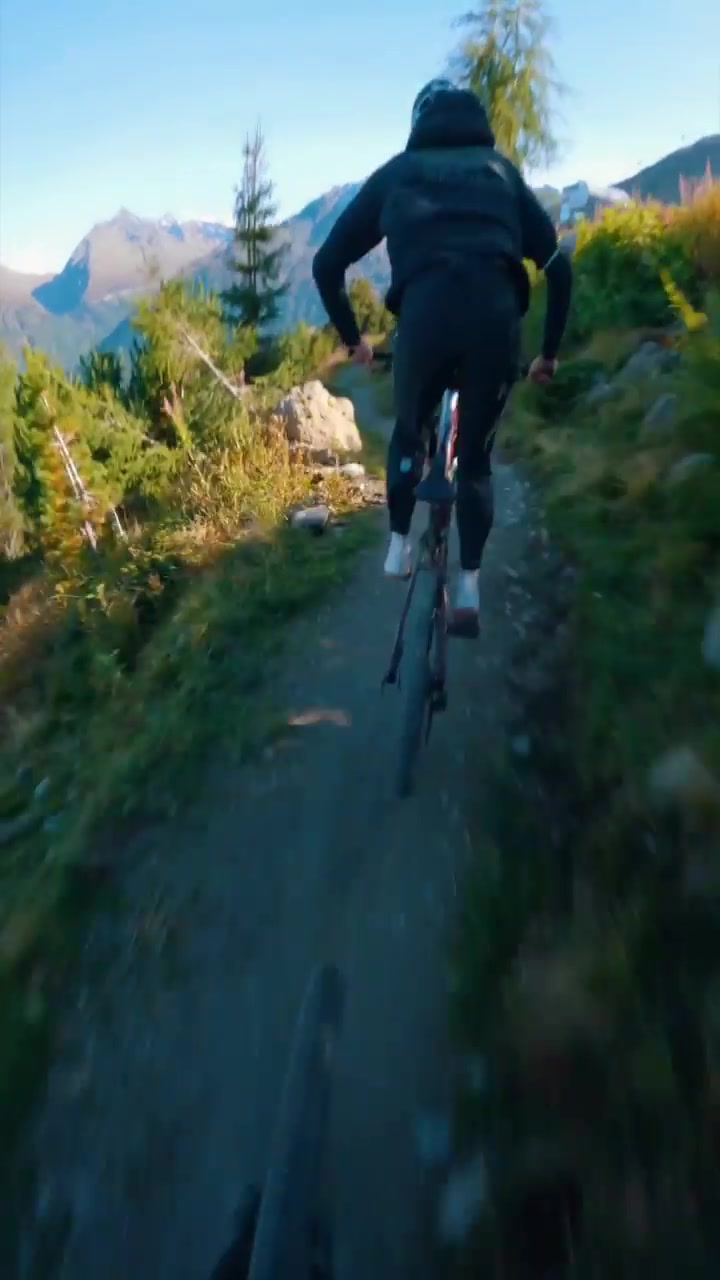
The first few seconds of the video are an urgent yank back to consciousness: "Fucking wake up, bro." as if the rider warned himself to be alert. The short video captures a mountain biker navigating a rocky, downhill terrain through a panoramic backdrop of mountains and trees, capturing every hillock, tree root, and trail bend through a first-person perspective. From the angle, the rider faces the searing wind, rocks, twigs, and different challenges the trail throws.
Mountain Biking: A Pursuit of Speed and Nature
Mountain biking, rooted in wilderness exploration and racing, is a high-speed, full-body workout that makes the cyclist meet the terrain head-on. Unlike road cycling, mountain biking is designed for rough, uneven terrain and takes cyclists through rocky, uphill and downhill trails, muddy fields and cliff-side paths. The rider rides aggressively on the bike, going over steep descents, tight turns and uphills. The front wheel is pointed to the direction of travel, manages the rough terrain, and makes the trail easier to navigate. The bike is like a fortified tank, designed with suspension systems and sturdy tires to absorb impacts and maintain grip. Brakes, wheels, helmet, and other types of gear are carefully chosen for the rider's safety and efficiency. Most importantly, mountain bikers are expected to be masters of balance, body positioning, and lightning-fast decisions to control the bike, going up, down, or across the trail. The rider's position is essential. The rider has to be properly equipped with safety gear and mounted on the bike to handle the terrain. The bike is equipped for rough roads, with thick tires and a sturdy frame. The sport is about the thrill of pushing boundaries, as the rider steers through trails, and the excitement of overcoming obstacles. The trails offer natural obstacles: tree roots, jumbled rocks, muddy fields, etc.
Biking's Thrills and Newbies
A video of downhill mountain biking is available for everyone to see. There are no obstacles to watch a video of mountain biking, and the sport leaves an impression of the scenic aspects of it and the raw adrenaline it releases. Even when seeing it on a screen, the audience may get drawn to the excitement of the experience. Mountain biking offers a more immersive experience than other types of cycling. The video is shot from a first-person perspective, making the viewer feel as if they are the one navigating the twisting trails and obstacles. It allows everyone to see the exact way the biker goes through obstacles. The visuals make it easier to understand the thrill of it. The video makes it clear why people are drawn to the adrenaline rush and the excitement of the sport.
Learning the sport through first hand experiance
Paths, Kinds, and Challenges
The video alone is enough to make you want to try mountain biking yourself. It is essential to understand the basics like types of trails, slopes, and downhill terrain. The rider needs to be able to get through the trail. The video demonstrates downhill mountain biking, a subset of mountain biking where the rider descends steep slopes at high speeds. Other types include cross-country, trail riding, and endurance racing. The trail for the rider is more challenging than just going through the rough terrain. Any obstacle along the way should be handled with caution and skill. It involves a lot of balance, body positioning, and lightening-fast decisions.
Handling the Bike
Steering the bike is essential. The bike's front wheel takes the rider through rocky and muddy trails. The rider has a sturdy, grippy tire and a high-quality suspension system to absorb impacts. Riding the bike involves balance, maneuverability and agility. The rider sits upright on the seat, and sometimes even standing, to maintain control over the bike and steer the way through. The suspension system helps the rider move around with ease, absorbing any impact and providing a smooth ride. The rider needs to be able to control the bike and overcome obstacles: a sharp turn, a rocky stretch, or a muddy field. The rider also needs a refractory, strong helmet to protect themselves from any accident.
Downhill Thrills and Spills
The most challenging part of mountain biking is downhill trails. The rider has to be alert and assess the risk of downfalls. Downhill mountain biking can be dangerous, with steep slopes and tight turns, but the rider must be aware and cautious all the time to handle the thrill and the falls. The thrill of riding overlooked hills, short tree roots, and rocky cliffs in the face of gushing wind is not easy to handle.
Downhill biking: Know Before You Go
Doing a downhill bike ride is an exciting adventure. It is essential to be aware of the trail's terrain, ensure safety gear, and pick the right bike. Here are a few tips for beginners:
- Check Your Gear: Invest in a good quality, well-fitting helmet; you will feel more confident in your riding abilities, and it helps you ride with caution.
- Understand Your Limits: This is not to discourage you, but to make you aware of the risks. Understand that mountain terrain is not a concrete road, and you will have to deal with the uneven terrain and obstacles.
- Pick the Right Bike: Different types of bikes are designed for different tasks. Mountain bikes are made for rougher terrain and are not meant for trips on the road.
- Pick the Right Trail: Every trail will take you through different obstacles, and you need to assess the trail and your ability to handle the tough terrain.
- Ride Your Line: Through the tough trails, you will come across twists and turns, rocks and bumps, and you need to ride through it with confidence and skill. Ride your line on the trail, turn your handlebars slightly and steer steadily
- Start Small: You need to understand that going over steep slopes and hard, rocky trails is not easy, and you need to practice handling the small rocks and twigs first to gain the skill. A downhill bike ride is exhilarating, and it is important to be aware of the risks. The rider's ability to handle the bike and roughness of terrain is essential to push yourself, but it is critical to be aware of the risks and the thrill.
Questions readers ask
What kind of bike is used for mountain biking, especially for downhill trails?
Mountain bikes used for downhill trails are typically built like fortified tanks, equipped with sturdy suspension systems, thick tires and a robust frame. These features help absorb impacts, maintain grip on rough terrain, and provide stability during high-speed descents and tight turns.
How does mountain biking differ from road cycling?
Mountain biking is designed for rough, uneven terrain, taking cyclists through rocky, uphill and downhill trails, muddy fields, and cliff-side paths. In contrast, road cycling is typically done on smooth, paved surfaces with a focus on speed and endurance over long distances.
What skills are essential for mountain biking, particularly for downhill trails?
Mastery of balance, body positioning, and quick decision-making are crucial for mountain biking, especially on downhill trails. Riders must be able to control the bike effectively, navigating steep descents, tight turns, and various obstacles with precision and agility.
What equipment is necessary for mountain biking?
Essential equipment includes a sturdy mountain bike with suspension systems and thick tires, a well-fitted helmet for safety, and other protective gear. Brakes and wheels are chosen for efficiency and safety, and the rider's position and gear must be properly equipped to handle the terrain.
What makes downhill mountain biking different from other types of mountain biking?
Downhill mountain biking focuses on descending steep slopes at high speeds. This is different from other types like cross-country, trail riding, or enduro, which involve a mix of uphill and downhill riding, longer distances, and varied terrain challenges.
Related deep dives
Similar reads based on topic and creator.



Recent articles
Fresh deep dives from the latest Reels we unpacked.



Comments
Be the first to comment.