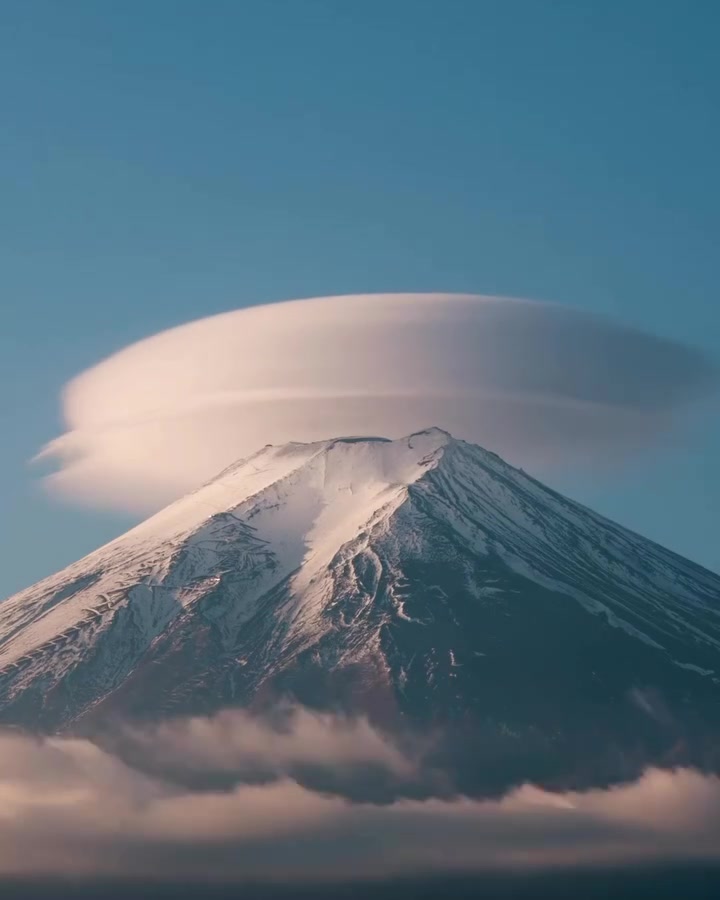
Mount Fuji is an iconic symbol of Japan, but rare instances of lenticular clouds transform the iconic peak into an ethereal landscape. One such cloud hovers dramatically over the summit of the snow-capped mountain, captured in a beautiful, slightly muted color palette. This ethereal image showcases the interplay between atmospheric conditions and Japan's most celebrated mountain.
Lenticular Clouds — The Saucer Clouds
Lenticular clouds are unique formations that resemble flying saucers or pancakes, with distinct edges and a smooth, saucer-like shape. They are created when moist air is forced to ascend over a mountain or other geographical barriers. As the air flows over the summit, it cools and condenses, forming clouds that can appear stationary or appear to drift. Not all mountains experience lenticular clouds, but the famous Mount Fuji is a popular place to see these clouds. The lenticular cloud in Kohki's photo adds an almost otherworldly beauty to the mountain. It appears to hover above it, rather than touch it, as if it was layered on top. Its sharp edges create a mesmerizing contrast against the soft, natural contours of the mountain. No lens flare or filter manipulation can match the majesty these clouds lend this particular locale. It is a testament to how Mount Fuji's own stratospheric height only enhances what nature creates. The cloud shapes above Mount Fuji vary depending on the atmospheric conditions. Some may appear as perfect semicircles, while others may look more like pancakes or bread loaves. When around Japan’s most famous mountain, these saucer clouds are typically seen around the summit, often stacked one on top of the other, creating a breathtaking sight. Because they are illusory compared to the fixed mountains they grace, they have a fleeting quality that makes seeing them even more elusive. The sight snaps you from the everyday, from the ground you're on, and gives you a feeling like you're on the precipice of breaking through to outer space.
Mt. Fuji’s Cloud Surf
Mount Fuji serves as a convenient backdrop for photos, with its symmetrical shape and snow-capped peak. But it’s also the perfect place for these clouds because of its elevation and geography; these lenticular clouds are especially impressive when viewed from the bottom of the mountain. The mountain's height and the weather conditions create the perfect environment for the formation of these unique clouds. Mount Fuji’s height tends to create lenticular clouds especially in winter, when moist air pushes over the mountain's side and turns into clouds. Lenticular clouds are a common sight in Japan, often seen over mountains and other geographical features. There is something about Mt. Fuji itself that makes seeing these clouds especially magical — their appearance makes the mountain feel like it is not just a mountain, but a whole other world. Mount Fuji is part of the landscape where lendsicular clouds appear regularly. They are generally caused by a combination of strong winds, stable atmospheric conditions, and the presence of a mountain or other geographical feature. The clouds form when moist air is forced to ascend over the mountain, cooling and condensing into clouds. The unique topography of Mount Fuji, with its steep slopes and conical shape, creates the perfect conditions for the formation of lenticular clouds.
Why Lenticular Clouds Form
Lenticular clouds form when moist, stable air is forced to ascend over a geographical barrier, such as a mountain. As the air rises, it cools and condenses, forming clouds that can appear to hover in place or drift incrementally. This unique formation occurs when wind and moisture levels meet the necessary atmospheric conditions, creating a phenomena that some visitors may think is part of a science fiction film. Mountains are the most common places to see lenticular clouds, especially those that are tall and isolated, like Mt. Fuji which is one of the tallest mountains in Japan. Lenticular clouds are often seen at high altitudes, where the air is thin and cold. The clouds can take on a variety of shapes and sizes, from small, wispy clouds to large, saucer-shaped clouds. In the case of Mt. Fuji, the clouds are especially impressive, as they form around the summit of the mountain, creating a mesmerizing display. That said, there is a non-negligible risk of creating a veritable snowstorm when they occur.
Clouds that Inspire
Photographer Kohki captured the lenticular cloud over Mount Fuji in the visual way he did, in part because of its ethereal beauty, which encompasses the mountain itself, but also because of its rarity. These clouds are often seen only in certain conditions and at certain times of the year, making them a rare and special sight. Their unusual shape and the way they appear to hover in the sky make them a popular subject for photographers and artists, who are drawn to their unique and otherworldly appearance. Lenticular clouds are as much a visual pleasure as they are a natural marvel. They are often depicted in art and literature as symbols of mystery and wonder. The ethereal beauty of lenticular clouds has inspired artists, writers, and musicians for centuries. One famous example of a lenticular cloud depicted in literature is in J.R.R. Tolkien's "The Lord of the Rings," which features a scene where Frodo and Sam see a lenticular cloud hovering over Mount Doom.
The Mount Fuji Cloud Compendium
Lenticular Clouds are made up of water droplets, which form when moist air rises over a mountain and cools. This cooling causes the water vapor in the air to condense into droplets, which then form clouds. Lenticular clouds are typically composed of multiple layers of clouds, with each layer forming at a different altitude. These crystals from the moisture in the air form as the clouds form. These formations shape up when a large volume of air cools to a certain temperature as wind pushes against Mt. Fuji, where it rewraps itself around the nucleus of impurities and converts into a weather phenomenon that is incredibly striking. This type of cloud is beneficial to aircrafts to navigate or track, due to its stationary aspect, as well as to weather forecasters to predict the movement of masses of air.
Winter’s Weapon
The winter season in Japan is particularly beautiful because of the lenticular clouds that form over Mt. Fuji. This is due in large part to the weather conditions that occur during the winter months, which create the perfect environment for the formation of these unique clouds. The clouds are especially striking against the backdrop of the snow-capped mountain, and their ethereal beauty is a sight to behold. The winter air in Japan is often very cold and dry, which creates the ideal conditions for the formation of lenticular clouds. As the air rises over the mountain, it cools and condenses. These clouds are more likely to form in Japan during the winter months, when the air is cold and dry, and the winds are strong. Through the ground level clouds, the lenticular clouds become a phenomenon that can easily be seen from far away. This makes winter an ideal season to observe lenticular clouds, particularly from the base of the mountain. The clouds create a haze effect, with the air causing them to look more ethereal.
Heading to Japan
Japan is a country full of natural scenery, and Mount Fuji is among the most famous, beautiful sites. The combination between Mount Fuji and lenticular clouds is especially unique and stunning. It's a signature of Japan that is especially worth seeing for both its natural beauty and visual poetry. If you find yourself taking a trip to Japan, consider planning at least a day trip to see Mount Fuji. You can travel to Kawaguchiko and enjoy a view of the mountain. If you time your trip right, you may be able to catch a glimpse of a lenticular cloud. Viewing the clouds from there is best when you have the morning fog and the elevated mist clear out in the late morning. From a distance, the clouds make the mountain look much taller than it actually is. This is because the composition of the clouds themselves make the mountain more elusive. When hiking, make sure to be safe and bring warm clothes, as it can get cold.
Getting to Mount Fuji
- Getting There*:* There are three main routes to access Mount Fuji — the west, south, and north sides. The most popular route is the south, due to its proximity to Tokyo. The Yamagori route is particularly scenic, with views of Lake Kawaguchi and the surrounding mountains. The most popular route is the south, due to its proximity to Tokyo. The Yamagori route is particularly scenic, with views of Lake Kawaguchi and the surrounding mountains.
- Best Time to Visit:* The best time to visit Mount Fuji is during the summer months, from July to September, when the weather is mild and the skies are clear. This is also the peak climbing season, with thousands of climbers attempting to reach the summit. The weather conditions are also more stable, making it easier to see the lenticular clouds. The winter season attracts fewer visitors, but skiing and snowboarding are popular.
Questions readers ask
What exactly are lenticular clouds and how do they form?
Lenticular clouds are unique cloud formations that resemble flying saucers or pancakes. They form when moist air is forced to ascend over a mountain or other geographical barriers, cools, and condenses, creating clouds that can appear stationary or drifting. Mount Fuji's height and geography make it a prime spot for these clouds, especially in winter.
Why do lenticular clouds often appear over Mount Fuji?
Mount Fuji's elevation and symmetrical shape create the perfect conditions for lenticular clouds. The mountain's height forces moist air to ascend and cool, forming these unique clouds. Additionally, the mountain's iconic silhouette provides a stunning backdrop, making the clouds even more visually striking.
Can I see lenticular clouds from the base of Mount Fuji?
Yes, lenticular clouds are especially impressive when viewed from the base of Mount Fuji. The mountain's height and the weather conditions create the perfect environment for these clouds, and viewing them from below enhances their ethereal and otherworldly appearance.
Are lenticular clouds common only over mountains like Mount Fuji?
No, lenticular clouds can form over any geographical feature that forces moist air to ascend, such as other mountains and even hills. However, Mount Fuji's unique shape and elevation make it a particularly spectacular location to view them.
What makes the lenticular clouds over Mount Fuji appear so magical?
The combination of Mount Fuji's height, the atmospheric conditions, and the unique shapes of the clouds themselves contribute to their magical appearance. The clouds often appear to hover above the summit, creating a mesmerizing contrast against the mountain's natural contours. Their fleeting nature and the way they transform the landscape add to the ethereal experience.
How do atmospheric conditions affect the shapes of lenticular clouds over Mount Fuji?
Atmospheric conditions greatly influence the shapes of lenticular clouds. Depending on the wind speed, temperature, and humidity, the clouds can appear as perfect semicircles, pancakes, or even bread loaves. The varying shapes add to the unique and otherworldly beauty of the sight.
Related deep dives
Similar reads based on topic and creator.

Recent articles
Fresh deep dives from the latest Reels we unpacked.

Comments
Be the first to comment.