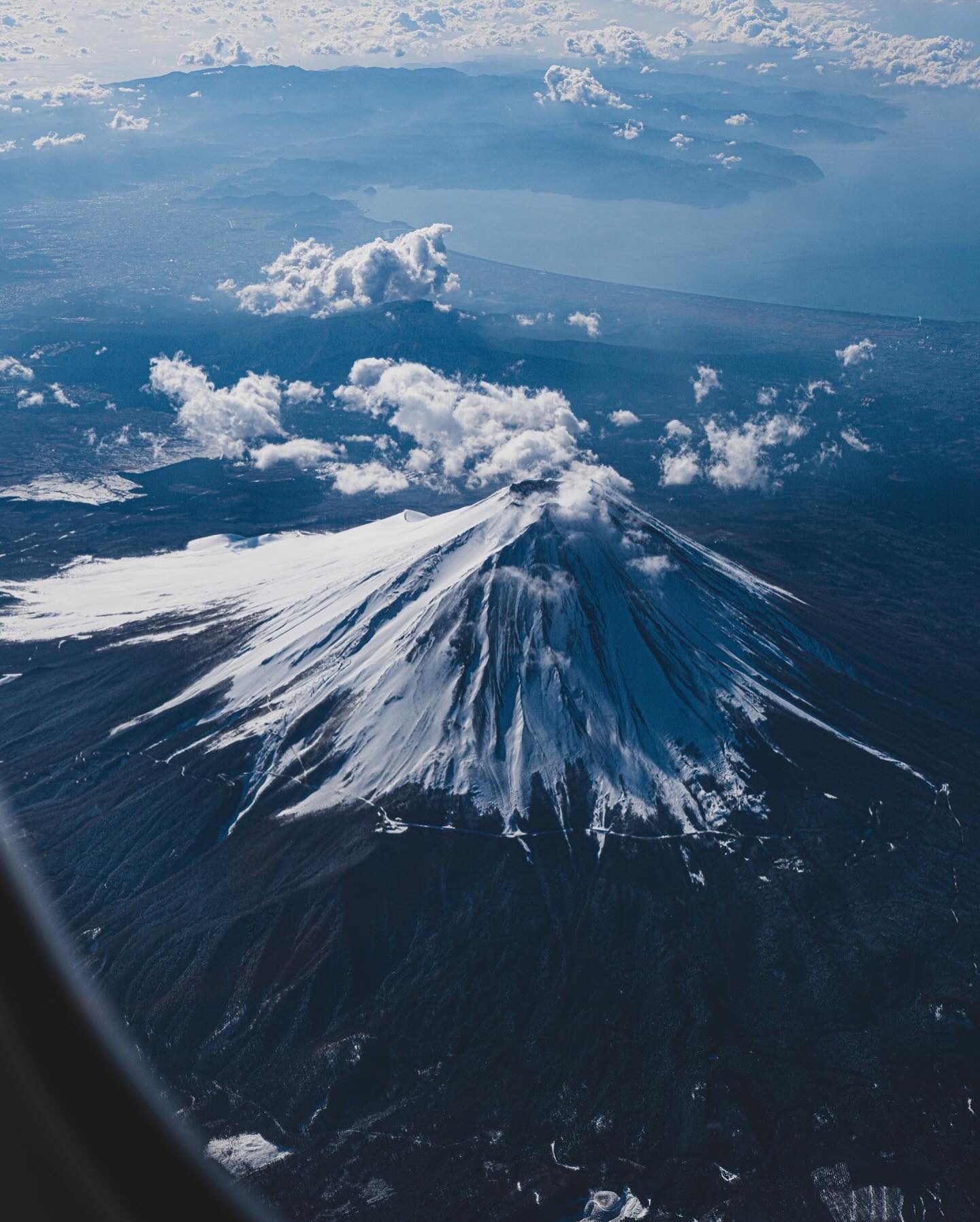
The glacier-topped cone of Mount Fuji cuts through the skies over Japan. From above, the snow-capped volcano stands out above the clouds and the bare ground below, transformed into a geological sculpture. Its height, 3,776.24 meters, demands attention, but so does the way it changes from one aerial angle to the next.
The Dragon from Above
Mount Fuji at first resembles a dragon. Its conic shape tapers. Ridged scars slant diagonally from the peak — the Dragon's scaly back. From above, the symmetry appears. The icy cap is the Dragon's head. Its body lengthens in varying shades of blue, green, and brown. The highest point is covered in snow, while the sides are bare. The aerial view of the surrounding scenery is equally striking. The reels show a thick layer of clouds. Aircraft wings cut through them, while the volcano's exposed sides reach higher above. As a result, the clouds appear to form a natural barrier around the mountain, giving off an ethereal glow. Pairing with Fuji's presence, clouds create a texture, like sand. These features blend into a stunning aerial scenery, as planes hover near and far.
The Beauty of Height
Today, airplane sightseers can affordably view the world from above. Capture the unique landscape of a mountain that’s visible for miles. This is the new normal of travel. Viewers can experience the landscape as the creator does. Several factors contribute to the popularity of aerial photos and videos. One is the rise of drone technology, which has made capturing aerial imagery more accessible to the average person. This also applies to flights. Drum roll for drones, which have allowed for more dynamic and immersive aerial tours of natural landscapes. Soaring views are powerful. Mount Fuji provides a physical and spiritual connection. The elevation this video provides also gives a bird's eye view of the mountain.
The Dance of Distance
The videos show Mount Fuji from different angles and distances, adding layers to the viewing. From far away, Mount Fuji's outline is visible through the clouds. The peaks appear more gradually the closer they get. This is due in part to the weather. The mountain can be covered in clouds, giving it a shrouded, mysterious look. Finally, the volcano emerges from the clouds, adding a contrast to the white mist. The snow-capped peak is also more defined. From the sky, a different view of Mount Fuji is created, giving a greater appreciation of its grandeur.
The Static View
Mount Fuji’s most distinctive feature is its height. It towers above the rest of the landscape, even in a small frame. The aerial views capture that uniquely. Contrast a mountain framed by clouds and land with the mountain viewed from the ground. The peak appears more majestic because of the clouds. While the surface remains static, clouds move and shift. Even when the view is stuck, the clouds change. The shape of the clouds contributes to the overall effect. They encircle the mountain, or the camera does.
The Horizon
Unlike other mountains, Fuji’s peak is shaped like an umbrella spilling to the sides. Soaring above the surrounding landscape, it has symmetrical slopes and an eye-catching, flat top. Snow covers the top, while trees and farmlands stretch out from its base, making it visually striking. Fuji’s white top contrasts with the surrounding landscape. The mountain’s height is emphasized by the angle and distance. What’s more, the surrounding landscape is rich and varied. The ocean is visible, as is a large body of water, and the wider landscape. It's far, but its details are revealed by the distance. These features include fields, farms, and lakes, as well as towns and villages. From above, it becomes a patchwork landscape.
Practical Advice for Aspiring Aerialists
Find a Window Seat: Best for views, ASAP get your plane seat, overlooking Mount Fuji. This isn't always easy, but it's worth it. Timing: Japan is vibrant in colors in spring and fall, when hikers scale the mountain all the way to the top. Spring typically offers wildflowers. Autumn seeps in when leaves change colors. Both start in mid-September. Check the Weather: There are two scenarios. On a clear day, enjoy awe-inspiring scenes. Clouds reveal Fuji’s mystical nature. They can even emphasize it.
Questions readers ask
What makes the aerial view of Mount Fuji so unique?
The aerial view of Mount Fuji is unique due to its distinctive conical shape and snow-capped peak, which transforms into a dramatic geological sculpture from above. The way the mountain changes with different angles and the surrounding clouds also contributes to its striking appearance.
How does the appearance of Mount Fuji change as the plane approaches?
As the plane approaches, Mount Fuji's outline becomes more visible through the clouds. The peaks appear more gradually, and the snow-capped peak becomes more defined, creating a contrast with the white mist. This gradual reveal adds a layer of mystery and grandeur to the viewing experience.
What role do clouds play in the aerial views of Mount Fuji?
Clouds play a significant role in the aerial views of Mount Fuji. They form a natural barrier around the mountain, giving off an ethereal glow and creating a textured landscape. The movement and shape of the clouds also contribute to the overall effect, making the mountain appear more majestic and dynamic.
Can you see Mount Fuji from any airplane window, or are there specific flights that offer the best views?
The visibility of Mount Fuji from an airplane window depends on the flight path and weather conditions. While it's possible to see Mount Fuji from many flights, specific sightseeing flights and drone tours offer the best views, allowing viewers to experience the mountain from various angles and distances.
How has drone technology impacted the way we view Mount Fuji from above?
Drone technology has made capturing aerial imagery of Mount Fuji more accessible, allowing for more dynamic and immersive aerial tours. This has contributed to the popularity of aerial photos and videos, providing a bird's eye view of the mountain and its surrounding landscape.
What makes Mount Fuji's peak appear more majestic from the sky?
From the sky, Mount Fuji's peak appears more majestic due to the contrast created by the clouds. The way the clouds encircle the mountain and the movement of the clouds contribute to the overall effect, making the peak appear more defined and grand.
How does the aerial view of Mount Fuji connect to the Japanese culture and spirituality?
The aerial view of Mount Fuji provides a physical and spiritual connection to the Japanese culture. Its symmetrical slopes and flat top have long been seen as a spiritual beacon, and the way it towers above the landscape from above emphasizes its significance as a natural and cultural icon.
Related deep dives
Similar reads based on topic and creator.

Recent articles
Fresh deep dives from the latest Reels we unpacked.


Comments
Be the first to comment.