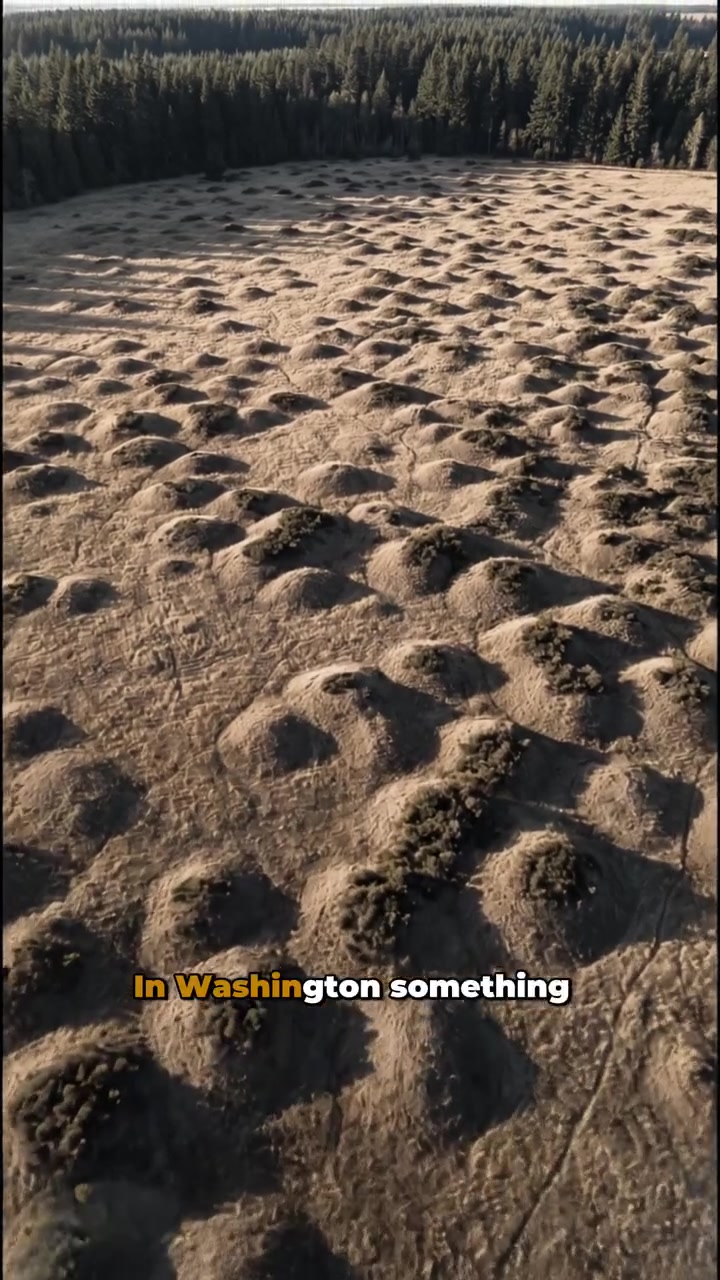
The landscape of Washington is dotted with thousands of earthen mounds, remnants of a geological mystery that stretches across the continent. These enigmatic formations, known as Mima Mounds, are far from unique to their home state, appearing in various climes and geologies throughout the United States and into Baja California.
Geology’s Puzzling Rinse Cycle
Mima Mounds, named for a Washington valley they inhabit, are small volcanic hills that can rise as high as 2 meters and stretch up to 40 meters across, yet they are only visible from an elevated view. From the ground, the mounds blend into the surrounding landscape, and even the air can’t quite reveal how they are distributed. The mounds' distribution patterns and their presence in places with different climates and geology make them one of the great mysteries of modern geology.
A Landscape Puzzle
Mima Mounds are part of a broader American geological puzzle that challenges conventional wisdom about landscape formation. They are akin to a giant, non-uniformly spaced mound field that scientists can only hypothesize about. They were named after the Mima Prairie in Washington State, but are found in fields in California, Idaho, Oregon, Utah, Wyoming, Montana, Washington, North and South Dakota, Nebraska, Kansas, Missouri, Arkansas, Louisiana, Mississippi, and even into Baja California, Mexico.
The Many Faces of Explanation
30 Theories in Search of Evidence
The theories of origin for the Mima mounds are diverse. The many theories offer different explanations that are both outside and beyond the range of observations. They are based on the assumption that all Mima mounds, regardless of their location, would have a unique formation process. As a result, the lack of evidence spanning centuries of formation is a major hindrance to the proposed theories being generally accepted. It is not just scientists who are drawn to the mysteries of these mound fields. Theories generated by the general public also fill the void left by scientific uncertainty. The overall lack of evidence for these proposed mechanisms ranges from glacial formation, earthquakes, freezing ground, wind, shrinking clay, and vegetation have all been proposed from to the more eccentric theories that examine the role of human intervention in the landscape.
Computing Uncertainty
For the proposed theories that are still considered plausible, they fall back on computer models to try to explain the formation of the mounds. While they are successful in predicting the formation of some Mima Mounds, the models are unable to account for variation in the mound fields or their distribution around the continent. The current models use broad conditions to simulate formation and return a result that mimics reality. However, many other hypotheses don't fit the models or fail to account for the variability between mound fields.
Burrowing Small Animals
A theory that has recently gained traction is the role that burrowing pocket gophers play in forming the mounds. Computer models have been developed to show that burrowing by these mammals could be sufficient to create the mounds. However, data still remains inconclusive. The question remains open even if the models are correct. Are burrowing animals alone or just a contributing factor to the formation of the mounds? Without further evidence, this remains one of the many questions that need to be answered.
Evaluating the Mystery
The contiguous ridges found among the Mima mounds have long been the subject of interest and have sparked a scientific debate. The debate centers around the patterns of the mounds and their distribution in regions with various climates and soil properties. For those who want to explore the fascinating world of Mima Mounds, there are many options. There are many geographical resources and educational articles that can be used to explore the landforms.
- Observe From the Air: Local tour companies offer aerial tours of the Washington and Baja California regions, providing unique perspectives on the vast expanse of Mima mounds.
- Interactive Maps: Geographical information systems (GIS) maps provide interactive overlays of Mima mound fields, which are available for public use.
- Field Trips: Conservation groups, reserves, and regional government agencies frequently offer guided field trips to explore the enigmatic Mima mounds. What makes one type of mound unique is its location. The mounds aren’t isolated events. The fields puzzle scientists and enthusiasts alike, offering a glimpse into the complexity of environmental and geological interactions.
Questions readers ask
What are Mima Mounds and where can they be found?
Mima Mounds are small, earthen formations that can rise up to 2 meters high and stretch up to 40 meters across. They are found in various landscapes across the United States, from Washington to Baja California, and are named after the Mima Prairie in Washington State. They blend into the surrounding landscape, making them visible only from an elevated view.
Why are Mima Mounds considered a geological mystery?
Mima Mounds are considered a geological mystery because their distribution patterns and presence in diverse climates and geologies defy easy explanation. Despite numerous theories, scientists lack conclusive evidence to explain their formation, making them one of the great puzzles in modern geology.
What are some of the theories about how Mima Mounds were formed?
There are over 30 theories about the formation of Mima Mounds, ranging from natural processes like glacial activity, earthquakes, and wind, to more speculative ideas involving human intervention. Some theories even propose that burrowing animals like pocket gophers could be responsible, but none have been proven conclusively.
How do computer models help in understanding Mima Mounds?
Computer models are used to simulate the formation of Mima Mounds under various conditions. While they can predict the formation of some mounds, they struggle to account for the variability and distribution of mound fields across different regions. This limitation highlights the complexity of the mystery.
What role do burrowing animals play in the formation of Mima Mounds?
A recent theory suggests that burrowing pocket gophers could contribute to the formation of Mima Mounds. Computer models have shown that their burrowing activities might be sufficient to create the mounds, but the data remains inconclusive, and further research is needed to confirm this theory.
Are Mima Mounds unique to a specific region, or are they found in other places?
Mima Mounds are not unique to a specific region. They are found in various landscapes across the United States and into Baja California, Mexico. Their widespread distribution adds to the mystery, as they appear in areas with different climates and geologies.
Can visitors see Mima Mounds easily, or do they require special conditions to be visible?
Mima Mounds are not easily visible from the ground; they blend into the surrounding landscape. To fully appreciate their distribution and pattern, visitors typically need to view them from an elevated position, such as a hill or an airplane.
Related deep dives
Similar reads based on topic and creator.

Recent articles
Fresh deep dives from the latest Reels we unpacked.



Comments
Be the first to comment.