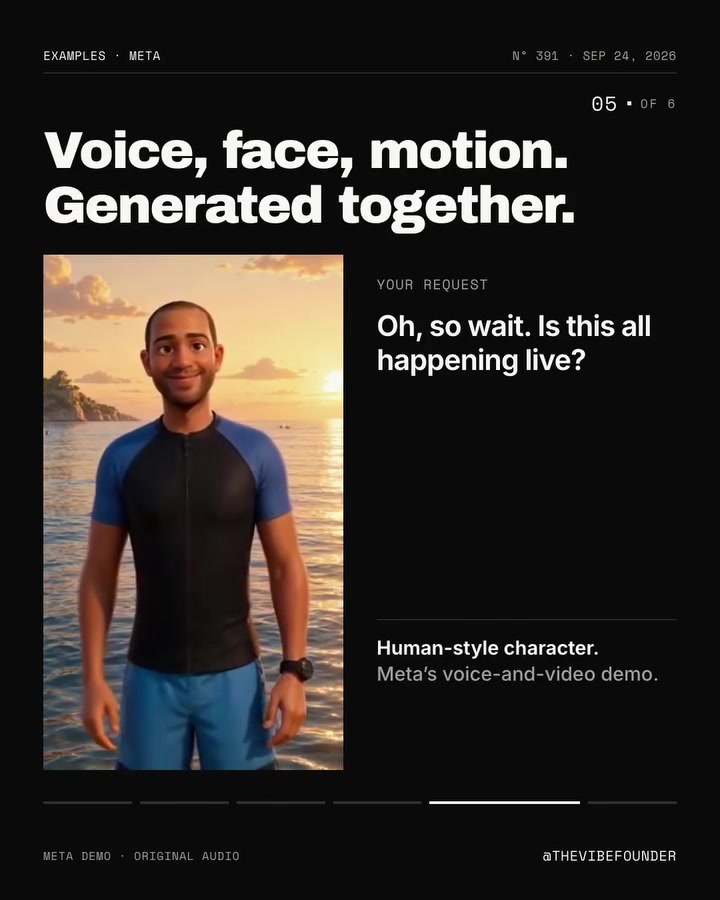
Watching a smiling avatar lounge on a digital beach, it's hard to deny the uncanny realism of Meta's new voice-and-video avatar demo. The company showcases a character whose voice, face, and motion are all generated together, seamlessly.
The Avatars at Your Voice's Command
Meta’s voice-and-video avatar demo, shown on Sept 24, 2026, isn't just a talking head. The product integrates voice, face, and motion so the avatar can respond to prompts and tell a short story. Avatars are available as part of the "Examples" Meta showcase. The avatar’s biggest draw is that the technology generates its voice, facial expressions, and movements simultaneously, creating a realistic, responsive digital persona. It's as if Meta has found a way to bring your voice command to life, with complete synchronicity between all vocal, facial, and movement outputs – it’s a small victory for a company often the subject of criticism. The beach setting serves as a tranquil stage for the avatar to express itself. The avatar’s likeness is detailed, from the shape of its face to the subtle expressions. Its voice sounds lifelike, too, as it responds to its environment and user requests. This human-style avatar is touted as Meta’s next stride in virtual reality and AI.
The Blur between Reality and Digital
With the ongoing debate about deepfakes and AI-generated content, Meta's avatar tech adds another layer to the discussion. The technology has the potential to revolutionize entertainment, education, and communication. This is a technology built to mimic human behavior and appearance, raising ethical and social questions. What if avatars become too realistic, and people can’t tell what is real and what is generated? Yet, the digital world isn't stopping. Virtual reality and augmented reality are becoming more popular, and avatars could help bridge the gap between physical and digital experiences.
A Human-like Face and Realistic Speech
Meta isn't just creating a virtual talking head. The avatar's face and expressions are designed to be almost indistinguishable from those of a real person, making it a valuable tool for a range of applications. The technology generates the avatar's voice in real-time, with the right tone and even meaningful pause and emotion. Meta achieves this by combining advanced machine learning with sophisticated voice synthesis algorithms, but the exact details of its algorithms remain proprietary. No matter the exact mechanism, avatars can perform complex tasks such as reading a book, telling a story, or even having a conversation with someone. The avatar is capable of generating a realistic hand and body motion to match the voice and facial expression. It’s designed to move naturally, with subtle gestures and movements that mimic a real person to make it appear more credible. This is not something new to Meta. The company has been working on avatars for over a decade, but this latest demo marks a significant leap in realism.
A Realistic Human-Style Look
The avatar's design emphasizes realistic facial features and expressions, from the subtlest eyebrow raise to a full smile. The body is also modeled to look human-like, with natural movements and gestures. The avatar is able to walk, sit, stand, and react to its environment in a way that feels natural and believable. The technology doesn’t just generate a static image or a pre-recorded video. The avatar reacts in real-time to user prompts, making it a dynamic and engaging tool. The human-like appearance and realistic reactions make the avatar a valuable tool for a range of applications, from entertainment to education and communication.
Realistic Expressions and Movement
The avatar’s ability to express emotions and react to its environment is one of its most impressive features. It can laugh, cry, frown, and smile, all with remarkable authenticity. This emotional range makes the avatar a powerful tool for storytelling and communication, as it can convey a wide range of emotions and reactions. The avatar’s movements are also designed to be realistic, with natural gestures and body language. It can walk, sit, stand, and react to its environment in a way that feels natural and believable. This makes the avatar a valuable tool for virtual reality and augmented reality applications, as it can interact with users and other avatars in a realistic way.
Connecting with other People and Apps
Avatar technology can also be integrated with other apps and platforms, making it a versatile tool for a range of applications. It can be used for virtual meetings, online gaming, and even social media. Meta’s technology is designed to be easy to use, with intuitive controls and a user-friendly interface. Users can customize their avatars to suit their needs and preferences, from changing their appearance to adjusting their voice and movements.
How to Enter the Avatar World
Those curious about Meta’s avatar technology can’t interact with it directly out of the box. However, the company’s growing ecosystem of VR and AR devices like Meta Quest 3 and Quest Pro might be the entryway.
- Virtual Reality Applications: The avatar’s lifelike movements and expressions make it an ideal tool for VR experiences. VR is becoming more popular as a way to immerse users in interactive and engaging experiences.
- Augmented Reality Applications: With AVR equipment, avatars could blend seamlessly into the real world, providing a unique and innovative way to interact with digital content.
- Education and Training: Meta’s avatars can be used for immersive learning experiences, providing students with a realistic and engaging way to learn.
- Entertainment and Gaming: Avatars can be used to create realistic and engaging characters for games and entertainment. From storytelling to interactive experiences, avatars can bring a new level of realism and immersion to entertainment.
The Promise of the Virtual Realm
The digital world is evolving quickly, and as it stands, Meta’s avatar has the potential to revolutionize how we interact with technology. This new technology could give users a realistic, immersive and engaging way to connect with digital content and each other. But like all new technologies, it also comes with challenges and concerns. How can we ensure that avatars are used ethically and responsibly? How can we protect users’ data and privacy? How can we prevent the spread of misinformation and deepfakes? Questions abound, but Meta’s avatar technology brings one thing for sure: a future where the line between the real and the digital worlds is clearer. The potential applications for this technology are vast, and the company is already working on integrating avatars with its other products and services.
Questions readers ask
What exactly makes Meta's new avatar demo different from previous virtual avatars?
Meta's new avatar demo stands out because it integrates voice, face, and motion all at once, creating a seamless and realistic interaction. Unlike previous avatars that might have just one or two of these elements, this one responds to prompts and tells stories with synchronized vocal, facial, and movement outputs, making it much more lifelike.
Can I access and interact with these avatars right now?
As of now, the avatars are part of Meta's showcase, so they're available to view in the “Examples” section. However, there isn't any indication that users can interact with them directly yet. It seems the demo is more of a showcase of what's possible with the technology.
How does Meta generate such realistic voices and facial expressions in real-time?
Meta uses a combination of advanced machine learning and sophisticated voice synthesis algorithms. While the exact details of these algorithms are proprietary, the result is a voice that sounds lifelike with the right tone, pauses, and emotions, and facial expressions that are almost indistinguishable from those of a real person, and generated in real-time.
Will these avatars be used for more than just entertainment?
Yes, the potential applications go beyond entertainment. Meta's avatars could revolutionize fields like education, communication, and even customer service. Imagine avatars that can teach, interact, and assist in a way that feels almost human, bridging the gap between physical and digital experiences.
What ethical concerns might arise from such realistic avatars?
The main concern is the blurring line between reality and digital content. As avatars become more realistic, there's a risk people might struggle to tell what's real and what's generated. This raises questions about consent, misuse, and the potential for deepfakes, which could have serious social and ethical implications.
What's the significance of the beach setting in the demo?
The beach setting serves as a tranquil and relatable backdrop, allowing the avatar to express itself in a natural environment. It helps highlight the avatar's ability to interact with its surroundings and respond to user requests, making the demo more engaging and convincing.
How does Meta ensure the avatars’ movements are so natural?
Meta has been working on avatar technology for over a decade, so they’ve had time to refine the movements. The avatars are designed to move naturally, with subtle gestures and movements that mimic a real person. This attention to detail makes the avatar appear more credible and lifelike.
Recent articles
Fresh deep dives from the latest Reels we unpacked.




Comments
Be the first to comment.