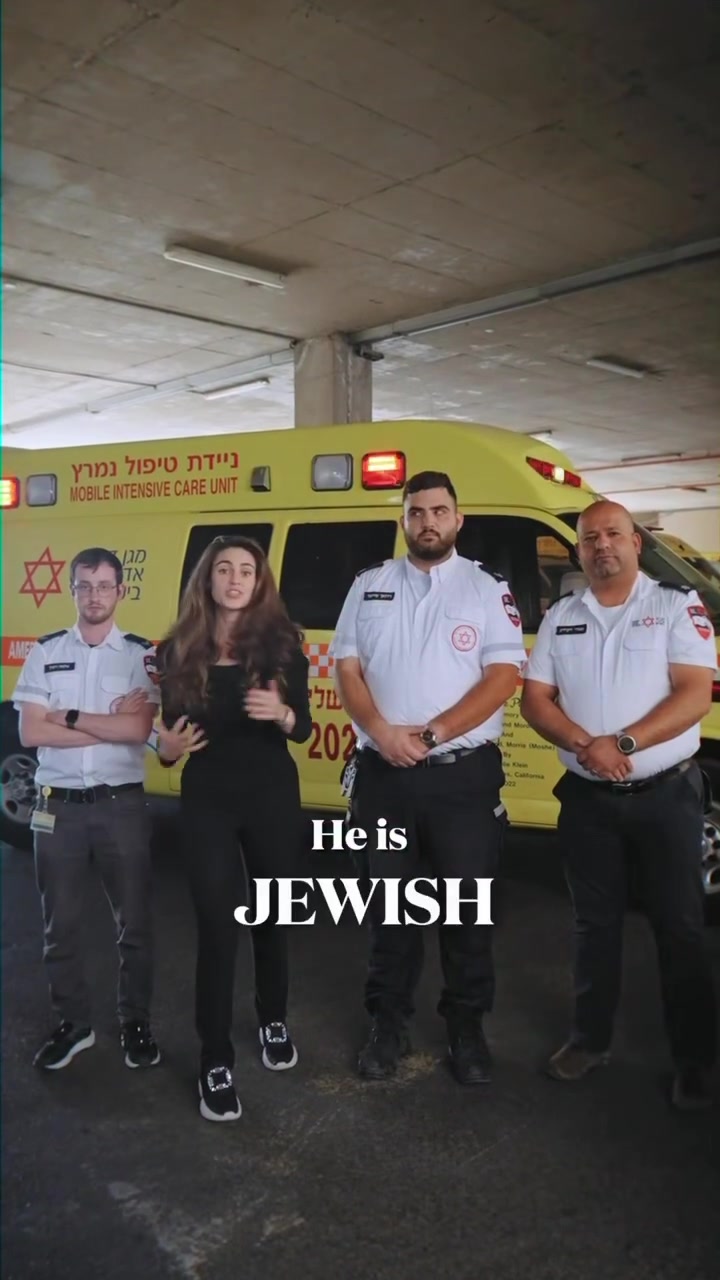
Three Doctors, One Mission — Life in the Magan David Adom Ambulance
An ambulance speeds through the streets of Israel, and EMT Fadi, a Muslim, presses gauze against a patient's wound for pressure. Fadi’s father didn’t have much experience with hospitals and doctors—and even less with emergency services. But once, he was involved in a critical accident on the road, requiring immediate medical care. That was the day it all changed for his son. Fadi had never thought of himself as a doctor, let alone an EMT. Shlomo and Radwan are EMTs and ambulance drivers for their nation's emergency medical service, Magan David Adom. These men serve a shared mission, to save lives. The fact is, their medical service is the largest ambulance fleet in the world. Magan David Adom is the largest non-governmental organization in Israel.
On the Front Lines of Israeli Unity
The work of Magan David Adom (MDA) challenges otherwise isolationist views on healthcare within Israel. MDA, founded in 1930, originated as a humanitarian response to community needs and has evolved into a comprehensive, volunteer-run emergency response service. MDA stands unique in its mission, unifying volunteers from different backgrounds in a shared cause. The service provides a wide range of services, but at its core, it offers crucial emergency medical services, such as the Emergency Mobile Intensive Care Unit. MDA EMTs and paramedics act as first responders; once a call is placed, they rush to the scene, performing life-saving treatment on the spot. The fleet includes over 900 ambulances, mobile intensive care units for those with the worst injuries, and light vehicles for low-emergency cases. Among the fleet, a Mobile Intensive Care Unit (MICU) is a priority vehicle. Inside the unit are the essentials: ventilators, oxygen, and maternity kits to assist childbirth in emergencies. In addition, advanced cardiac life support (ACLS) equipment aids EMTs in severe cardiac cases, and a nurse, a paramedic, and an experienced physician man the unit. It's the teamwork and training of MDA personnel that make the difference. Unlike other organizations, MDA doesn’t focus on the victim’s identity or affiliation. When asked how the crew’s diverse backgrounds contribute to their complaints, a paramedic responded, “We don’t check who the patient is, they just do whatever it takes to save a life.”
The Human Connection: Training
New EMTs receive extensive training in both medical and human relations skills. The six-month course includes study of emergency medicine, trauma, and human relations. Candidates must pass a series of exams, simulation drills, and field training assignments. After successful completion, trainees become EMTs or paramedics. Teamwork and communication are crucial in an ambush. During a call, the ambulance driver and EMT work together on the scene and during transport to the hospital. EMTs are trained to run through a list of necessary questions: Is the patient alert and oriented? What are the signs of breathing problems? Is there immediate trauma?
The Human Connection: In The Trenches
To be an EMT is to know that patients are not always dealt with in a clinical setting. Fadi shares, “An old patient told me she felt she was in a cemetery not a hospital.” She was alive, but in agonizing pain. Amidst the chaos, the crew makes human connections: they listen to patients and their families. Magen David Adom has services in Arabic, English, and Hebrew, but universal compassion transcends language. “I believe that when I save a life, it is as if I am saving my father,” Fadi says.
The Human Connection: Overcoming Prejudice
Fadi's father’s story is a part of them all. Fadi notes that his own experience encouraged him to join if not for saving others, then for gratitude to the people like Shlomo, Radwan, and the others. Even with the training, Radwan admits the early days were challenging. He worried people would see him differently. But soon, he understood that the crew didn’t care about nationality or religion. Radwan and Fadi are Muslim EMTs working for a Jewish service. The team’s values are central in their mission. As Shlomo puts it, “It doesn't matter if the patient is Jewish or Muslim. We just do whatever it takes to save the life.”
The Human Connection: A Team
To join Magen David Adom is to commit to a nation’s health in humanity. As mentioned, The MDA’s fleet of emergency vehicles is impressive, but it’s the crew that is responsible for successful rescue. The crew is subjected to over 1000 critical hours a year. The ambulance is their rotating workplace for treatments. Experience plays a part in crew training. Drive like a Nazi is a training exercise to get EMTs acquainted with rough roads. Another exercise to learn how to manage the equipment and the order of operations is the X-Ray game. EMTs work quickly to get fresh blood to the sufferer in proper order. “Everything I could say sounds trite: adrenaline, excitement, inspiration. 'You don't know’” When asked, what his experiences mean to him, Fadi says, “Just your morale…”
Every One Deserves To Be Treated
Radwan, Shlomo, and Fadi describe consistent first-hand account and training. The team is unapologetic about their passion, “All you need to understand is that every single life deserves to be treated. Sometimes the reality is that without us, some people might die. The only goal is to preserve a life.” According to the crew, providing care to those in need is a duty, not a choice. Paramedic volunteers are lifesavers in a vehicle. They patch patients up and transport them to the hospital. They do all of this with a human connection. They just do whatever it takes to save a life.
Questions readers ask
What is Magan David Adom (MDA) and what does it do?
Magan David Adom, or MDA, is Israel's national emergency medical service. It provides a range of emergency medical services, including ambulance transport, mobile intensive care, and first response teams. MDA is unique because it's a volunteer-run organization that unites people from diverse backgrounds to save lives.
What is a Mobile Intensive Care Unit (MICU) and why is it important?
A Mobile Intensive Care Unit (MICU) is a specialized vehicle within MDA's fleet. It's equipped with advanced medical equipment like ventilators, oxygen, and maternity kits, and staffed with a nurse, paramedic, and physician. MICUs are crucial for handling severe injuries and urgent medical situations right at the scene.
How does MDA handle the diverse backgrounds of its volunteers?
MDA's strength lies in its ability to unite volunteers from different religious and cultural backgrounds. The organization focuses on the shared mission of saving lives, rather than the identity or affiliation of the patient. This approach fosters a sense of unity and ensures that everyone receives the best possible care.
What kind of training do MDA EMTs undergo?
MDA EMTs undergo a rigorous six-month training program that covers emergency medicine, trauma care, and human relations. The training includes exams, simulation drills, and field assignments. This extensive preparation ensures that EMTs are equipped to handle a wide range of emergency situations effectively.
How does MDA's approach differ from other emergency medical services?
MDA stands out because it doesn't focus on the victim's identity or affiliation. Its diverse team of volunteers works seamlessly together, prioritizing the patient's needs above all else. This inclusive and unified approach is a key factor in MDA's success and efficiency in emergency response.
Is MDA the largest ambulance fleet in the world?
Yes, MDA operates the largest ambulance fleet in the world. With over 900 ambulances, mobile intensive care units, and light vehicles, MDA is well-equipped to handle a wide range of emergencies across Israel.
Related deep dives
Similar reads based on topic and creator.

Recent articles
Fresh deep dives from the latest Reels we unpacked.




Comments
Be the first to comment.