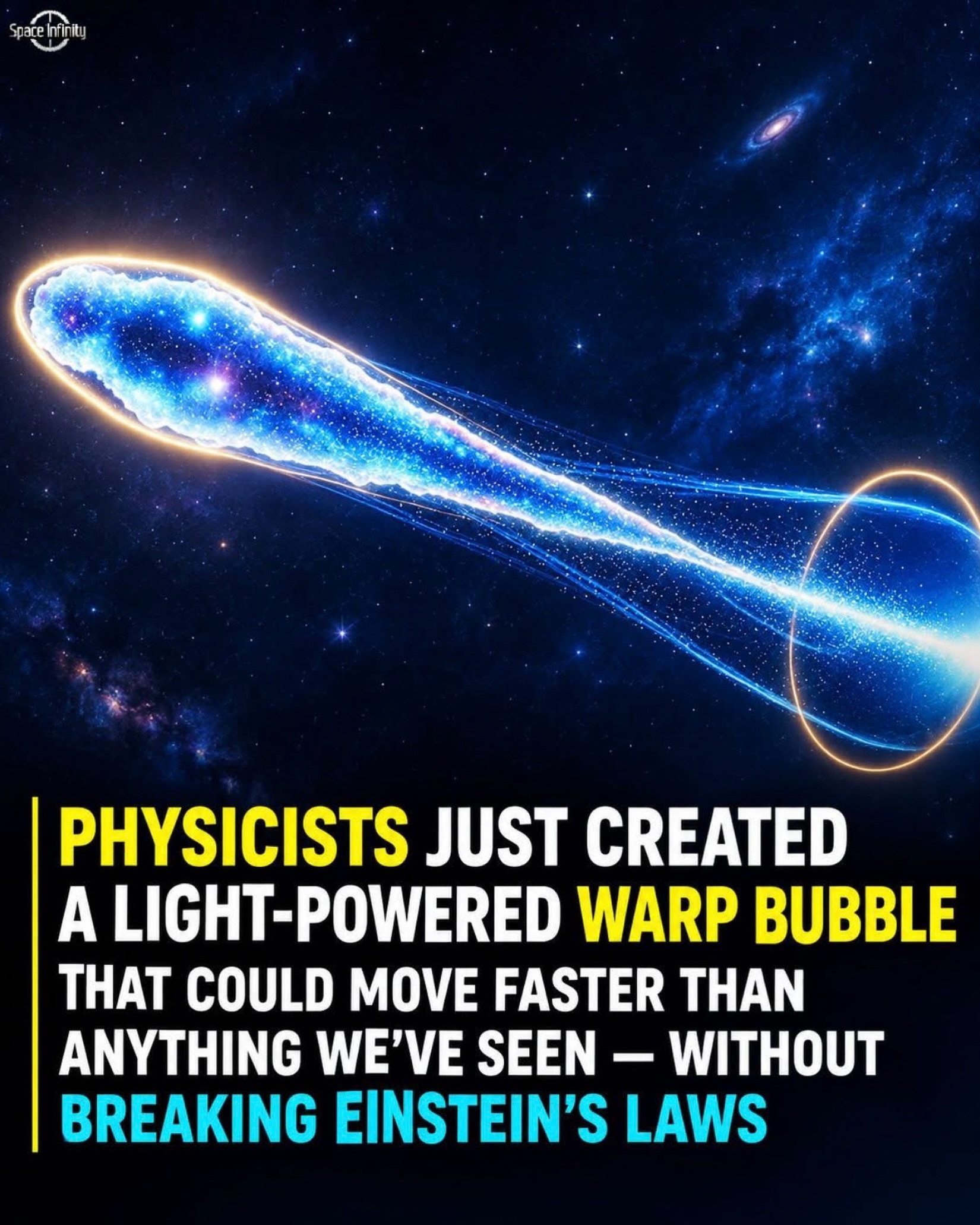
Physicists at the University of Rochester have taken a giant leap in manipulating spacetime. They engineered an unbelievably tiny light-powered warp bubble. The accomplishment is remarkable considering the bubble doesn’t break Einstein’s laws of physics.
The Warp Bubble
A warp bubble is a controlled distortion of spacetime. The team from the University of Rochester has managed to create something miniscule: a tiny bubble which, when viewed from the outside, appears to move light about 1.4 times faster. However, it's essential to note that the light itself moves normally inside the bubble. Taking this even further, nothing actually travels faster than light. So, the bubble distorts the surface of space and time, creating an observable effect. The bubble lasts a billionth of a second and spans roughly a millimeter. The University of Rochester researchers were able to control the bubble using specially designed metamaterials — artificial composites that can manipulate and control light and other electromagnetic waves. This tiny device is generating enormous anticipation in physics.
The Future of Communication, Technology, and Travel
The idea of a warp bubble fits into the larger picture of modern physics. The quest to harness and manipulate forces like gravity and spacetime has been a long journey, pushing the limits of imagination and science. The Rochester experiment shows potential applications for future research into faster-than-light communication, quantum technologies, and theoretical warp propulsion. Take that, Star Trek! However, these breakthroughs remain experimental; they are not fuelling the engines for spaceships ready to be mass-produced. The University of Rochester reports anticipate potential applications in faster-than-light communication, quantum technologies, and theoretical warp propulsion.
Liftoff
Mimicking Supernovas
The research team led by University of Rochester physicists excavated the mechanism behind the bubble. Metamaterials, the primary technique used, consist of synthetic materials designed to control and manipulate electromagnetic waves. These materials have atomic properties arranged to interact with light in specific ways. This allows for the control and manipulation of the bubble, meaning that nothing travels through space at a speed faster than light, per Einstein's laws.
Holding the Bubble
In the Rochester physicists' experiment, they used laser light to activate the metamaterials. This creates a controlled distortion of spacetime, forming the bubble. Using metamaterials, just like in such materials in space, allows for control of the bubble. So, even though the bubble's lifespan is short, the possibility of further development of the technique remains promising. For now, the bubble is the size of a millimeter and only lasts billionths of a second. That makes it challenging to figure out exactly how to harnass its power. However, scientists are hopeful that the potential of warp bubbles will expand as research continues.
Dreaming of Warp Drive
The future of warp bubbles can be imagined in a host of potential applications, including faster-than-light communication, quantum technologies, and theoretical warp propulsion. Although it sounds like science fiction, the University of Rochester physicists' experiment demonstrates that manipulating spacetime could make it possible. Moreover, this advancement represents a significant step towards unlocking the secrets of the universe and the potential for breakthroughs in communications and travel.
A Reality Check
For anyone desiring to harness the power of warp bubbles, it will involve a journey into the world of metamaterials and spacetime distortions. Science fiction or reality? Well, this article is not more than a couple of paragraphs long. That means there is a lot still left to be discovered about warp bubbles. However, those interested in these cutting-edge technologies can become familiar with research and resources from the University of Rochester. This will help them keep up-to-date with the most recent innovations.
The Road Less Traveled
There's still a lot to learn about warp bubbles, including practical applications. This futuristic technology could change everything from communication to travel -- but that's only a dream until more breakthroughs come along. Think about the potential for faster-than-light travel and communication. Don’t miss the latest findings from the University of Rochester.
Questions readers ask
What exactly is a warp bubble, and how does it differ from traditional faster-than-light travel?
A warp bubble is a controlled distortion of spacetime, created by manipulating electromagnetic waves with metamaterials. Unlike traditional faster-than-light travel concepts, a warp bubble doesn't actually move anything faster than light. Instead, it distorts the fabric of space and time, making it appear as if objects are moving faster from an outside perspective. The light inside the bubble moves at its normal speed, but the bubble itself can make light appear to move 1.4 times faster from the outside.
How do the University of Rochester physicists control the warp bubble with light?
The physicists use specially designed metamaterials, which are artificial composites that can manipulate and control light and other electromagnetic waves. By activating these metamaterials with laser light, they create a controlled distortion of spacetime, forming the warp bubble. This process allows them to control the bubble and ensure that it adheres to Einstein's laws of physics.
What are the potential applications of this warp bubble technology, and how realistic are they?
The potential applications include faster-than-light communication, advancements in quantum technologies, and theoretical warp propulsion for space travel. However, these are currently experimental and not ready for practical use, such as powering spaceships. The technology is still in its early stages, and while it's exciting, it's important to manage expectations about immediate real-world use.
How long does the warp bubble last, and what are the challenges in harnessing its power?
The warp bubble created by the University of Rochester team lasts for about a billionth of a second and spans roughly a millimeter. The short lifespan and small size make it challenging to harness the power of the bubble. Researchers are hopeful that as the technology develops, the potential of warp bubbles will expand, allowing for more practical applications.
What are metamaterials, and why are they crucial for creating warp bubbles?
Metamaterials are synthetic materials designed to control and manipulate electromagnetic waves. They have atomic properties arranged in a way that interacts with light in specific ways, allowing for the creation and control of the warp bubble. These materials are crucial because they enable the distortion of spacetime without violating Einstein's laws of physics, making the warp bubble possible.
Related deep dives
Similar reads based on topic and creator.



Recent articles
Fresh deep dives from the latest Reels we unpacked.




Comments
Be the first to comment.