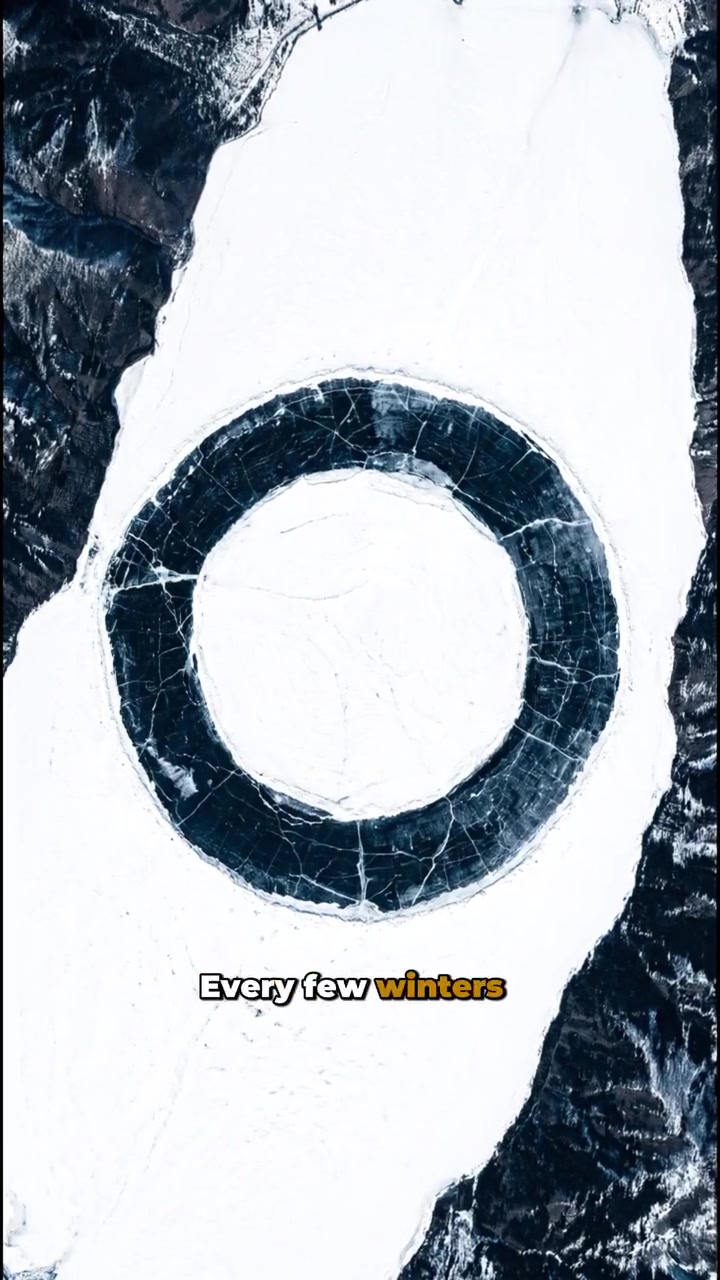
Every few winters, Lake Baikal, the world's deepest lake in Siberia, becomes the site of a mysterious phenomenon. Dark, circular rings, some up to seven kilometers wide, emerge on its frozen surface. Scientists and spectators alike have witnessed these formations since 1969, but they remain as unpredictable as ever. They appear in different spots across the lake, lasting from days to months, and vanish without a trace. But what causes the dark ice rings on Lake Baikal ? These rings are so immense that they're only visible from space or satellites. The leading theory points to hidden warm whirlpools spinning beneath the ice.
The Frozen Circles of Lake Baikal
The appearance of dark circular rings, which have a circumference of up to 7 kilometers, in winter on Lake Baikal has baffled scientists and spectators alike. These unique formations are a distinctive feature of the world's deepest freshwater lake, located in the frozen heart of Siberia. The phenomenon has been documented since at least 1969. No one can predict the exact time and place of their appearance. They can vanish within a few days or linger for months. The first reports of these rings were made in the 1960s. Yet, no one had seen a similar phenomenon elsewhere. The rings are so large that the only practical way to observe them is from space. Their formation and disappearance are still shrouded in mystery. The rings' edges are marked by a thin, breakable layer of ice. This thinner ice is a significant danger for those crossing Lake Baikal, a popular winter activity. The ice is thin enough to threaten the safety of trucks carrying cargo on the frozen lake. The frozen Baikal surface boasts a history of mysterious signs that are often observed from space, but not always understood. The rings, both large and small, somehow form perfect circles, which makes their mysterious nature even more remarkable. The phenomenon has made waves in scientific circles.
The science and mystery of underwater whirlpools
The process that creates these mysterious ice rings is shrouded in mystery. Initially, scientists suspected the rings were caused by methane rising from the lake's depths. However, when they tested the water, they found no methane. This led them to investigate what was really happening to the ice. The ice rings reveal an unexpected challenge: the ice along the ring is dangerously thin, enough to swallow a truck. The leading theory involves an underwater whirlpool. The whirlpools form eddies or swirling whirls beneath the frozen lake's ice. These eddies warm the ice from below, thinning it. The warmth creates a circle in the ice, making it look like the ice is being drawn by some unseen force. But why the whirlpools form in specific spots and years remains a puzzle for researchers.
The silent dance of water, ice, and science
The swirling phenomenon
The formation of these icy circles is a stunning example of nature's complexity. Despite covering hundreds of meters, the rings are remarkably circular. Whether scientists' theory of hidden whirlpools is correct, it's crucial to uncover why the whirlpools form when they do and why the warm water eddies appear in specific spots. The leading theory suggests that despite their depth, the eddies have an impact on the surface. This shows that even in the most isolated location, unseen forces play a significant role. The phenomenon's existence on Lake Baikal is tied to the lake's unique environmental conditions, including its depth and the way it freezes over.
The world's deepest and oldest lake
Lake Baikal, the world's deepest and oldest freshwater lake, is a UNESCO World Heritage site. It is in the frozen heart of Siberia, Russia. it spans 636 kilometers in length and 79 kilometers in width, making it one of the largest lakes in the world. The lake is also notable for its clear waters, which can reach depths of over 1,600 meters. Around 8,000 species call the lake home. In addition to being a fascinating natural phenomenon, Lake Baikal is also a critical freshwater source. The lake holds approximately 20% of the world's unfrozen freshwater, making it a vital resource for the region. The lake's water is so pure and clean that it is used for scientific research and drinking water.
The mysteries of the deep
The mystery of the dark ice rings is just one of the many enigmas that Lake Baikal holds. The lake is home to a unique ecosystem, with many species of plants and animals found nowhere else in the world. There are still many unknowns about the lake's depths, including what causes these mysterious ice formations. The mystery continues to captivate scientists and spectators alike, as they strive to unravel the secrets of this remarkable body of water. Lake Baikal's unique geological and ecological characteristics create an environment that fosters strange and beautiful phenomena. The ice rings are just one example of the many wonders that can be found in the depths of this mysterious lake. As researchers continue to study the lake, they hope to unlock more of its secrets and better understand the forces that shape our world.
The risks of the lake
Baikal’s ice is hazardous, especially in the winter. The thin ice makes trekking on the lake risky. Even in winter, truckloads of cargo crisscross the lake, and this presents a genuine danger due to the thinner ice. Tourists and locals alike should be aware of the risks. The phenomenon is both fascinating and fraught with danger. The ice is thin and can be hazardous, especially for those who are not familiar with the lake's unique conditions.
Exploring the rings
If you're planning a trip to Lake Baikal, consider visiting during the winter to witness the mysterious ice rings for yourself. Ensure you are aware of the potential dangers and take appropriate safety measures. The frozen lake offers a unique and unforgettable experience, but it's essential to be prepared and stay safe. It's a rare opportunity to witness the phenomenon. The formations are unpredictable, so make sure to visit during the winter.
Questions readers ask
What exactly causes these dark ice rings on Lake Baikal?
Scientists are still trying to figure this out, but the leading theory involves underwater whirlpools. These whirlpools create warm eddies beneath the ice, melting it from below and forming the distinctive circles. The exact mechanism behind why these whirlpools form in specific spots and years remains a mystery.
How dangerous are these ice rings for people who cross Lake Baikal in winter?
The ice rings are quite dangerous. The edges of these rings are marked by a thin, breakable layer of ice, which can be hazardous for those crossing the lake, especially for trucks carrying cargo. It's important for anyone venturing onto the lake to be aware of these potential hazards.
Can these ice rings be seen from anywhere other than space?
Because of their immense size, up to seven kilometers in width, the ice rings are best observed from space or via satellites. From the ground, they might not be as visible or distinguishable, especially given the vast expanse of the frozen lake.
Why do these ice rings form in different spots across the lake each time?
The exact reason for the varying locations of the ice rings is still unknown. Scientists speculate that it could be due to the unpredictable nature of the underwater whirlpools and the specific conditions that cause them to form in certain areas of the lake.
Have there been any other similar phenomena observed in other lakes or bodies of water?
As of now, similar phenomena have not been reported in other lakes or bodies of water. The ice rings on Lake Baikal are unique, making them a subject of great interest and mystery in the scientific community.
What steps are being taken to further understand and study these ice rings?
Scientists are actively investigating the underlying causes of these ice rings. They are studying the lake's water composition, temperature, and the behavior of underwater currents to better understand the formation of these mysterious circles.
Related deep dives
Similar reads based on topic and creator.


Recent articles
Fresh deep dives from the latest Reels we unpacked.




Comments
Be the first to comment.