Jev Is Interrupting
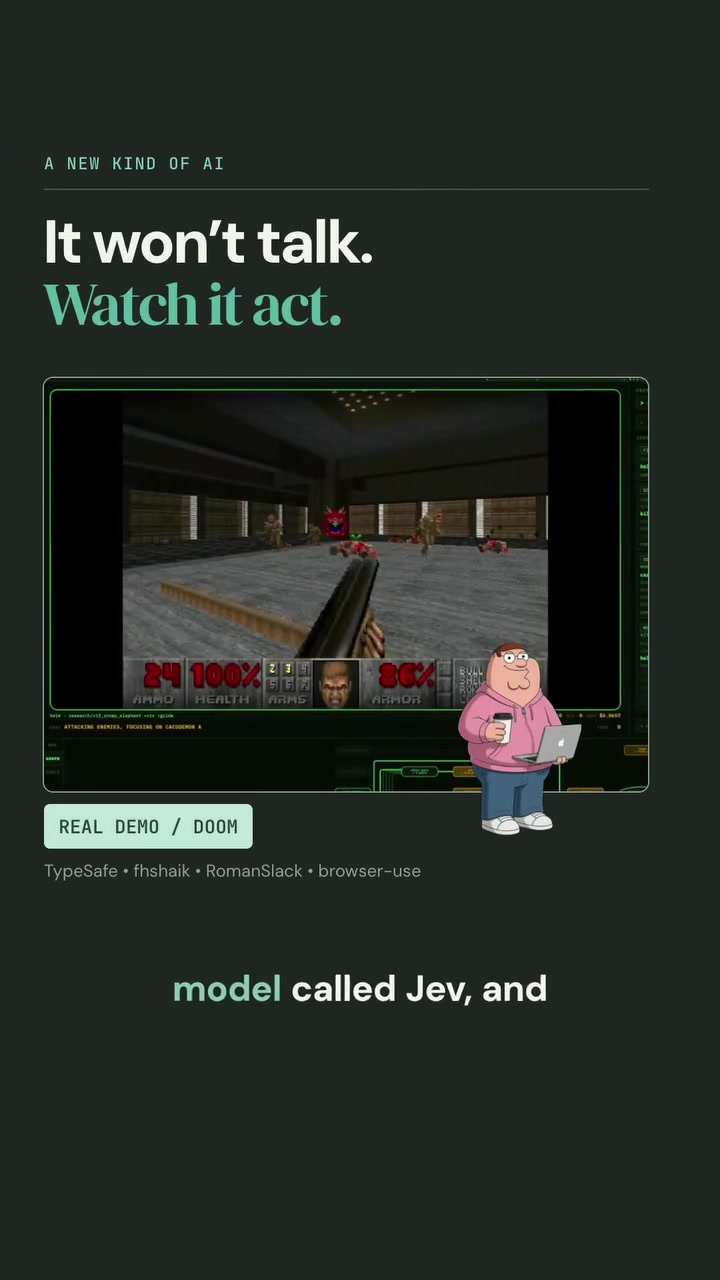
A new AI model named Jev bursts onto the scene. Its superpower? Playing games like Doom and Super Mario, booking flights, and even flying drones. The catch? It can't write a single word. Chatbots like ChatGPT, Claude, and Gemini can generate text, but Jev is designed for a different, less verbose task. This AI decides.
The Decision-Making AI that Can't Write
This AI prioritises "decisions". You give Jev a scenario and a list of options, and it picks one instantly. It's a classification model that understands plain language. Unlike chatbots, which are built for conversations, Jev is like a smart if-else statement, picking options by sorting them into boxes. TypeSafe, the company behind Jev, calls this a "System 1" model, named after psychologist Daniel Kahneman's fast thinking system. Jev doesn't ponder or deliberate; it acts on instinct. Jev won't spell out the best move in Super Mario. It'll just tell you to jump or run. It can't draft a reply to a customer saying, "I was charged twice." It will tell you—with 97% confidence—to route the issue to the billing department. Jev makes 92% of its decisions in a fraction of a second, while a chatbot costs 100 times more. When developers had Jev making flight bookings, sorting research papers, playing games, flying drones, and trading, they noticed a pattern. Chatbots write, Jev decides, and regular code acts. Together, they can divide tasks more efficiently.
The Inside Track on AI's Next Phase
Jev is not your friendly neighborhood chatbot. These tiny AI decision engines could fundamentally change the way we interact with technology. Picture this: Instead of chatting with AI, we'll have AI deciding what happens next. Think of tiny Jev models hidden inside apps, making thousands of decisions per second. This is a significant shift in the AI landscape, where models are specialized rather than generalist. This could lead to more efficient, faster, and cheaper AI-driven services, as different pieces handle different jobs. Jev is not yet ready for prime time. It's still in early access, and some of the most impressive demos come from TypeSafe's own tests. It tends to deliver confidently incorrect answers. Jev can't count and struggles with dates. The flight demo—which booked flights in just 7.1 seconds—did not actually purchase tickets. It searched Google Flights. The drone demo runs in a simulator.
The Cost and Speed Edge
Jev was launched by TypeSafe on September 26, 2026. The company initially came out of stealth mode with $40 million and Diogo Almeida, a former OpenAI researcher who helped invent the training method behind ChatGPT. Almeida is confident that Jev is "ridiculously fast and cheap," and the numbers seem to back that up. The AI makes decisions at a snail's pace of 92% in a quarter of a second. Compare that to a chatbot, which costs 100 times more. One developer built a browser agent that booked a real flight in 7.1 seconds for less than half a cent. Another sorted over a thousand research papers by topic for 8 cents. Someone had it play Super Mario by reading the game's memory and made it autonomous. Another developer taught it to finish the first mission of StarCraft, and it built a Minecraft bot. Meanwhile, another developer hooked up the model to a drone, letting it make tactical calls a couple of times per second. The drone's safety, however, was controlled by regular code.
Do we really need AI for everything?
AI isn't just a chatbot anymore. The next wave of AI is about intelligent, automated decision-making. Jev might not be a ChatGPT killer, but it does the thinking ChatGPT does not. On the other hand, Jev isn't something founders or developers need. Jev won’t explain what to say or do. The advantage of machine learning comes in its decision-making skills. It's a calculator, not a cashier. In the future, AI might not be the assistant you chat with. Instead, it could be the tiny decision engines hidden inside the apps we already use.
When Will AI Replace Humans?
Jev's power comes from its decision-making speed. If Jev can book a flight, decide a buying strategy, or filter through research papers, it can replace humans in many roles. So it is scary to think about Jev in the future. While Jev is not yet ready to replace humans, its fast decision-making abilities could eventually lead to human job displacement. The jobs that involve repetitive tasks or decision-making where speed matters could be the first to go.
How To Use JEV
Aside from the obvious limitations that Jev can't write, there are a few other factors. Jev is not practical for tasks involving text generation, and it can be prone to confident mistakes. Nonetheless, there is an upside. Jev could be a great fit for browser tasks such as booking tickets, organizing, and automating tasks. It could also be used to make significant implications in specific areas such as games, drones, and trading. Jev could therefore be utilized in call centers and for customer service. Jev can be a good partner with other automation tools. But ultimately, Jev is just a tool. It doesn't replace human intelligence. When Jev combines with other AI tools, workflows, or codes, it is more efficient and purposeful.
Related deep dives
Similar reads based on topic and creator.




Recent articles
Fresh deep dives from the latest Reels we unpacked.




Comments
Be the first to comment.