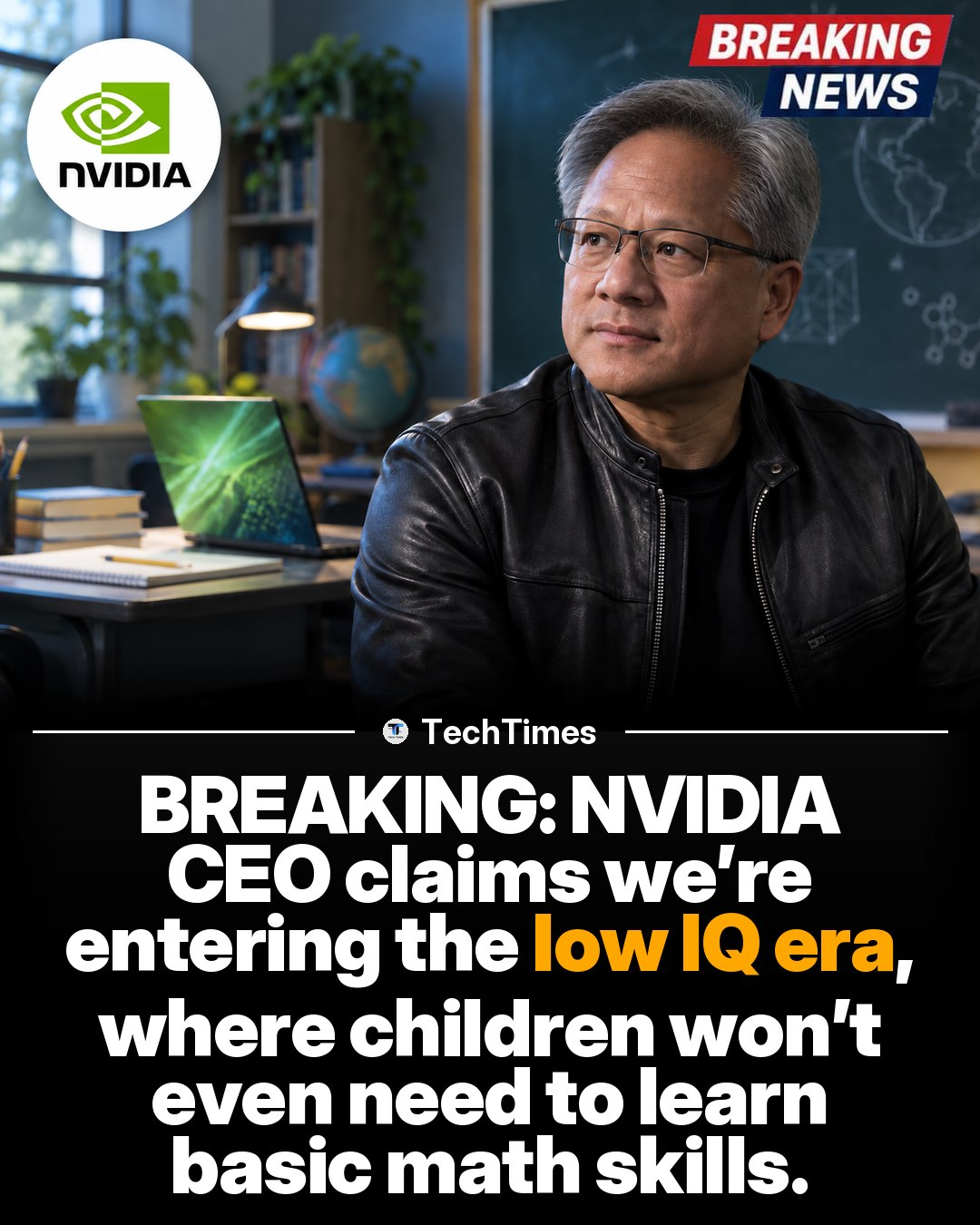
NVIDIA CEO predicts a future where math skills will be obsolete — a bold vision for education and AI. The technology world isn't just about silicon and software. It's also shaping our ideas about learning: NVIDIA CEO Jensen Huang has declared that the world is entering a low “IQ era”, where even basic math skills might become unnecessary.
An Era of Artificial Mathematics
Hauang's prediction is based on the immense power of artificial intelligence. As he sees it, children will not need to learn basic math concepts. AI-enhanced tools will handle these simple calculations, freeing up human minds for more complex problem-solving. Today, students may get their daily dose of math challenge from computer math applications. Huang and NVIDIA envision a future where these apps are so sophisticated that critical thinking becomes more important than basic mathematical education. Math can still be valuable, but the traditional arithmetic basics could change. This eases the learning curve for children, so they can concentrate more on comprehension. The statement overlooks the fact that AI proficiency itself would require an understanding of basic concepts. Regardless, Huang's opinion reflects a shift in educational priorities, suggesting that an AI-driven knowledge economy might de-emphasize traditional learning milestones.
Philosophies of intelligence
Huang's pronouncement also echoes a broader trend in society — the idea that learning should serve humanity. It's not about turning children into human calculators, but nurturing the ability to think critically, creatively, and ethically. By the age of ten, students are already tackling complex equations and logical reasoning due to increasing demands. This trend aligns with Huang's prediction; though students may not need to learn fundamental math, they will require more sophisticated skills.
The NVIDIA Factor
NVIDIA's expertise lies in graphics and AI tech, evident in products like gaming hardware and data center GPUs that accelerate complex computations. These technologies play a significant role in advancing AI skills. There is a methodological process linked to their products. NVIDIA has been instrumental in creating tools for deep learning and AI research. The company's A100 Tensor Core GPU, for instance, has been pivotal in the development of large language models. It’s a case where the product's capability ties in directly with Huang’s predictions about education.
Math and creative thinking
Huang's view suggests that mathematical proficiency will shift from rote calculation to creative problem-solving. He does however acknowledge that basic math remains crucial to everyday life, but sees a future where AI does the heavy lifting, freeing students to explore and innovate. This idea is tied to the company's AI-powered products and their potential to enhance education. Huang's statement is a provocative vision of a future where AI handles the routine, letting humans excel in what machines can't do.
The Shape of Future Learning
This prediction is equatable to industry-standard approaches to AI integration. Huang anticipates a world where machines take over routine tasks. Such an approach will require a rethinking of traditional educational paradigms. Study notes would become irrelevant. The educational system will then focus on fostering creativity, critical thinking, and problem-solving skills throughout a student's learning curve. The younger generation will eventually be spared from the drudgery that comes with fundamental learning. The future of education could pivot entirely around this idea.
Preparing for Huang's Future
Technically, NVIDIA's products won’t directly train students in these skills. But the technology will shape the future of learning platforms. Here's how to navigate a world where basic math might be replaced:
- Embrace AI Tools: Use AI-powered learning applications to discover creative solutions.
- Promote Human-Centric Learning: Shift the emphasis from basic calculation to higher-order thinking.
- Get on the AI Treadmill: Develop skills around AI systems. Explore NVIDIA's educational resources and AI kits for hands-on learning.
Future Learning in Perspective
Huang’s prediction holds both promise and challenges. Imagine a classroom where children learn through interconnected problem-solving rather than isolated calculations. Present-day tools for creative problem-solving and critical thinking will push the boundaries of learning. However, the transition will require a revamp of the educational system and greater investment in robust AI development. AI will replace rote learning and help uncover creative problem-solving and critical thinking skills. The Generation Alpha can look forward to an intellectual leap.
Questions readers ask
What does Jensen Huang mean by the 'low IQ era'?
Huang is referring to a future where basic math skills, traditionally seen as indicators of intelligence, might become less important because AI will handle these tasks. He envisions a shift in educational priorities towards critical thinking and creative problem-solving, as AI takes over more routine calculations.
How does NVIDIA's technology support this vision of AI handling basic math?
NVIDIA's advanced AI and graphics technologies, such as the A100 Tensor Core GPU, are designed to accelerate complex computations and support deep learning. These tools are pivotal in developing AI models that could eventually handle basic math tasks, freeing up human minds for more sophisticated problem-solving.
If AI handles basic math, what skills will students need to focus on?
According to Huang, students will need to focus more on critical thinking, creative problem-solving, and ethical reasoning. These skills are seen as more valuable in an AI-driven knowledge economy, where routine tasks are handled by machines.
What are the potential benefits of this shift in educational priorities?
The shift could ease the learning curve for children, allowing them to concentrate more on comprehension and complex problem-solving. It also aligns with the idea that education should serve humanity by nurturing abilities that machines can't replicate, such as creativity and ethical thinking.
What are the challenges or limitations of this vision?
One challenge is that AI proficiency itself requires an understanding of basic concepts. Additionally, while AI can handle routine tasks, it may not fully replace the need for human oversight and ethical decision-making in complex scenarios.
Can AI truly replace the need for basic math education entirely?
Huang acknowledges that basic math remains crucial to everyday life, but he envisions a future where AI does the heavy lifting. This doesn't mean basic math education will be obsolete, but rather that its role in education might change, with a greater emphasis on creative problem-solving and critical thinking.
Related deep dives
Similar reads based on topic and creator.


Recent articles
Fresh deep dives from the latest Reels we unpacked.



Comments
Be the first to comment.