What is a Foldable Satellite Antenna?
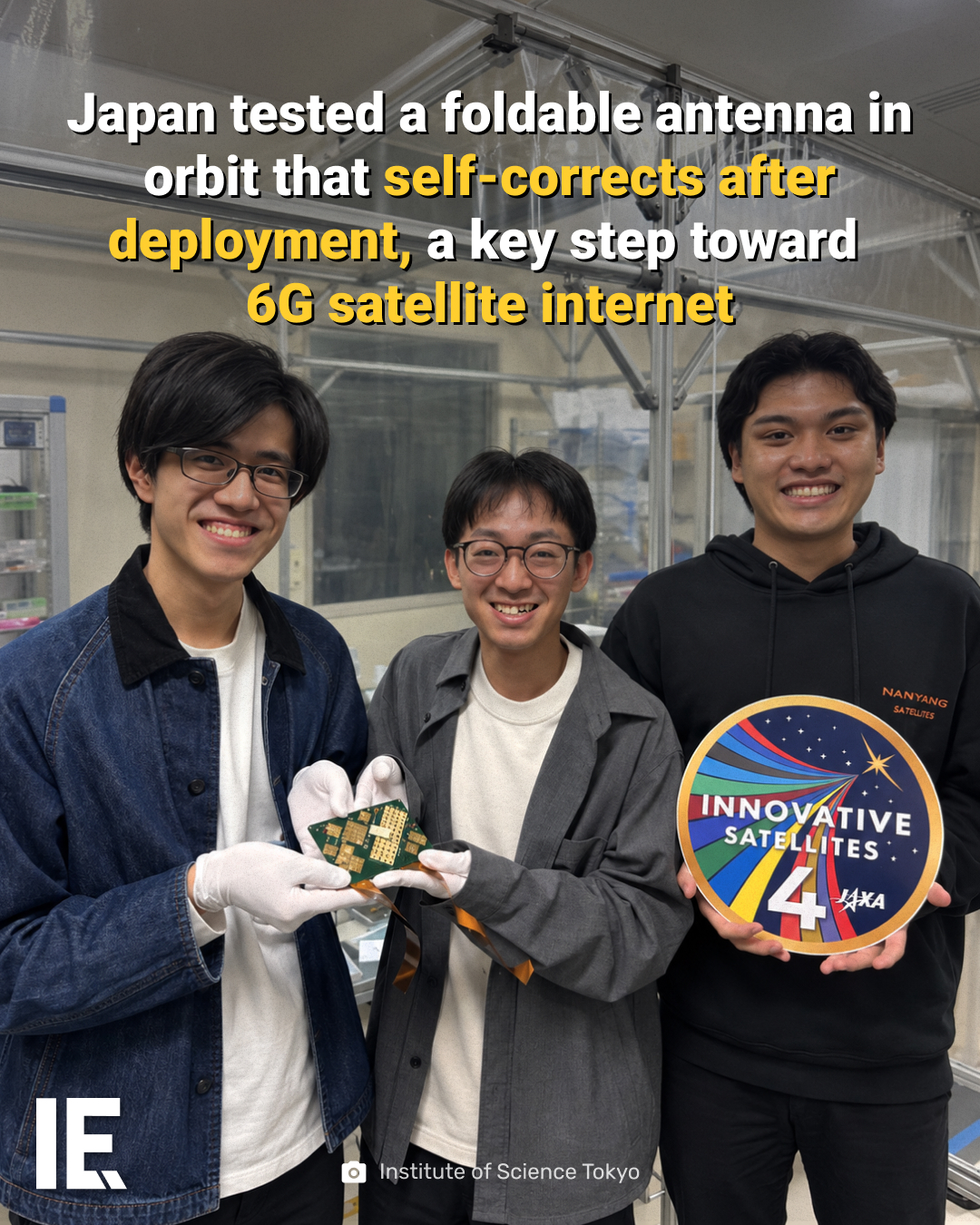
Japanese company Innovative Satellites made history by developing a foldable satellite antenna that self-corrects after deployment. Weighing in as a very small object — but packing big capabilities. The key innovation here isn't bulk or strength — it's the antenna’s ability to adjust itself upon launch. If left to its own devices, space equipment must contend with the unforgiving void's harsh speeds, temperatures, and micrometeoroids. The foldable antenna's small size makes rocket launches more economical. Unlike conventional antennas — which need to bend or fold without kinking or rusting — Innovative Satellites' antenna self-corrects after unfolding. The Japanese Institute of Science Tokyo, one of the organizations involved in Innovative Satellites, is behind this impressively small object. They also won an award for the technology.
Why it matters: Towards the 6G Satellite Future
Space infrastructure is moving faster than ever. We've been using satellites for decades — but now, we're at the cusp of leapfrogging from 5G to 6G, which promises lightning-fast internet. The new foldable antenna technology gears us up towards this new era. While 5G internet is available on Earth and some low-Earth orbit satellites, we’re on the brink of a 6G world with more speeds and more connections. The dawn of 6G satellite communication is already apparent. Massive space projects like SpaceX’s StarLink and OneWeb’s communication satellites are already paving the way by deploying low-Earth orbit (LEO) satellites. 6G is estimated to be 100 times faster than 5G. Innovative Satellites is contributing to this push for low-Earth orbit satellite networks, providing a key step in the deployment of 6G internet. Shorter, cheaper, and more sustainable — foldable antennas will be a game-changer in making 6G a reality.
The mechanics of satellite self-correction
Shredding the Space Junk Myth
Space junk is a real problem, and while it won't immediately obliterate your 6G internet — we need efficient equipment and for it to happen in the first place. By shrinking the size of antennas, 6G satellites lower the risk of running out of storage space and instead, streamline deployment. The foldable antenna's self-correcting mechanism is essential for modern satellites. Traditional antennas often rely on hydraulic or mechanical motors to unfold. These systems can be complex and prone to failure in the harsh conditions of space. Innovative Satellites' innovative design takes a new approach with its self-configuration.
Making height gain
Antenna size is key. When deployed from a spacecraft, it needs to function correctly. This antenna’s size and efficiency in deployment could be a determining factor in how 6G satellites operate. The antenna’s compact size before deployment — and the ability to unfold and self-correct makes it useful for 6G internet technology. The design overcomes the technical challenge of deploying large antennas in space. Researchers at the Institute of Science Tokyo are helping solve the problem by focusing on the tech that gives the antenna its over 3 positions of functionality.
The team behind the foldable antenna
While the antenna is a technical marvel, the people behind Innovative Satellites are also key to the story. The team includes engineers and researchers, studying how, when, and where the new foldable satellite antennas can be most useful. They've also worked closely with the Institute of Science Tokyo, a research organization renowned for its contributions to space technology. All of this collected curiosity from concerned, dedicated scientists helped bring the foldable antenna to life. The 4XA award given to Innovative Satellites recognizes their pioneering work in advancing satellite technology. Their relentless work on improving the antenna's self-corrective abilities is just one of the many ways they've pushed (and continue to push) the boundaries of satellite technology.
Practical guidance: Building better satellites for the public
Intrigued by satellite technology? Here are some steps to help you dive into the world of satellite antennas and their impact:
- Start small: Working with satellite technology can be intimidating, but starting with small projects can make it more accessible. Building a small antenna or working with amateur radio satellites can help you learn the basics. The Institute of Science Tokyo website is a good place to start.
- Stay updated: The field of satellite technology is always evolving, and new advancements are being made regularly. Keep an eye on developments in the field and stay updated.
- Get hands on: Building your small-scale projects will give you firsthand knowledge. You have to learn about aerospace engineering and materials science to work on the big projects.
- Join a community: Engaging with communities dedicated to space exploration and satellite technology can offer valuable insights and support. Joining online forums or attending local events and conferences can help you meet like-minded individuals.
Questions readers ask
How does Innovative Satellites' foldable antenna self-correct after deployment?
The foldable antenna uses a sophisticated self-correcting mechanism that allows it to adjust itself once it's deployed. This reduces the reliance on complex hydraulic or mechanical motors, which are prone to failure in space. Instead, it relies on a self-configuring system to ensure proper functionality.
What makes the foldable antenna a game-changer for 6G internet?
The foldable antenna's small size and self-correcting capabilities make it a game-changer for 6G internet. It allows for more economical rocket launches and streamlines the deployment of low-Earth orbit satellites, which are crucial for achieving the high speeds and connectivity promised by 6G.
Can this technology help with the problem of space junk?
Yes, the foldable antenna technology can help mitigate the problem of space junk. By reducing the size of the antennas, it lowers the risk of running out of storage space in satellites and streamlines their deployment, making the overall space infrastructure more efficient.
How does the foldable antenna compare to traditional satellite antennas?
Traditional satellite antennas often rely on hydraulic or mechanical motors to unfold, which can be complex and prone to failure. In contrast, the foldable antenna self-corrects after deployment, making it more reliable and efficient in the harsh conditions of space.
What role does the Japanese Institute of Science Tokyo play in this technology?
The Japanese Institute of Science Tokyo is one of the organizations behind Innovative Satellites. They have contributed significantly to the development of the foldable antenna, including the self-correcting mechanism that allows the antenna to function correctly after deployment.
Related deep dives
Similar reads based on topic and creator.
Recent articles
Fresh deep dives from the latest Reels we unpacked.




Comments
Be the first to comment.