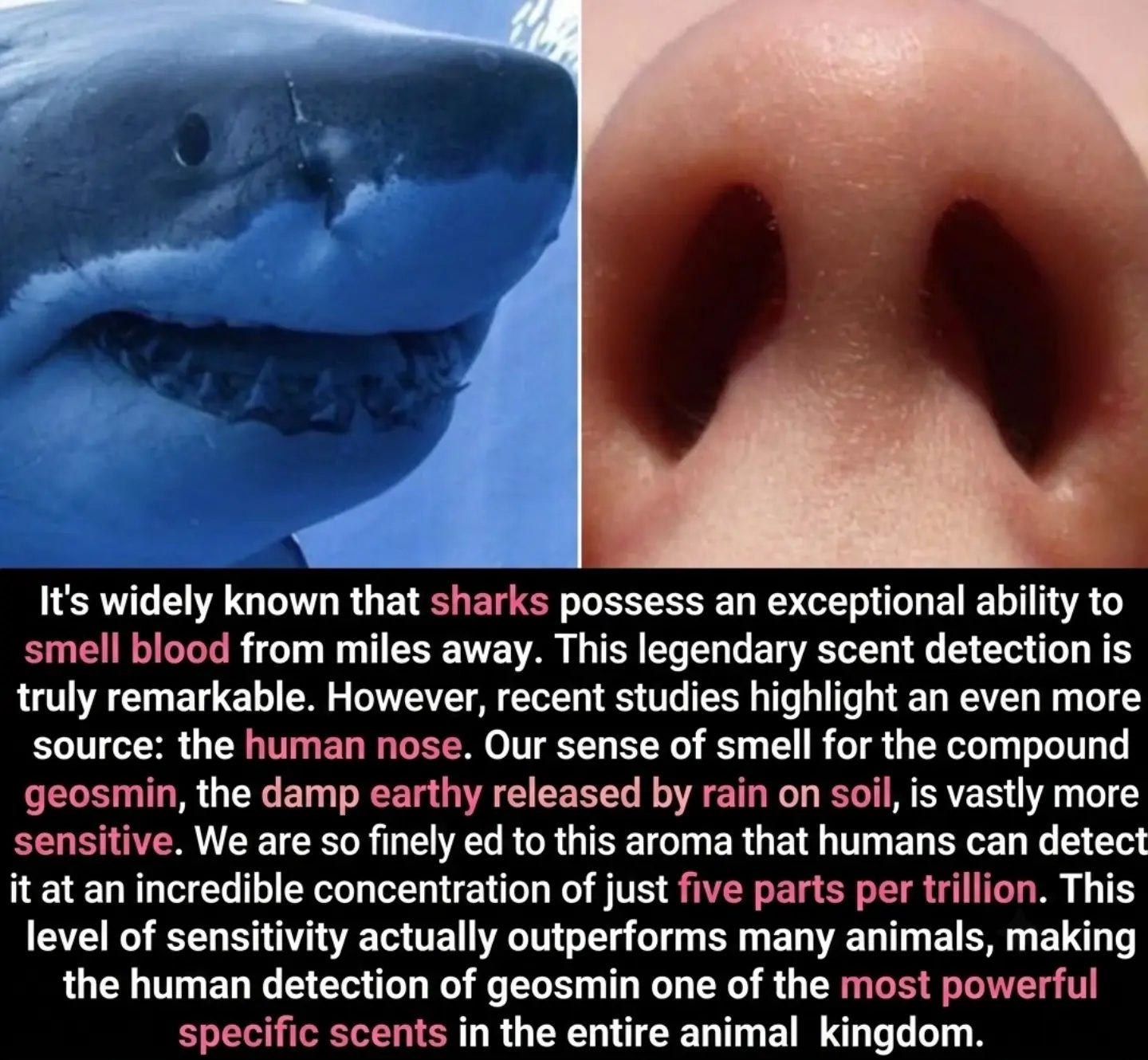
The Incredible Sense of Smell in Sharks and Humans
The sense of smell is a powerful tool in the animal kingdom, and both sharks and humans exhibit remarkable olfactory abilities. Sharks are renowned for their extraordinary ability to detect blood from incredible distances. At the same time, humans possess an equally impressive sense of smell, particularly when it comes to detecting geosmin, the compound responsible for the earthy scent of rain.
Context / Why this matters
This olfactory prowess is more than just a fascinating fact; it has significant implications for both survival and scientific research. For sharks, the ability to detect blood over vast distances is crucial for hunting and survival. For humans, the sensitivity to geosmin has historical and evolutionary significance, providing clues about how our ancestors found freshwater and fertile land.
Main discussion
Sharks and Their Remarkable Sense of Smell
Sharks are widely known for their exceptional ability to smell blood from miles away. This legendary scent detection is a key to their hunting strategy. Sharks can detect minute traces of blood in water, allowing them to track prey efficiently. Their sensory organs, specifically the ampullae of Lorenzini, are incredibly sensitive to electrical fields, which enhance their ability to locate even the smallest amounts of blood in the water.
The remarkable scent detection of sharks is often cited as an example of their exceptional olfactory abilities. Sharks can detect blood from miles away, an evolutionary advantage that enables them to locate and hunt prey over extensive distances. This sense of smell is not just remarkable; it is a crucial survival mechanism in the ocean environment.
Human Sensitivity to Geosmin
While sharks' sense of smell is legendary, recent studies highlight an even more remarkable source: the human nose. Humans have a heightened sensitivity to geosmin, the organic compound responsible for the earthy scent of rain. Geosmin is produced by certain bacteria and fungi in the soil, and when it rains, the scent is released into the air, creating the iconic aroma known as petrichor.
Our sense of smell for geosmin is vastly more sensitive. Humans can detect geosmin at an incredibly low concentration—just five parts per trillion. This means that humans can smell a single drop of geosmin diluted in hundreds of Olympic-sized pools. This sensitivity is one of the most powerful and specific scents in the animal kingdom.
Evolutionary Significance
The human detection of geosmin has significant evolutionary implications. Our ancestors likely relied on this hyper-tuned sense to track down freshwater and fertile land across vast distances. The ability to detect geosmin would have been crucial for survival, as it would have helped early humans locate water sources and fertile soil, which were essential for survival and agriculture.
Practical tips
Enhancing Your Sense of Smell
While humans have a natural sensitivity to geosmin, there are ways to enhance your sense of smell in general. Regular exercise, a balanced diet, and avoiding habits like smoking can improve your olfactory abilities. Additionally, practicing mindfulness and paying attention to your surroundings can help you notice and appreciate scents more acutely.
Mindful Smelling
Mindful smelling involves focusing on the scents around you and taking the time to identify and appreciate them. This can be as simple as taking a deep breath and noticing the scents in your environment. Whether it's the smell of rain, fresh flowers, or a home-cooked meal, mindful smelling can enhance your sensory experience and appreciation for the world around you.
Important takeaways
Understanding the sense of smell in both sharks and humans provides valuable insights into the natural world. Sharks' ability to detect blood from miles away is a testament to their exceptional olfactory abilities, which are essential for hunting and survival. Humans' sensitivity to geosmin highlights our own remarkable sense of smell and its evolutionary significance in finding freshwater and fertile land.
Conclusion
Both sharks and humans exhibit extraordinary olfactory abilities. For sharks, the ability to detect blood from vast distances is a key survival mechanism. For humans, the sensitivity to geosmin has historical and evolutionary significance. By understanding and appreciating these remarkable senses, we can gain a deeper appreciation for the natural world and our place in it. Next time it rains, take a deep breath and appreciate the power of your own sense of smell.
Questions readers ask
How far away can sharks detect blood in the water?
Sharks can detect blood from incredibly far distances, with some species capable of sensing just a few drops of blood in an Olympic-sized swimming pool. This extraordinary ability is a vital part of their survival strategy, allowing them to hunt effectively in their ocean habitat.
What is geosmin, and why can humans detect it so easily?
Geosmin is a compound produced by certain bacteria and fungi, responsible for the earthy scent often associated with rain. Humans have a remarkable sensitivity to geosmin, able to detect it in concentrations as low as 5 parts per trillion. This sensitivity is likely due to our evolutionary history and the importance of detecting water sources.
How does a sharks sense of smell aid in its survival?
A shark's sense of smell is one of its primary hunting tools. By detecting blood and other chemical traces from long distances, sharks can locate prey that might otherwise remain hidden. This keen olfactory sense is crucial for their survival and efficient hunting.
What is petrichor, and how is it related to geosmin?
Petrichor is the distinct earthy scent that often accompanies rain, particularly after a dry spell. Geosmin is one of the primary compounds responsible for this scent. When rain hits dry soil, it releases geosmin into the air, creating the familiar and comforting smell of petrichor.
Why are sharks so effective at detecting blood over great distances?
Sharks have specialized olfactory receptors and a unique nasal structure that allows them to detect even minute traces of blood. Additionally, water currents help carry these chemical signals over long distances, enhancing the shark's ability to track down potential meals.
What role does human sensitivity to geosmin play in our daily lives?
Human sensitivity to geosmin is not just a curiosity; it plays a role in how we perceive our environment. The detection of geosmin can signal the presence of water, which has been crucial for our ancestors. Today, it contributes to our enjoyment of natural scents and can even influence our mood and well-being.
How does the human sense of smell compare to a shark's?
While both humans and sharks possess remarkable olfactory abilities, they serve different purposes. Sharks rely heavily on their sense of smell for hunting and survival, detecting chemicals over vast distances. Humans, on the other hand, have a heightened sensitivity to certain compounds like geosmin, which has played a significant role in our historical and evolutionary journey.
Related deep dives
Similar reads based on topic and creator.


Recent articles
Fresh deep dives from the latest Reels we unpacked.




Comments
Be the first to comment.