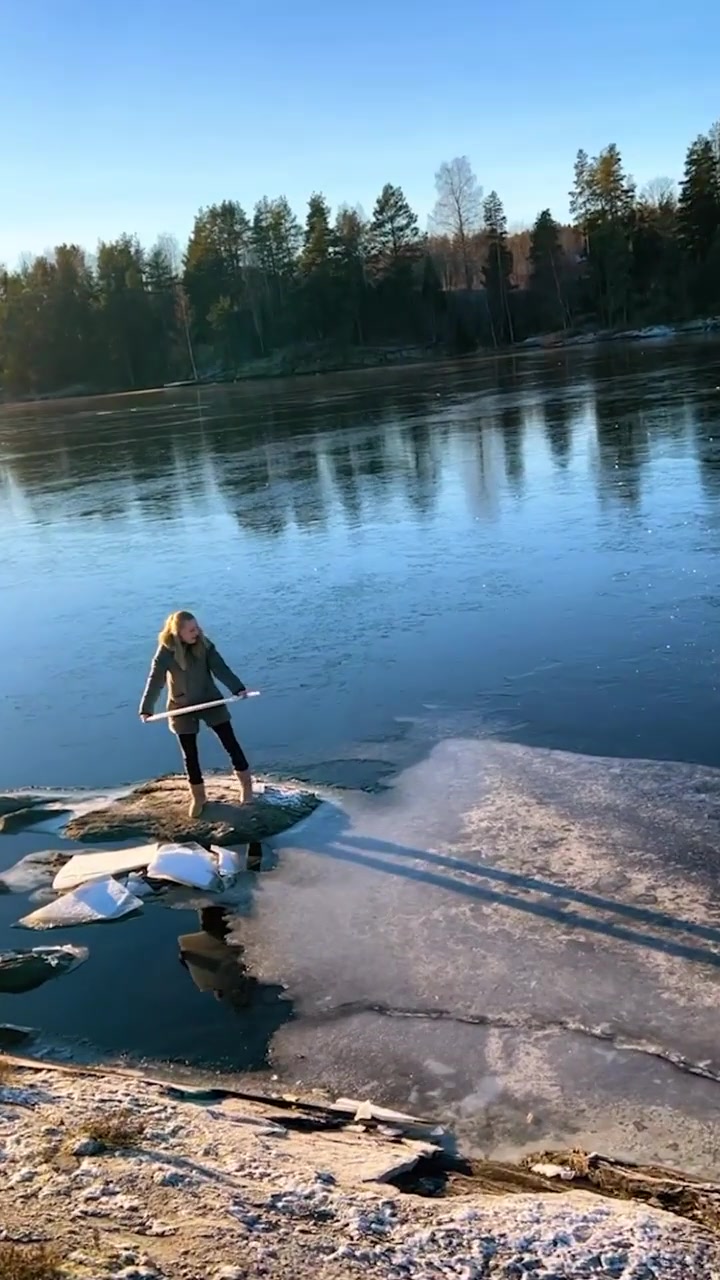
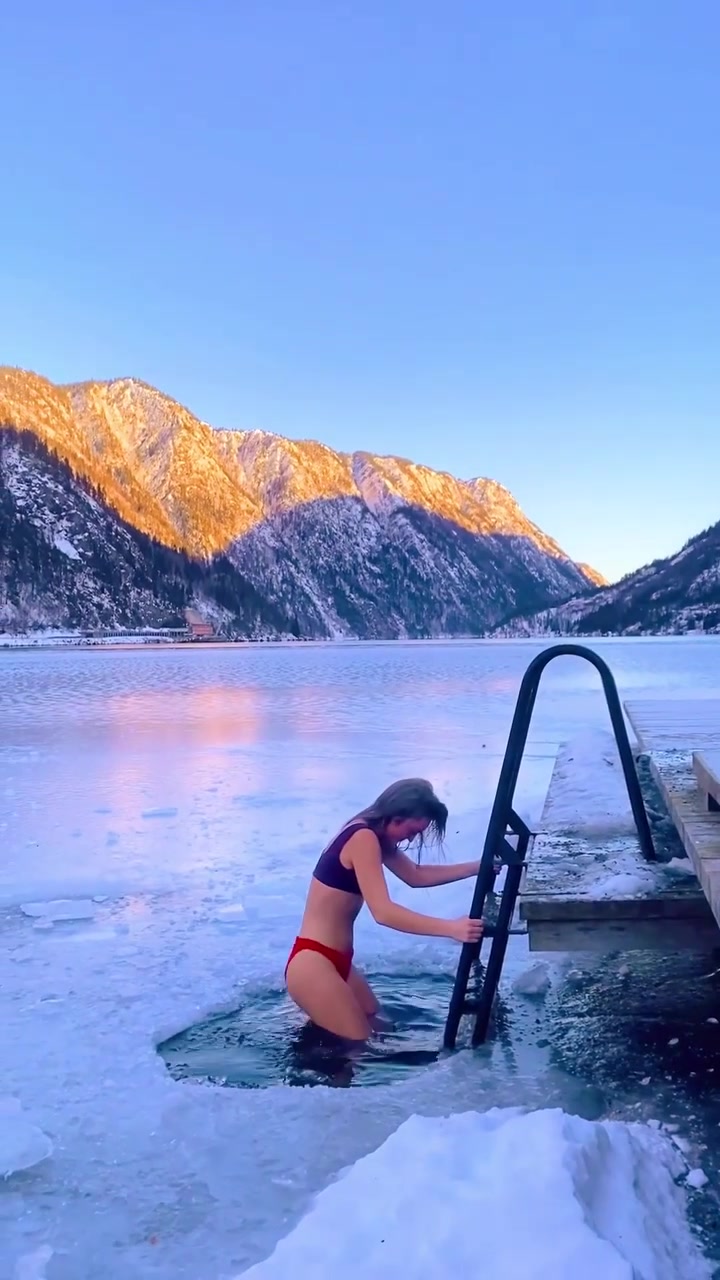
Ice breaks on the partially frozen lake around @nichlasbotten with a satisfying crunch. The view is completely immersive. The scene is a beautiful winter morning in Lennartsfors, a small forest-encircled hamlet in west-central Sweden. This is a serene yet moving visual that caught many on Instagram. On the surface, it’s a short of a single man and the lake. But it is also a sensorial record of something few urbanites ever see.
Winter’s delicate dance on ice
Nature is the only producer of a frozen lake, appearance of unique and delicate patterns of ice. Lakes freeze in winter at or around 32°F/0°C when water molecules begin to crystallize and form a solid. Water contracts when it freezes and forms the distinctive hexagonal patterns of ice crystals. Frozen lakes display these delicate and ephemeral patterns in response to temperature changes, winds, snowfall, and other weather variables. The resulting patterns range from a smooth ice surface to intricate flaws and cracks. The lake in this video is covered in a thin layer of ice, but the breaking ice is still happening. This suggests the lake is either in the early stages of freezing or thawing. As the person’s weight shifts from one foot to the other, the ice above the water begins to break. Ice breaking creates a sound of snapping, cracking, and splashing sounds. These sounds are what the caption describes as “satisfying”. The ice on the lake in Lennartsfors doesn’t break all at once. Instead, it cracks with small fractures that gradually expand. This process is slow and staccato, the ice often making a little thumping sound as cracks form and splinters shift. Ice deformation happens when the force exerted surpasses the strength of the ice. Normally the snow and the chemicals within the water create layers of ice that have varying levels of hardness. These layers, plus the weight of the person, makes the surface more brittle. The ice breaks in sheets but the central conclusion is that the person was safe and sound and didn't fall into the lake. Snow and ice transform a lake’s surface, changing water into a reflective surface that mirrors its surroundings. It can make the sky, trees, and other objects appear as if they’re floating above the water. This effect is most pronounced in deep waters, where the lake’s bottom is barely visible, and the sky and other objects dominate. And this is the image that the clip of lakes in winter evokes.
Lennartsfors, Sweden on Instagram
The video was taken in Lennartsfors, Sweden which is a small hamlet in the west-central of the country. The video’s caption notes the exact geographic coordinates of the place, and the video itself displays the distant forest and pine trees, the blue sky behind it, and the lake front. This one small section of Sweden is full of lakes, streams, and forests. There are 26 lakes in Varmlands lan alone. The dominant visual of the video is a small lake, with cold blue water. It evokes that very particular end of autumn or early winter crispness with the trees there. The day itself is sweet and sunny, with a clear blue sky in the background. The captions on the video describe the video as a “satisfying Reel”. This description is intriguing and sets the tone for the piece. The word “satisfying” describes something that is pleasing, often in a textural or auditory sense. This definition suits the purpose of the video — it serves as a representation of the sound of the ice cracking and the sight of the lake. To many, this is satisfying in a purely sensory fashion.
The winter mechanics of ice
A lake does not freeze all at once. The slow process is how this video unfolds. Some areas are frozen to the water, while some are entirely clear. The scene starts with a dark blue surface that transitions to partially frozen ice and then clear. The ice breaks on the lake with some force. This is because the ice itself is solid but brittle. The water underneath pulls the ice apart and the person walks over the ice. Ice on a lake is not homogenous either. As it turns out, the food for breaking ice on a lake is different layers and the formation of these are inherently unique. Various factors affect the ice. The wind, snow, and temperature all affect it. Snow for example traps air pockets between crystals, making the ice structure porous and reducing its strength. The bottom layer is the first to form and often the strongest. Ice that is formed from meltwater is generally not as strong as ice from clear water.
How frozen lakes resist and break
As a person walks on the ice layer, some areas break and others do not. This happens because the ice layer is never entirely uniform, as no two ice sheets exactly identical. Even small divergences in the thickness of ice or the structure of the ice can cause parts of the sheet to break while others hold fast. For example, a thin sheet of ice will quickly break and crack if even a small amount of force is applied. The ice on a lake usually starts forming around the edges and gradually spreads inward. This means that the ice on the lake’s edge is often thicker than the ice in the middle. And as the ice gets thicker, it also gets harder.
The natural soundscape of ice breaking
The ice itself has a role to play. As a person walks, the sound of the ice breaking is eloquent and clear. The ear catches this sound and the clip itself moves on to the next sound. The audio of the video has the sound intact and clear, which makes the sound of the ice breaking consistently gratifying. It captures the sounds in perfect harmony with the visual aesthetics of the frozen lake. The crunch of the ice underfoot provides a satisfying auditory sensation. The sound is a form of somatic pleasure, the ability to be aroused and stimulated. The ice in the video is also part of the somatosensory experience. Ice is brittle, so it can break easily. This is a key feature of the ice and the breaking. As the person walks, even the slight weight of a person is enough to cause the ice to break. The fact that it is not a complete sheet of ice but rather a thin covering means it can break. And this is why gentle movements and light footfalls are crucial.
Tips for walking on frozen lakes
When a lake is partially frozen, it is a good idea to be cautious. Check the thickness of the ice. If it is less than 4 inches thick, stay away. Watch the edge of the lake and be careful not to walk on thin ice. Wearing a life jacket or flotation device when walking on a lake is also a good idea. And always having someone with you in case of an accident is essential.
- Beware of migrating ice: Ice sheets can move because of winds or currents, so be cautious around the edges. Avoid the center of the lake where the ice is thin.
- Be aware of the conditions: The ice might melt away during the day, so keep an eye on the weather. If the temperature is warmer, or if a warm front is approaching, consider leaving the ice alone. Ice is inherently beautiful in its simplicity and unpredictability. But there is also an immense danger to walking on ice. Whether it’s from the temperature inside the ice or from outside elements in the ice, there’s always a chance of it breaking. And this is a stark reminder that ice is a delicate balance between frozen and solid.
Questions readers ask
What causes the unique patterns on the surface of a frozen lake?
The unique patterns on a frozen lake are formed due to temperature changes, winds, and snowfall. When water freezes, it contracts and forms hexagonal ice crystals, which create these intricate and delicate patterns. The layers of ice, along with the weight of the person, can also make the surface more brittle, leading to the breaking of ice.
How does the ice on a lake break?
Ice on a lake breaks when the force exerted, such as the weight of a person, surpasses the strength of the ice. The ice doesn't break all at once; instead, it cracks with small fractures that gradually expand, often making a thumping sound as cracks form and splinters shift. The process is slow and staccato.
Why does the ice make a satisfying sound when it breaks?
The satisfying sound of ice breaking comes from the snapping, cracking, and splashing sounds created as the ice fractures and shifts. This sound is often described as satisfying due to its unique and rhythmic nature, which is particularly captivating in a peaceful winter setting.
What makes the lake in Lennartsfors, Sweden, a unique place to capture winter scenes?
Lennartsfors is surrounded by a vast number of lakes, streams, and forests, with 26 lakes in Varmlands lan alone. This small hamlet offers a serene and picturesque setting with its cold blue water, pine trees, and crisp end-of-autumn or early-winter atmosphere, making it an ideal place to capture unique winter scenes.
Can you safely walk on a thin layer of ice like the one in the video?
Walking on a thin layer of ice can be risky. The video shows a person safely navigating the ice, but this is not always the case. The ice's strength depends on its thickness and the weight it bears. It’s advisable to avoid walking on thin ice to prevent accidents, especially when the ice is in the early stages of freezing or thawing.
What makes the view of a frozen lake so immersive?
The view of a frozen lake is immersive due to the reflective surface created by the ice and snow, which mirrors the surroundings, making the sky, trees, and other objects appear as if they’re floating above the water. This effect is most pronounced in deep waters, where the lake’s bottom is barely visible, enhancing the serene and captivating atmosphere.
Do all lakes in Sweden have the same ice patterns?
The ice patterns on lakes in Sweden can vary greatly due to differences in weather conditions, water chemistry, and the lake's specific environment. While some lakes may exhibit smooth, uniform ice surfaces, others may display intricate cracks and fractures. The unique patterns seen in the video are a result of the specific conditions in Lennartsfors during the early winter season.
Related deep dives
Similar reads based on topic and creator.

Recent articles
Fresh deep dives from the latest Reels we unpacked.
Comments
Be the first to comment.