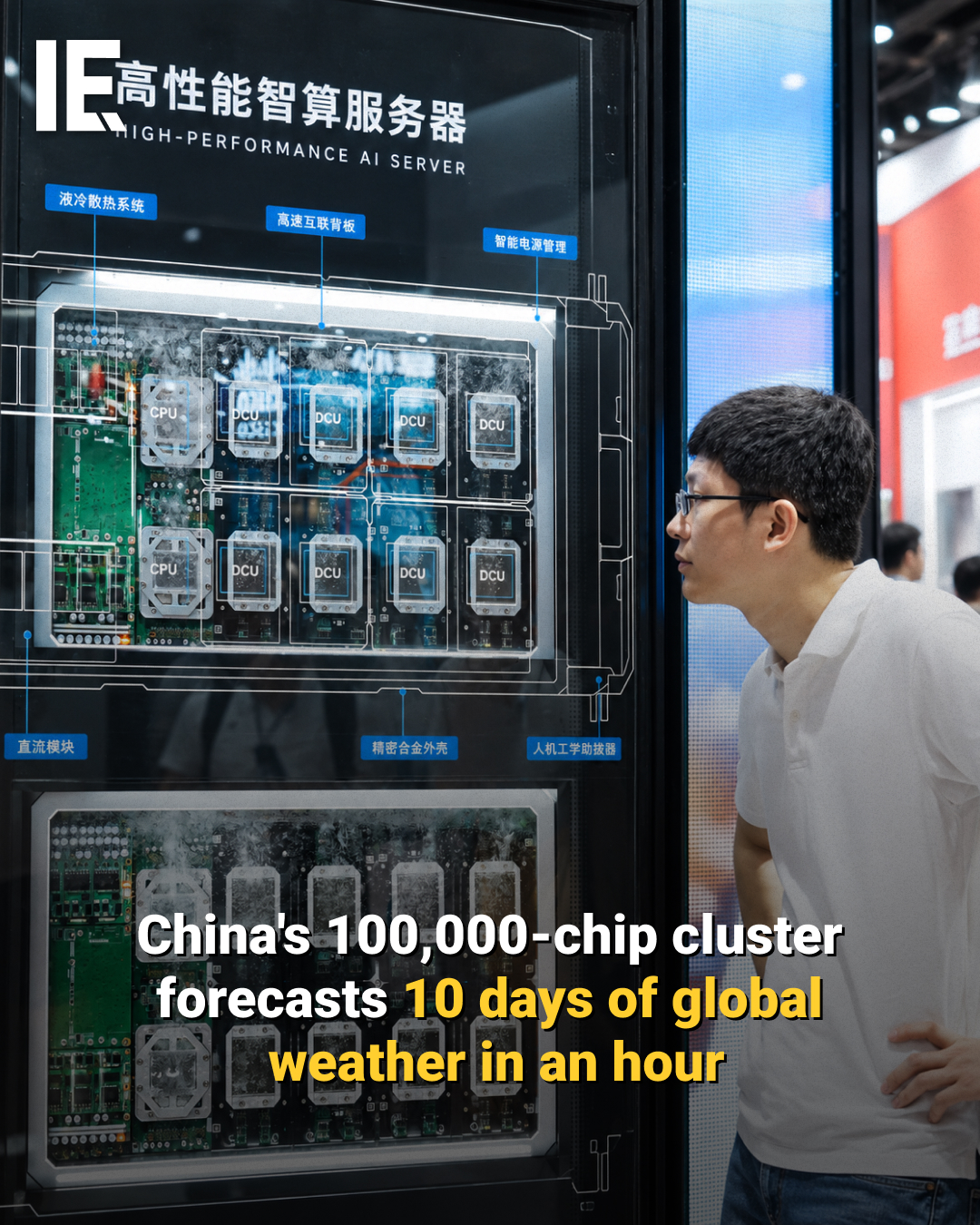
China’s 100,000-chip cluster is a cutting-edge feat of engineering: a supercomputer capable of forecasting 10 days of global weather in just one hour. The server rack showcases the AI server’s power. Its fusion of CPUs (central processing units) and DCUs (data computing units) sends a clear message of its computational potential.
The Beast Behind the Forecast
The high-performance AI server display is a window into the future of computational power. This beast sports over one hundred thousand chips, all working in concert to deliver unmatched processing capabilities. Its rows of circuit boards are adorned with CPUs and data computing units. Together, these components allow for a seamless execution of complex tasks – reserving 10,000 plus circuits for artificial intelligence (AI) alone. The AI server’s architecture stands out for its flexibility and efficiency. CPUs handle general-purpose tasks, while DCUs take on data-intensive jobs. This specialisation enables the system to manage vast amounts of data at lightning speed. The server's unique setup amplifies its processing capabilities, allowing it to solve complex queries and model intricate systems like our global climate. The server's of chips is a testament to its power and precision. The AI server is designed for efficiency, integrating these chips in a way that maximizes performance and minimizes energy consumption. Its compact design allows for easy integration into existing infrastructures, making it a versatile tool for various applications.
Weathermapping the world
In a world grappling with climate change, high-performance servers are more essential than ever. Accurate weather forecasting can save lives and livelihoods, and these servers are at the heart of it all. By processing vast amounts of data, they predict weather patterns with exceptional accuracy. It allows authorities to issue early warnings and make informed decisions. The server’s capacity to forecast 10 days of global weather in one hour is a game-changer. It’s not just about predicting the weather; it’s about understanding the complex interplay of factors that drive our climate. This level of precision enables scientists and policymakers to better grasp the impact of climate change and develop strategies to mitigate its effects. This kind of computational power is crucial for advancements in other fields, such as medical research and space exploration. Industries ranging from agriculture to finance rely on accurate forecasting to make strategic decisions and optimize operations.
The Intelligence Of The AI
The AI server’s hardware components represent a symphony of computational power. The CPUs, the brains of the operation, execute instructions and perform calculations. The DCUs, on the other hand, are specialized. They crunch through large datasets and extract meaningful insights. This division of labor is key to the server’s efficiency and speed. The cluster’s design is a masterclass in parallel processing. Each chip can work independently, allowing the system to perform multiple tasks simultaneously. The AI leverages this architecture to enhance performance and reduce latency. The DCUs, in particular, excel at handling AI workloads. They enable the system to process large datasets and train complex models efficiently.
Balancing act
The server’s architecture is a terrific demonstration of how different components collaborate efficiently. The integration of CPUs and DCUs allows the system to handle a wide range of tasks, from general-purpose computing to data-intensive operations. The chips work in tandem, enabling the server to perform complex computations with precision and speed. Despite its power, the server is not immune to challenges. Balancing the workload between CPUs and DCUs is crucial for optimal performance. If the distribution of tasks is inefficient, the system’s performance can suffer. Similarly, managing the heat generated by the chips and circuit boards is essential for maintaining the server’s longevity. The power of the AI server is in the specific chip and hardware configurations, and slight missteps can impact the outcomes.
Making it work for you
Harnessing the power of high-performance AI servers requires a nuanced approach. Below are some tips for integrating and effectively utilizing these powerful tools.
- Assess your needs: Before investing in an AI server, assess your computational needs. Understand the type of data you’ll be working with and the tasks you’ll be performing. It’ll help you choose the right hardware configurations and plan your server’s architecture.
- Plan your infrastructure: Once you’ve identified your needs, plan your infrastructure. Decide on the number of chips, CPUs, and DCUs required. Consider the layout of your server rack and the arrangement of circuit boards. It’ll help ensure optimal performance and efficient use of resources.
- Optimize workload distribution: Efficient workload distribution is crucial for maximizing the server’s potential. Allocate tasks between CPUs and DCUs based on their capabilities. Utilize the DCUs for data-intensive tasks, while CPUs handle general-purpose computing.
- Monitor and maintain: Regular monitoring and maintenance are essential for keeping the server in top condition. Monitor the system’s performance, heat generation, and energy consumption. Ensure that the server’s cooling systems are functioning optimally and that the circuit boards are free of dust and debris.
Invisible Architect
The high-performance AI server’s impact goes beyond weather forecasting. It’s a testament to the power of technology and its potential to transform our world. By pushing the boundaries of what’s possible, it opens up new avenues for exploration and innovation. As we continue to develop and refine these systems, they’ll play an increasingly vital role in shaping our future.
Questions readers ask
How does China's 100,000-chip cluster achieve such rapid weather forecasting?
The cluster uses a combination of CPUs for general tasks and DCUs for data-intensive jobs. This specialisation allows it to process vast amounts of data quickly, enabling it to forecast 10 days of global weather in just one hour.
What makes the architecture of this AI server unique?
The architecture is unique because it integrates over 100,000 chips, including CPUs and DCUs, in a way that maximizes performance and minimizes energy consumption. This setup allows for efficient handling of complex tasks and vast datasets, making it highly versatile for various applications.
Can this AI server be used for applications beyond weather forecasting?
Absolutely. The AI server's high-performance capabilities make it suitable for a wide range of applications, including medical research, space exploration, agriculture, and finance. Its ability to process complex data and model intricate systems makes it a valuable tool in many fields.
How does the AI server's design contribute to its efficiency and speed?
The server's design emphasizes parallel processing, where each chip can work independently. This allows the system to perform multiple tasks simultaneously, enhancing performance and reducing latency. The division of labor between CPUs and DCUs further optimizes its efficiency.
Is this AI server available for use outside of China?
The article doesn't specify the availability of the AI server outside of China. However, it does mention that the server's compact design allows for easy integration into existing infrastructures, suggesting it could be adapted for use in other countries with the right partnerships and agreements.
What role do the DCUs play in the AI server's operations?
DCUs, or data computing units, are specialized for handling large datasets and extracting meaningful insights. They work alongside CPUs, which handle general-purpose tasks, to ensure the server can process complex queries and model intricate systems efficiently.
Related deep dives
Similar reads based on topic and creator.




Recent articles
Fresh deep dives from the latest Reels we unpacked.




Comments
Be the first to comment.