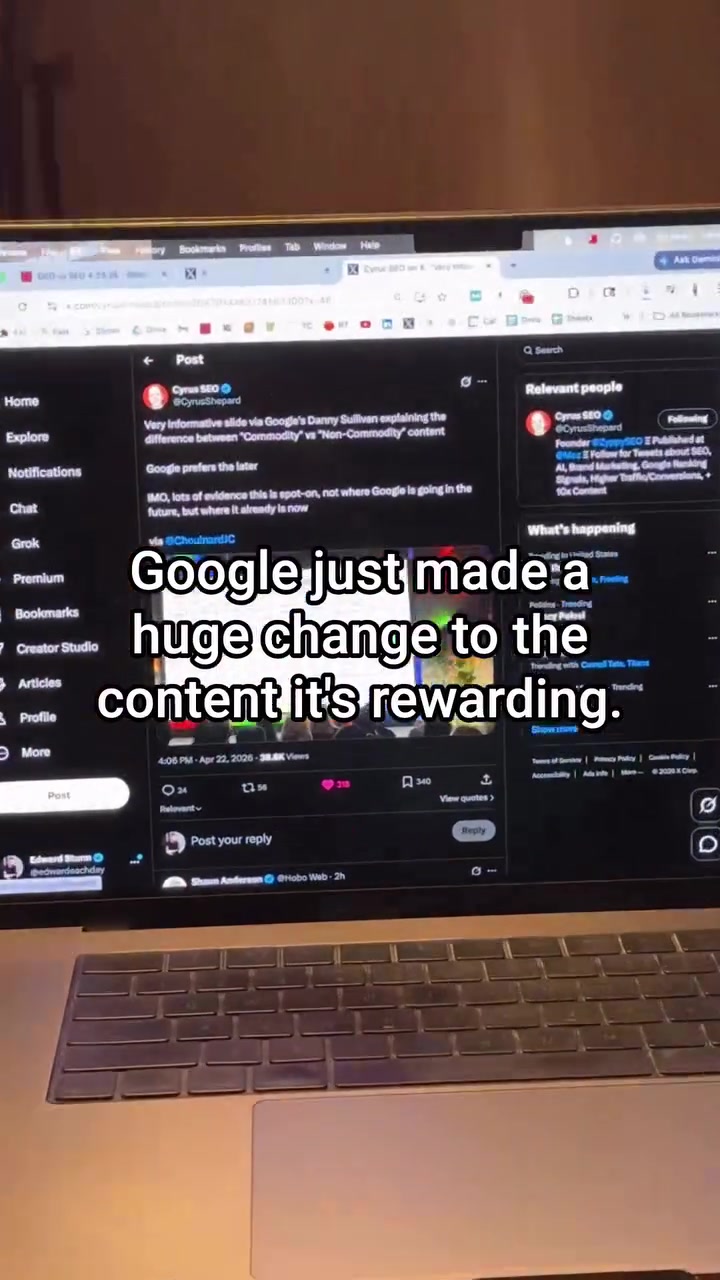
Google’s search engine has prioritized different types of content over time. Until recently, the search engine tended to reward titles like "Top 10 Things to Consider When Buying Running Shoes" or "Seven Tips for First-Time Home Buyers". But that’s changed. Today, Google is honoring content that explores specific customer problems in depth. Google has updated what it rewards. The search engine now places greater prominence on detailed, problem-solving content. The shift is evident when viewing search results. If someone searches for information about shoes, Google may push to the top a deep dive on why a particular customer's shoes collapsed after 400 miles. Or, it might reward an examination of what happens when marble soaks up grape juice and how that might affect a home construction. Google’s recent changes are logical. It now favors content that tackles real customer queries. Because of this, marketers can no longer rely on generic top-10 lists. They must focus on content that answers specific questions. Google's change matters for anyone who relies on the search engine to drive traffic. For instance, someone who writes about dog supplies. Instead of topics like "Top 10 Dog Toys for Pit Bulls," someone with this niche should create content that asks: "This $12 Dog Toy Survived Three Pit Bulls for Six months - Here’s What Finally Broke It." The more specific the question, the more likely Google will reward the content. Beyond shifting niche content, the change also affects how businesses use keywords. In this example, "compactkeywords.com" offers a course to help businesses find the right keywords. It teaches how to find terms that answer customer questions thoroughly. This will continue industry-wide, as businesses adapt to create Google-optimized content. But it doesn't stop at content-type shifts.
The Rise of the Unlikely SEO Star
The changes affect more than just blogs. More people are asking SEO to perform tasks that were unthinkable a few years ago. For example, a homeowner asks: "Why did my sewer line fail the inspection?" The best answer, in this case, isn't a 500-word article. The answer is better suited as a 30-second instructional video. Google recognizes that, so it rewards this type of content. Where a blog might have once served, a video might better address the audience’s need. This approach isn’t limited to home repairs. The same idea applies to a wide range of services. Videos are emerging as the new SEO superstars. What's more, videos are not the only content type gaining more Google visibility. Quora-style answers, too, are being rewarded. For example, a person needing to know "Why I refuse to install stone for a family of five": The answer could be a direct, concise Quora response. It could also be a detailed Reddit thread or a series of tweets. Doing so means understanding user pain points, and delivering specific, targeted responses. This tailoring is not only for large companies. Small businesses can benefit from it, too. The right tool will help.
Shifting Funnel Sense
SEO has changed how consumers interact with content. Google’s new reward system is only one part of the story. The funnel is also relevant. At the top, marketers cater to broad needs. For example, a consumer looking for a family-friendly pet needs a top-of-funnel piece exploring dog breeds. Or, a family of six shopping for a new home. For bottom-of-funnel marketing, products and services themselves are on full display. Marketers can't cater to broad needs here. Instead, they focus on nitty-gritty details. Look at a piece about why a stone floor installation is a bad idea for a large family. This bottom-of-funnel content is more direct. It will contain specifics that consumers can use, like how much granite can withstand grape juice, or how many times the average sewer line needs maintenance. SEO is changing, and businesses will benefit. Understanding the right funnel content will reap the benefits.
Making the Niche Relevant
Google's recent changes affect how niche sites present information. Consider a niche site that might discuss dog supplies. It might discuss how to keep a dog safe in the backyard. Or, what toys they should play with. But now, results favor content that gives the exact number of toys needed. This approach is best suited for e-commerce sites. Companies can likewise increase their product sales by adopting this method. Incorporating answers to specific customer questions will do this. For example, "What will break this toy, and how long will it last?" Adding this detail to product descriptions will attract audiences on Google.
Keyword Compaction
Google's new SEO approach means changing how online content fits together. The first step is creating the content. This content must be detailed and specific. For example, content must answer why a dog toy broke, and why it needed repairing. The next step takes place when the content is published. Using keywords at the right density will help the site rank. Tools like compactkeywords.com can help with this process. The tool helps find the exact keywords needed. Then, it places them at the right density. There is no need to manually research keyword difficulty. The tool can do this step. This approach is not only for niches like dog toys. It applies to a wide range of businesses. From travel guides to medical journals, the right tool can simplify keyword placement. Not only does it simplify this process, but it also helps content rank higher on Google.
From Walmart to Artisan, Search Strategies You Can Steal
Experts predict big businesses will adapt quickly. Small businesses can learn from this. They can observe how big companies present their products. They can then adopt this practice, too. For instance, a large retailer could create a video about why a particular vacuum breaks down. A smaller business can also create similar content. For instance, imagine a local business selling artisan coffee. It might create a video showing how a particular coffee blend is roasted. This approach isn’t limited to videos. Blogs can work, too. For instance, a local pastry shop can write an in-depth blog about how to bake the perfect croissant. The principle applies across industries. Businesses can use this approach to improve their ranking on Google.
The Search Guide to Competitor Content
Content needs to be more specific. Not only does Google reward more detailed content, but it also asks to publish long-form content. This content should be thorough. More importantly, it should be specific. For example, a blog about home remodeling needs to cover all the nitty-gritty details. The details should answer all customer questions. For instance, "Why did my marble soffit crack?" Or "Why did the sewer line break?" Specific questions will prove helpful. In-depth content can help businesses with greater domain expertise. If a company has established itself as an expert in a field, it can capitalize on this. The content can focus on deep dives. These dives might include analysis, tutorials, or comparisons. However, specific content is not limited to large businesses. Even small businesses can leverage this approach. A small business can show how a product works. They can also create a tutorial on how to maintain it. This will answer all customer questions in detail.
Google's New Content Strategy
Google’s new algorithm is a double-edged sword for marketers. While more detailed content is rewarding, it also demands more effort. Businesses will need to invest in creating high-quality and thorough content. They need content that answers specific customer queries. The end goal is to establish themselves as a thought leader in their niche. This content must be long. Google favors content that includes specifics. It also rewards content that includes references, studies, and detailed analyses. Simply creating content with an interesting title is not enough. Marketers must identify specific customer questions. They must then provide detailed answers to these questions. Writing longer content may sound daunting. It doesn’t have to be. There are tools that can help with this. For example, tools that help find the right keywords. There are also tools that help create detailed content. Tools like compactkeywords.com offer courses that teach how to find the right keywords. Then, it shows how to incorporate them into content.
The Future is Specific
Google’s search engine ranking algorithm changes. The result means the future of SEO is uncertain. Businesses need to adapt to the change. The shift demands that content be more specific. Google now rewards content that answers specific customer questions. This means businesses must invest in creating high-quality content. That content must be detailed and specific. It should also include references, studies, and detailed analyses. Doing so will help businesses be more competitive. This is not just true for large companies. It applies to small businesses, too. The future of SEO is specific.
Questions readers ask
How does Google's new content reward system work?
Google's new system prioritizes content that addresses specific, real-world problems rather than generic lists. For example, instead of a general article on running shoes, Google might favor a detailed piece on why a particular shoe model failed after a certain amount of mileage or a video of a home repair. The focus is on providing the most relevant and helpful information to users.
How can businesses adapt to Google’s new content rewards?
Businesses need to shift from creating generic content to producing detailed, problem-solving pieces. For example, instead of a list of top dog toys, a content creator might write about the durability of a specific toy model. This means identifying specific customer queries and crafting content that thoroughly answers these questions.
What types of content are now being rewarded by Google?
Google is now rewarding a variety of content types, including detailed blog posts, videos, and even Quora-style answers. The key is that the content addresses specific user pain points and provides targeted, helpful information.
How does this change affect keyword usage in SEO?
The shift means businesses need to focus on keywords that answer specific customer questions rather than just attracting traffic. Tools like compactkeywords.com can help businesses find and use these keywords effectively, ensuring their content is both relevant and optimized for search engines.
Why are videos becoming more important in SEO?
Videos are emerging as a favored content type because they can often provide more immediate and practical solutions to specific problems. For example, a 30-second instructional video might be more helpful than a lengthy blog post for a homeowner trying to fix a sewer line. Google recognizes this and rewards such content.
How can small businesses benefit from Google’s new content reward system?
Small businesses can create targeted, specific content that addresses the unique needs of their customers. By focusing on detailed, problem-solving content and using the right tools, small businesses can compete effectively and reach their audience more effectively.
What role do Quora and Reddit play in this new SEO landscape?
Quora and Reddit are gaining prominence as platforms where concise, direct answers to specific questions can be effectively rewarded. These platforms allow for targeted, community-driven responses that can provide immediate value to users, making them a valuable part of a well-rounded SEO strategy.
Related deep dives
Similar reads based on topic and creator.




Recent articles
Fresh deep dives from the latest Reels we unpacked.


Comments
Be the first to comment.