Strange Tadpole Discovery
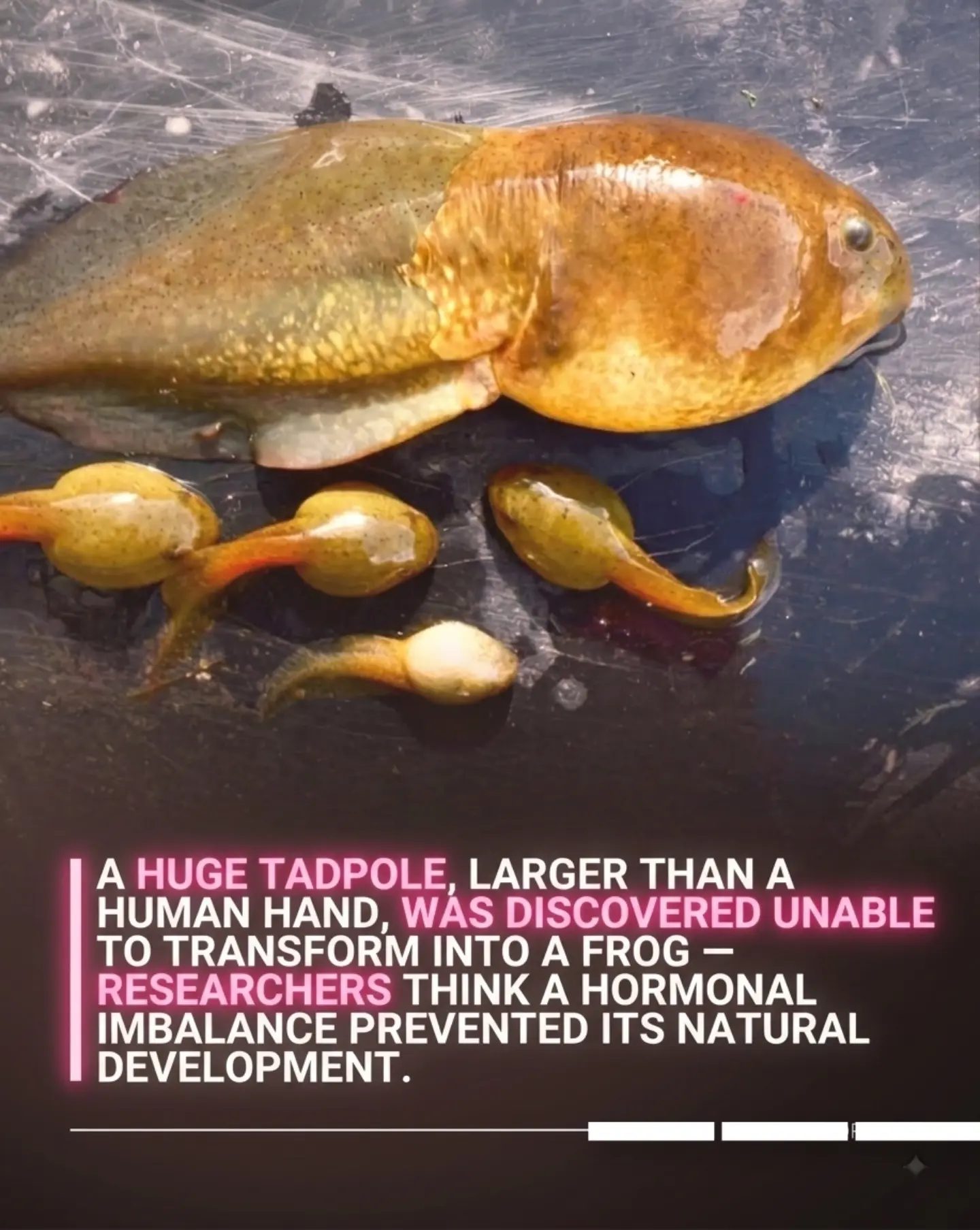
A colossal tadpole, one of the largest ever documented, has been discovered in Arizona. Known as Goliath, this American Bullfrog tadpole is notably larger than a human hand. Unlike typical tadpoles that swiftly transition into frogs, Goliath has remained in its tadpole form, continuing to grow larger. Researchers have identified a rare hormonal imbalance, specifically involving the thyroid, as the cause of this unique condition. This imbalance has prevented Goliath from undergoing metamorphosis, the process through which tadpoles normally develop legs and shed their tails.
Context: Why This Matters
The discovery of Goliath is a fascinating anomaly in the world of biology. It offers a rare glimpse into the intricate processes of amphibian development and the critical role of hormones in metamorphosis. Understanding such anomalies can provide valuable insights into the broader study of biology, ecology, and even human health. Hormonal imbalances, after all, are not confined to the animal kingdom and can have profound effects on human development and well-being.
Main Discussion
The Discovery and Growth of Goliath
Field researchers in Arizona made an astonishing discovery when they encountered Goliath, a tadpole that had grown to a size larger than a human hand. This finding is significant because it defies the typical developmental trajectory of tadpoles. Normally, tadpoles undergo a metamorphosis process where they develop limbs and lose their tails, transforming into adult frogs. However, Goliath has remained in its tadpole form, continuing to grow larger and larger.
Hormonal Imbalance and Metamorphosis
Researchers have pinpointed a hormonal imbalance, specifically involving the thyroid, as the reason behind Goliath's unusual development. The thyroid gland plays a crucial role in regulating metabolism and growth, and any disruption in its function can have dramatic effects. In Goliath's case, the imbalance has prevented the necessary hormonal signals from triggering metamorphosis. This lack of metamorphosis has allowed Goliath to grow exceptionally large, presenting a unique opportunity for scientists to study the underlying mechanisms of amphibian development.
The Significance of Goliath's Condition
Goliath's condition is not just a curiosity; it has significant implications for the study of biology and ecology. By understanding the hormonal mechanisms that regulate metamorphosis, researchers can gain insights into similar processes in other organisms, including humans. Hormonal imbalances are a common issue in human health, and studying Goliath's condition could provide new perspectives on how to address these issues.
Comparing Goliath to Typical Tadpole Development
To appreciate the uniqueness of Goliath, it's helpful to compare his development to that of typical tadpoles. In a normal scenario, tadpoles are small and aquatic, feeding on algae and other microscopic organisms. As they grow, they develop hind legs first, followed by front legs. Their tails gradually shrink and are absorbed into the body, while their lungs develop, allowing them to transition to a terrestrial lifestyle. This process is driven by a complex interplay of hormones, with the thyroid playing a critical role. Goliath's failure to undergo this transformation highlights the importance of hormonal balance in development.
Practical Tips for Understanding Amphibian Development
For those interested in biology and ecology, studying amphibian development can be both fascinating and informative. Here are some practical tips for enhancing your understanding:
-
Observe Local Amphibians: If you live in an area with a variety of amphibians, observing their life cycles can provide firsthand insights into metamorphosis.
-
Read Scientific Literature: There are numerous resources available that delve into the details of amphibian development, including journal articles, books, and online courses.
-
Conduct Small Experiments: If you have access to a controlled environment, you can conduct experiments to observe the effects of different factors on amphibian development. Always ensure that any experiments are ethical and comply with local regulations.
-
Engage with Experts: Reach out to local biologists, ecologists, or herpetologists who can provide guidance and answer questions about amphibian development.
Important Takeaways
The discovery of Goliath, the giant American Bullfrog tadpole, offers a unique opportunity to study the intricate processes of amphibian development. Key takeaways from this discovery include:
- Hormonal imbalances can have profound effects on development.
- The thyroid gland plays a critical role in regulating metamorphosis.
- Studying such anomalies can provide valuable insights into broader biological and ecological processes.
Understanding the development of amphibians like Goliath can enhance our knowledge of similar processes in other organisms, including humans. This knowledge can be applied to address issues related to hormonal imbalances and developmental disorders.
Conclusion
The discovery of Goliath, a giant American Bullfrog tadpole, is a remarkable example of the unexpected and awe-inspiring glitches that nature can produce. Goliath's unique condition offers a fascinating glimpse into the complex world of amphibian development and the critical role of hormones in metamorphosis. By studying such anomalies, scientists can gain valuable insights that could have broader implications for biology, ecology, and human health. Whether you are a biologist, an ecologist, or simply someone with a curiosity about the natural world, the story of Goliath is a testament to the endless wonders that nature has to offer.
Questions readers ask
Why is the Goliath tadpole so much larger than typical tadpoles?
Goliath is significantly larger than typical tadpoles due to a rare hormonal imbalance, particularly involving the thyroid. This imbalance has prevented Goliath from undergoing metamorphosis, allowing it to continue growing at an unprecedented size.
What is the significance of Goliath's failure to metamorphose?
Goliath's failure to metamorphose provides scientists with a unique opportunity to study the processes of amphibian development and hormonal regulation. By examining Goliath, researchers can gain insights into the specific hormonal cues that trigger metamorphosis in tadpoles.
How does Goliath's size compare to other tadpoles?
Goliath is notably larger than a human hand, making it one of the largest tadpoles ever documented. This extraordinary size sets Goliath apart from typical tadpoles and has drawn significant attention from the scientific community.
What are the potential implications of studying Goliath?
Studying Goliath can offer valuable insights into the complex processes of amphibian development and hormonal regulation. By understanding the reasons behind Goliath's unique condition, scientists may uncover new information about the hormonal triggers that control metamorphosis in amphibians, potentially even in other species.
What is the thyroid's role in Goliath's condition?
The thyroid plays a crucial role in Goliath's condition. A hormonal imbalance involving the thyroid has prevented Goliath from undergoing metamorphosis, allowing it to grow to an unusually large size. Researchers are studying this imbalance to better understand the role of thyroid hormones in amphibian development.
Why is Goliath's discovery so unusual?
Goliath's discovery is unusual because it represents a rare and anomalous case in the world of biology. The tadpole's enormous size and failure to metamorphosize make it a fascinating subject for study, offering insights into the mechanisms that control the growth and metamorphosis of amphibians.
Related deep dives
Similar reads based on topic and creator.

Recent articles
Fresh deep dives from the latest Reels we unpacked.
Comments
Be the first to comment.