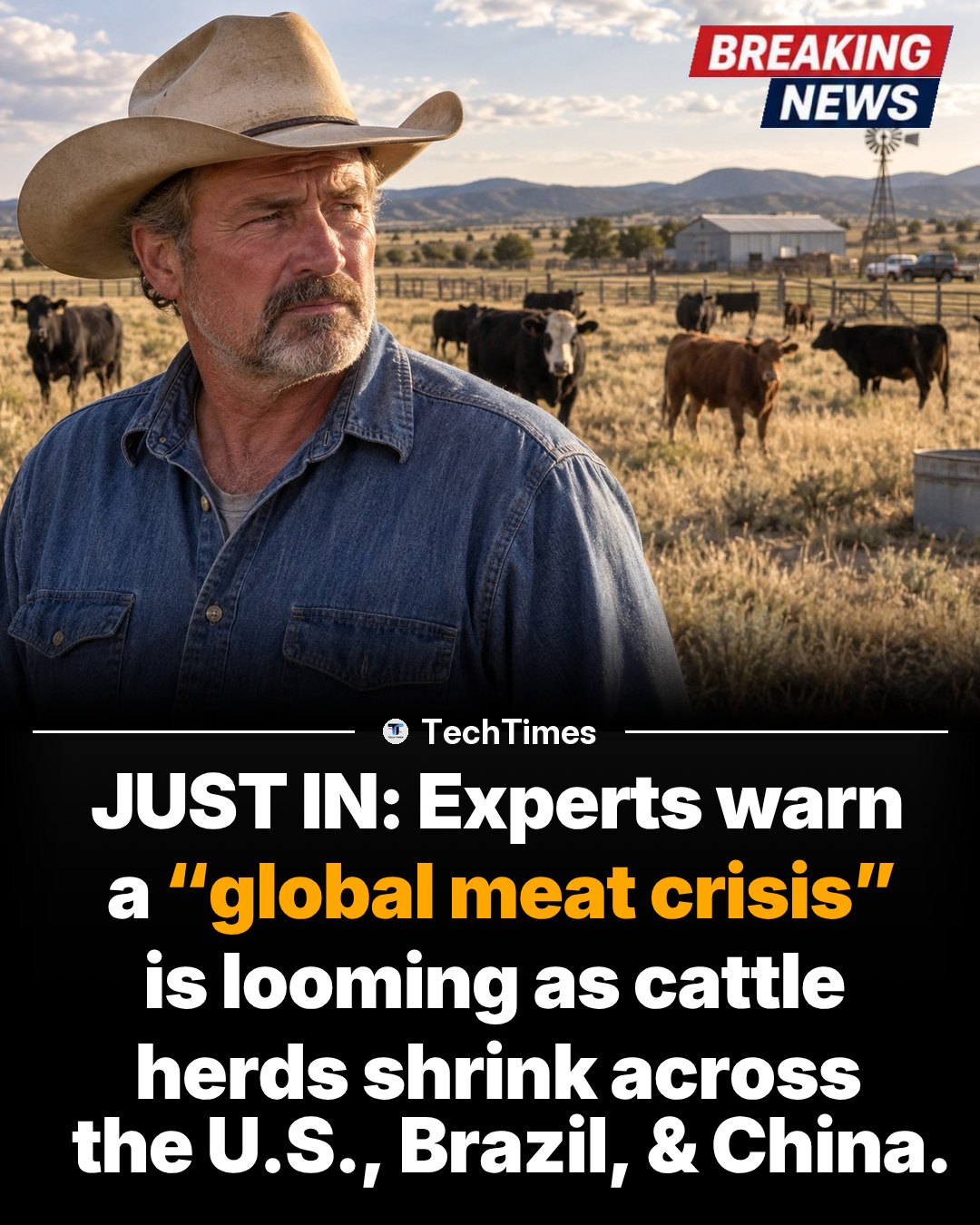
A man with a cowboy hat stands in a field with cattle in the background, a graphic overlays the scene, and a warning is flashed with cattle herds across the globe. The cattle herds in the United States, Brazil, and China are shrinking, sparking a potential "global meat crisis". TechTimes, a news outlet, reported the breaking news with experts sounding the alarm.
The shrinking supply of beef
The phenomenon in question is cattle shortages, caused by shrinking herds. A cowboy standing in a field exemplifies the image of the meat industry at its core, a business that relies on livestock. Over the past years, the numbers of cattle have been waning in the U.S., Brazil, and China. These countries are not only the powerhouses of the meat industry, but also the consumership. The cattle herds in these countries are shrinking the most, signaling impending trouble, considering that the population and demand are rapidly growing. The cattle herds are indeed shrinking, but the effects may not be as immediate as the news headline suggests.
We love meat and our population is growing
Meat consumption from the dwindling herds is widespread and growing and it is not a trend that will stop anytime soon. It is a problem that is deeply rooted in demographics and cultures. We can average each person consumes 90 pounds of beef, pork, poultry, and lamb in a year, according to the USDA. A more recent study shows that this number has been increasing steadily. The growing population is one of the major factors. According to the UN, the global population is expected to reach 9.7 billion by 2050, and The World Bank estimates that meat consumption is expected to increase by 70 per cent in the next few years. Adding to this, the increasing demand for meat from developing countries puts additional strain on meat production. Rising living standards and urbanization are driving demand, and cultures around the world continue to love beef.
Herd shrinkage and the meat industry
The shrinking cattle herds are being caused by various factors. They include climate change, disease, and land scarcity. One of the major reasons is diseases among cattle, with some devastating in nature. This intensifies the scarcity of meat and other products derived from cattle. Parasitic diseases such as cattle ticks, foot-and-mouth disease, and brucellosis are some of the health issues affecting cattle. Small-scale farmers in particular struggle to cope with these challenges. Diseases can exacerbate shrinking herds, and impact meat production and availability. In addition to diseases, climate change is also a significant factor. In the U.S., for example, droughts and extreme weather conditions can make livestock farming unsustainable.
The economic impacts
With the supply of cattle dwindling, the price of meat is bound to go up. The economic implications of a global meat crisis could be severe. As the supply of cattle decreases, the price of meat is expected to rise significantly. This could lead to increased costs for consumers and businesses, as well as potential job losses in the meat industry. The price of beef is expected to increase by 24%, with the highest increase occurring in the U.S. and Brazil. The rise in the price of beef is likely to occur in developing countries in particular, where meat is a major source of protein. This could lead to an increased number of people who struggle to meet their nutritional needs, particularly those in low-income areas. In addition, the cost of production is also expected to increase, which will further affect the price of meat, and the industry as a whole. The potential job losses in the meat industry are expected to be significant. This could lead to a lot of economic hardship in countries that are heavily dependent on cattle farming. The repercussions could be felt all the way to the supermarkets and the restaurants.
The crop demand factor
As economies grow, the demand for meat is also expected to increase. As consumers are becoming more and more aware of the impact of meat consumption on the environment, there is a growing interest in alternative protein sources. Such as plant-based meat substitutes and insect-based proteins. This could lead to a decline in demand for meat, which could help to stabilize prices. The global population is expected to grow from 7.9 billion in 2021 to 9.7 billion in 2050, according to the UN. With this, the demand for meat is expected to increase, and the price of meat is likely to increase as well. The global meat production is expected to reach 337 million tonnes, and this is expected to increase further as the world population grows. However, this could also lead to a decrease in the demand for meat, as consumers seek to reduce their environmental impact. This could also lead to a more sustainable agriculture, with a more diverse range of crops. The demand for livestock could decrease from about 40-50 percent to 10-15 percent of total crop demand.
The lack of land
There are other major factors than the rising demand for meat and the shrinking cattle herds that could lead to a global meat crisis. The lack of land, especially for farming, is expected to be a major factor. It can also lead to a rise in the number of animal meat substitutes. In some cases, more land is converted to forests or used for infrastructure development, which can also reduce the availability of land for livestock. The availability of land is expected to decrease by 40% in the next few decades. This could lead to a decline in cattle herds, and a significant decline in meat production. The lack of land is expected to lead to a reduction in the availability of meat. This could lead to a rise in the number of animal meat substitutes.
Feed & the Competition
The raising of cattle requires a lot of resources, in particular feed. Cattle farming takes up a lot of resources, and this could lead to a global meat crisis. The increasing demand for meat has led to increased competition for resources, as well as higher costs.
The rising crop demand
This competition is likely to intensify as the demand for meat continues to rise in large markets. The competition for resources has led to higher costs for farmers, leading to decreased income. The price of meat is expected to rise as the demand for meat continues to increase. This could lead to increased costs for farmers, and decreased income, leading to food insecurity for some.
The forages
However, forages can also increase the productivity of livestock. This can lead to more efficient use of resources, and reduce the need for land. This can also help to reduce the impact of climate change on the meat industry, as well as increase the availability of meat. The Competition for resources has led to higher costs for farmers, and this has also led to increased demand for beef. This could lead to higher prices for beef, and increased income for livestock producers. In the face of a potential meat crisis, substantial attention has focused on the potential for animals to eat forages. This can lead to more efficient use of resources, and reduce the need for land. This could also lead to more efficient use of resources, and reduce the need for land. The availability of land is expected to decrease by 40% in the next few decades. This could lead to a rise in the number of animal meat substitutes.
The shrinking land to raise cattle
The shrinking cattle herds are also caused by the scarcity of land for cattle rearing. The scarcity of land could be due to various factors, including urbanization, the expansion of agriculture, and the conversion of forests to farmlands. It could also be due to the use of land for infrastructure or recreation. This is likely to result in higher costs for farmers. This could lead to a rise in the number of animal meat substitutes. The scarcity of land is likely to increase in the next few decades. Cattle farming is increasingly being criticized because of the environment. Raising cattle for meat requires a lot of land and water. In addition, cattle farming is also associated with high amounts of greenhouse gas emissions. As a result, cattle farming is increasingly being criticized. The competition for resources has led to higher costs for farmers, and this has also led to increased demand for beef. According to the USDA, cattle feed is a major component of beef production, costing $54.94 per animal.
What you can do as a consumer
Even in light of these issues, there is still a lot you could do as a consumer to mitigate the global meat crisis. Incorporate Meatless Mondays: Consumers can help mitigate the impact of the potential meat crisis by reducing their consumption of meat. This can be done by participating in Meatless Mondays, or by simply choosing to eat less meat. The less demand for meat will reduce the impact of the potential meat crisis. This will also help to improve the environment, as livestock farming is a major source of greenhouse gas emissions. Reduce meat intake: Consumers should consider reducing their intake of meat as this could alleviate the stress on the production system. Consumers can also help to reduce the impact of the global meat crisis by choosing to eat more plant-based proteins, such as legumes, nuts, and seeds. This could help to reduce the impact of the potential meat crisis, as well as improve the environment. Support sustainable agriculture: Despite the challenges currently faced by the meat industry, there are still ways that consumers can support sustainable agriculture. This can be done through sourcing meat from certified sources, and by ensuring farmers get the right price for their produce. This could help to improve the environment, as well as improve the welfare of animals.
Questions readers ask
Why are cattle herds shrinking in the U.S., Brazil, and China?
The decline in cattle herds is due to several factors, including climate change, disease outbreaks, and land scarcity. In the U.S., extreme weather conditions like droughts make livestock farming difficult. In Brazil and China, diseases such as cattle ticks and foot-and-mouth disease are significantly affecting cattle populations.
How does the shrinking cattle population affect global meat supplies?
The shrinking cattle herds in the U.S., Brazil, and China are particularly concerning because these countries are major meat producers and consumers. As herds decrease, the global supply of meat is expected to tighten, potentially leading to higher prices and increased competition for meat products.
What role does meat consumption play in this global meat crisis?
Meat consumption is a significant factor in the global meat crisis. The average person consumes about 90 pounds of beef, pork, poultry, and lamb annually, and this number is increasing. With a growing global population expected to reach 9.7 billion by 2050, the demand for meat is also rising, putting additional strain on already dwindling cattle herds.
How will the global meat crisis affect prices and the economy?
As the supply of cattle decreases, the price of meat is expected to rise significantly. This could lead to increased costs for consumers and businesses, as well as potential job losses in the meat industry. The price of beef, for instance, is projected to increase by 24%.
What are the main diseases affecting cattle herds?
Several diseases are significantly impacting cattle herds, including parasitic diseases like cattle ticks, foot-and-mouth disease, and brucellosis. These health issues can be devastating, particularly for small-scale farmers who struggle to cope with the challenges they pose. Such diseases exacerbate the scarcity of meat and other cattle-derived products.
What efforts are being made to address the shrinking cattle herds?
The article does not explicitly discuss specific efforts to address the shrinking cattle herds. However, it is likely that governments and agricultural organizations are exploring solutions such as disease management programs, improved farming practices, and climate-resilient strategies to mitigate the impact of these challenges.
How does climate change impact cattle farming?
Climate change affects cattle farming through extreme weather conditions. In the U.S., for example, droughts and other severe weather events can make livestock farming unsustainable, leading to a decrease in cattle populations and, consequently, a reduction in meat supply.
Recent articles
Fresh deep dives from the latest Reels we unpacked.




Comments
Be the first to comment.