Founder Vesting 101: The Four-Year Cliff and More
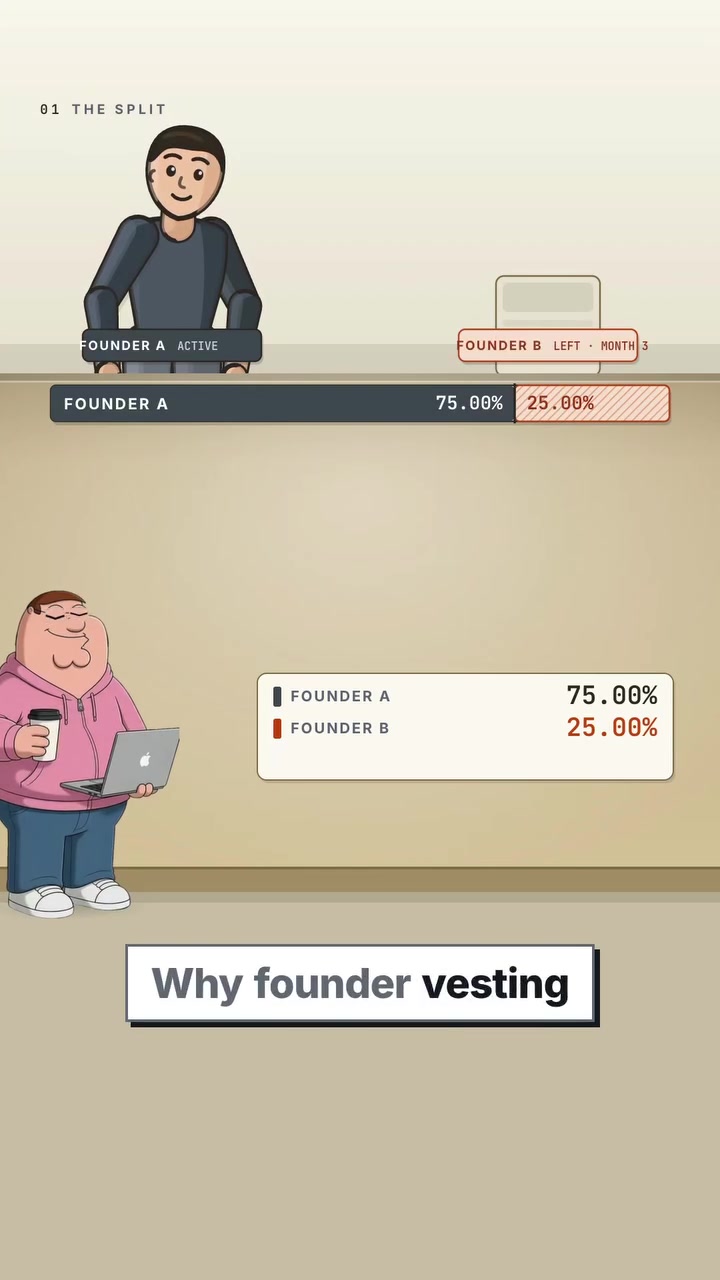
Suppose your startup co-founder quits after three months. Without vesting, they will still own their share of the company, potentially creating a massive problem. Splitting equity up front without vesting can be very dangerous for a startup. You could own a quarter of the company permanently, even if you contribute for three months. Investors will spot this and wonder why someone inactive has so much equity. Understandably, founder vesting is almost always implemented. It requires that the equity be earned over time — typically with a four-year cliff — instead of being awarded on the first day.
The Nuts and Bolts of Investing
Founders can vest their equity in a few different ways, but the standard method is four-year vesting with a one-year cliff. The equity allocation is usually straightforward. A founder might own, for example, 24% of the company. But vesting schedules ensure that they don't receive all 24% immediately. Instead of receiving all 24% immediately, that equity vests over 48 months. But for the first 12 months, nothing vests. That's called a cliff, which means if a founder leaves the company early, they leave with zero vested shares. Even if founder leaves after first 11 months, there would be no vested shares. After the one-year cliff, the first 25% of the grant vests all at once. So if the total grant was 24%, 6% becomes vested after the first year. Then the remaining 18% vests gradually each month over the next 36 months. If the founder quits after two or three years, they retain the portion they have earned to that point, which protects both the company and the remaining founders.
Vesting as an Equity Protection Mechanism
If you’re a founder, you might be excited and willing to take the risk, but investors are looking for a more tangible commitment from the founders. The objective is to incentivize founders to stick around and build the company, ensuring they have a real stake in the business. A creator highlights an important point: "A very common structure is a 4-year vesting with a 1-year cliff. The idea is simple. You don't fully earn your shares on day one. You earn them over time." This is the linchpin of the entire process. It allows founders to earn their shares over time by building the company. Moreover, investors aren't too keen on giving equity to founders without knowing their long-term commitment. Investors want the company founders to be incentivized to stay and build the company. Vesting isn't just for founders—it protects both sides. The company and the founder(s) who stay.
Why Vesting Protects Founders and Companies
Let's delve deeper into the specifics of vesting. Assume a startup with an equity split of 75% for Founder A and 25% for Founder B. Founder B leaves after three months and doesn't have any vested equity. Without vesting, the impact on the cap table is zero, as the company never received any shares from Founder B. Equity can also vest on a vesting schedule. This means they can give and regain the equity based on the performance on a monthly basis. In certain cases, it could even be quarterly.
The Basics of Earning Equity
A vesting schedule ensures that every founder earns his or her equity over time. The simple logic is that if you don't stay with the company for a certain period, you haven't earned the right to keep those shares. For founders who do stay, vesting ensures they retain the portion they earned, protecting both the company and the founders.
When Do Founders Earn Equity?
The first portion of equity vests all at once after the cliff period ends. So, if a founder leaves after two years, they actually keep half of their equity. In contrast, if a founder leaves after four years, they earn the full 24%. Suppose a founder quits after two years. In that case, they keep only whatever they have earned during those two years, which is only half of the equity. If a founder leaves early or stops performing, the equity earned to that point is forfeited. Some agreements specify that unvested shares are repurchased by the company.
Vesting Schedule
A 4-year vesting schedule with a 1-year cliff can be a good starting point:
- The first 25% of equity vests all at once after a 1-year cliff.
- The remaining 18% vests over the next 36 months.
- If a founder leaves before the cliff, they lose all vested shares.
- If a founder leaves after the cliff, they keep the vested portion. This ensures that founders are incentivized to stay and build the company.
The Cliffs and Nuances of Vesting
Vesting schedules with a cliff can have different timelines. The most common one is a 4-year schedule with a 1-year cliff. Founder A receives 0.5% per month from month 12 to 48. The bottom line is that vesting schedules are designed to ensure a long, sustained commitment from the founders.
Evaluate Startup Equity Commitments
Vesting plays a crucial role in protecting a startup’s equity. If something goes wrong and a founder leaves early, vesting ensures that they don't retain equity they didn't earn. Investors could look at a founders equity allocations and make their decisions based on this.
- Understand your vesting schedule: If there is a cliff, make sure you know its duration. Some cliffs are longer than a year, which means it will take longer to vest.
- Read your agreements: Vesting agreements can vary. Make sure you understand what happens to your shares if you leave the company and vice versa.
- Ask about anti-dilution clauses: Vesting agreements often come with anti-dilution clauses that protect founders from dilution.
- Understand the vesting plan: Make sure you know the vesting schedule—how much equity vests when, and how often. The vesting plan ensures that you understand how much equity you will get and when.
- Get professional advice: Make sure you have a lawyer or other professionals review your vesting agreements. No matter how small and informal your partnership, it's in your best interest to get professional advice. Vesting is a complex process.
Questions readers ask
What exactly is a cliff in the context of founder vesting?
A cliff in founder vesting is a period at the beginning of the vesting schedule during which no equity vests. Typically, this is set at one year. If a founder leaves before this period ends, they receive no vested shares. For example, if a founder leaves after 11 months, they get nothing. After the cliff, a portion of the equity vests all at once, and the rest vests gradually over the remaining period.
How does a four-year vesting schedule with a one-year cliff work?
In a four-year vesting schedule with a one-year cliff, founders don't receive any vested shares for the first year. After that, a portion of their equity (often 25%) vests all at once. The remaining equity then vests gradually over the next three years. This means that if a founder leaves after two years, they would have earned 50% of their total equity, and if they leave after three years, they would have earned 75%.
Can a founder customize their vesting schedule?
While the standard method is four-year vesting with a one-year cliff, founders can potentially customize their vesting schedules. However, this can be risky and may not align with investor expectations. Customization would need to be agreed upon by all parties involved and should be carefully considered to ensure it protects both the company and the founders.
What happens if a founder leaves before the cliff period ends?
If a founder leaves before the cliff period ends, they receive no vested shares. For example, in a four-year vesting schedule with a one-year cliff, if a founder leaves after 11 months, they would not receive any of their equity. This is why the cliff is a crucial protection mechanism for the company.
How does vesting protect the company and the remaining founders?
Vesting protects the company and the remaining founders by ensuring that equity is earned over time. If a founder leaves early, they only take with them the portion of equity they have earned up to that point. This prevents a situation where a founder who contributes very little ends up owning a significant portion of the company. It also incentivizes founders to stay and build the company over the long term.
What is the typical equity allocation for founders?
The typical equity allocation for founders can vary, but it often ranges from 20% to 30% of the company. For example, a founder might own 24% of the company. However, with vesting, this equity doesn't vest all at once. Instead, it vests over a period of four years, with a one-year cliff. This means the founder earns their equity gradually over time, rather than receiving it all on the first day.
Related deep dives
Similar reads based on topic and creator.




Recent articles
Fresh deep dives from the latest Reels we unpacked.




Comments
Be the first to comment.