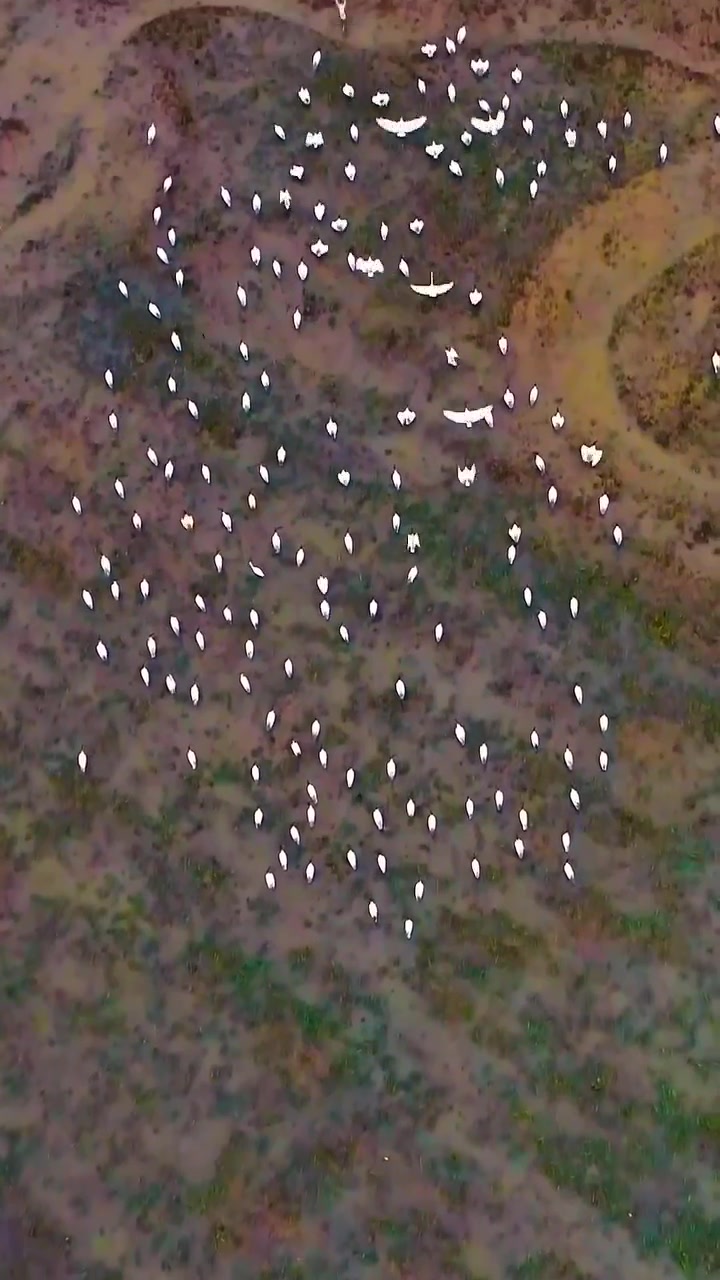
A swirling mass of white birds cast moving shadows over a sprawling grassy field. One of the most mesmerizing sights in nature is a flock of birds moving as a cohesive unit, as if a single, coordinated organism. Bird murmuration is a spectacular choreography, unlike other natural patterns and movements. Like flocks of birds that soar, swoop, and separate only to coalesce again. There are no isolated animals; there is one organism. They are moving two directions simultaneously starting from the bottom left corner and diving towards the bottom right. Then they swoop up and move compressingly toward the top right corner.
When birds fly in unison
Murmuration disappears like waterworks or clouds. One second it is there, moving with exquisite coordination, the next it is gone. Birds have a unique ability to perform in a chorus. They move ahead of the pack, pulling it along. They are constantly integrating information that is not very far away. Their immediate neighbors will have information that is not accessible to them at this point. The integration of this information and the creation of a global picture is a self- organized phenomenon. But how do they do that? And why?
The collective consciousness
The flock is like a living brain, capable of responding to threats in real time. Imagine every bird a neuron, each one making their own decisions rather than being told what to do. Yet, the group can move as a single organism, reacting to danger with a speed and agility that would make any human machine seem sluggish. The birds can change direction in mere seconds with no leader. Yet, their cohesion is maintained. A flock of starlings, for example, can keep flying with the group even without explicit orders.
The theory behind the dance
A web of coordinated movements
To prevent a collision, the bird moves away from the other bird. To stay in formation, it moves closer to the average direction of the birds nearby. To prevent the bird from falling behind, it moves forward. Since the brain has a limited capacity to process information. The only rule that applies to each individual bird is what we have just explained. However, the group's movement is fluid and flexible. It responds to the outside world. The birds have a short-range view of the other birds and the environment. This idea has been tested in computer simulations. There is a virtual swarm of birds and other artificial insects. These virtual birds have been programmed with the same three rules as the real birds, and their behavior has been analysed. Virtual birds have been tested by researchers. They have been programed to fly with the same three rules as real birds. They have flocked in a similar manner.
Gravity and the flock
At other times, the swarm splits apart in a burst of white wings, then grabs around a few of the birds and tries to pull them with it. Gravity pulls swirling loops the birds together. The laws of gravity also govern a flock of starlings. The term "Gravibots" describes the movements of the birds in the air. They are not just one bird moving and copying another, they have a specific direction and purpose. When the flock moves in unison, it will turn in all directions to avoid collision. This is the same way that a star swarm does its work.
The ballet of survival
Avoiding danger
Murmuration is a matter of survival. Predator evasion, navigation, and foraging. Also, it is used for social purposes. When catching insects, birds are more efficient in catching insects. Birds that are in a flock can reduce the energy they use for flight. They can also protect themselves from predators.
The flock and the open sky
Birds can create circles around the flock to provide a constant supply of air. This allows the birds to glide in a more aerodynamic manner. When birds are in a flock, they can take advantage of the updrafts and avoid turbulence. This helps them to conserve energy. The wind in the flock is also more calm and steady.
Are flocking and murmuration the same?
Flocking and murmuration are similar to each other, but they are not the same thing. Flocking is the behavior of a group of birds that are flying or moving together. Murmurations are a specific type of flocking that involves large groups of birds that are moving in a coordinated manner. The birds in a murmuration will change direction suddenly and often, creating a complex and dynamic pattern. Birds in a flock are more likely to move in a straight line or in a pattern that is less complex.
Your own aerial ballet
Murmuration is a fascinating and complex behavior, and it is still not fully understood. However, there are a few things that you can do to observe and appreciate it. Timing is important, as murmurations are most common during the winter months when birds are looking for food and roosting sites. Choose a location with a clear view of the sky. Birdwatching areas and open fields are ideal for viewing murmuration and clear skies. Listen to the bird's noise, which can be an additional clue that a murmuration is taking place. The birds can make a distinct "churring" sound as they move through the air, creating a symphony of nature.
What's the pull of the dance
Flocking is not simply a natural phenomenon, but one with applications in medicine and technology. It is still a mystery for scientists and a spectacle for observers.
Questions readers ask
What exactly is murmuration and why is it so fascinating?
Murmuration is the phenomenon where a large flock of birds moves in unison, creating intricate, flowing patterns in the sky. This is fascinating because it's a complex dance that scientists are still trying to understand. Unlike other natural patterns, murmuration involves birds moving as one cohesive unit, making it a mesmerizing sight.
How do birds coordinate their movements during murmuration?
Birds in a murmuration coordinate their movements through a process called self-organization. Each bird follows simple rules: moving away from nearby birds to avoid collisions, aligning with the average direction of nearby birds to stay in formation, and moving forward to prevent falling behind. This collective behavior creates a fluid, flexible movement that can change direction in mere seconds.
Is there a leader in a murmuration, or is it a collective decision?
There is no single leader in a murmuration. Each bird makes individual decisions based on the movements of its neighbors, creating a collective consciousness. This allows the flock to react to threats and changes in the environment with remarkable speed and agility, all while maintaining cohesion.
How do scientists study and understand murmurations?
Scientists study murmurations through a combination of field observations and computer simulations. They have programmed virtual birds with the same rules that real birds follow and analyzed their behavior. This helps researchers understand the underlying mechanics of how birds coordinate their movements during a murmuration.
What are the three rules that govern the movement of birds in a murmuration?
The three rules that govern the movement of birds in a murmuration are: moving away from nearby birds to avoid collisions, aligning with the average direction of nearby birds to stay in formation, and moving forward to prevent falling behind. These simple rules, when followed by each bird individually, create the complex, coordinated movements seen in a murmuration.
Can the same principles of murmuration be applied to other areas, such as robotics or artificial intelligence?
Yes, the principles of murmuration have been applied to other fields. Researchers have created virtual swarms of birds and other artificial insects, programmed with the same three rules as real birds. This has led to advancements in understanding collective behavior and has potential applications in robotics and artificial intelligence.
How does a flock of birds respond to a threat during murmuration?
When a threat is detected, the flock can change direction in mere seconds with no leader, thanks to the collective consciousness of the group. Each bird makes individual decisions based on the movements of its neighbors, allowing the flock to react swiftly and maintain cohesion, all while moving as a single organism.
Related deep dives
Similar reads based on topic and creator.

Recent articles
Fresh deep dives from the latest Reels we unpacked.


Comments
Be the first to comment.