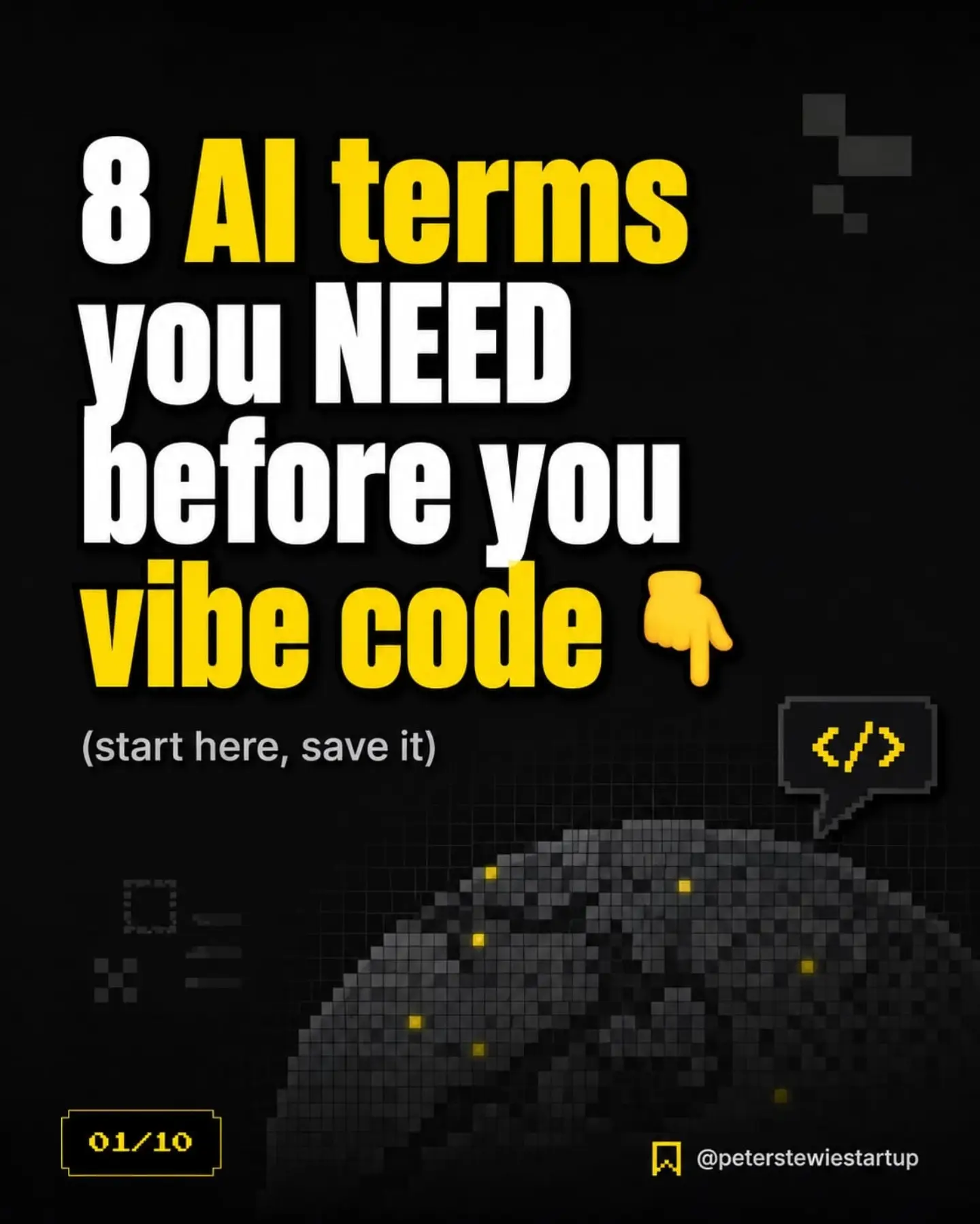
Vibe coding might be all the rage, but diving into AI development without grasp the basics can lead to confusion and mistakes. "Most people jump into vibe coding without understanding the basics," underscores the frustration. According to the caption, learning just eight foundational AI terms can save hours of frustration and costly errors. These terms are vital for anyone building AI-powered apps or tools.
What you need to know: Eight AI fundamentals
No one needs to become a full-fledged AI engineer to build useful tools, but understanding these eight AI terms can make the process smoother and more effective. These terms range from fundamental concepts like Git & GitHub and API to more specialized ideas like tokens, context windows, and hallucinations. Even for those who aren't planning to write a single line of AI code, familiarizing yourself with these terms can enhance your ability to communicate with developers, spot potential issues, and make more informed decisions about AI tools. The importance of grasping these basics spans far beyond avoiding rookie mistakes and confusion. It's about shaping the future of your AI tools and ensuring the best outcomes from available technology. For example, understanding API can allow specific tools to seamlessly communicate. Without these fundamental concepts, it can be challenging to harness AI tools effectively. The list includes:
- Git & GitHub
- API
- Tokens
- Context Window
- RAG
- MCP
- Hallucinations
- Harness
AI literacy: why language really matters in the machine learning age
AI has exploded in notoriety and relevance over the last few years; it's no longer a fringe topic. But it comes with a language barrier that can hinder progress and innovation. Learning the core AI terms isn't just about avoiding confusion — it's about bridging a critical gap in communication and understanding. Learning AI terminology is akin to learning a new language; it unlocks new ways of thinking and collaborating. For instance, recognising the meaning of "tokens" can help you optimize costs and manage memory more efficiently. And in a world where AI tools are increasingly integrated into our daily lives, being AI literate can make a world of difference. The ability to understand and communicate in AI terms can create opportunities for innovation, problem-solving, and leveraging AI tools more effectively.
Parsing text, paying the price: the hidden cost of AI tokens
Tokens are the units AI models use to process text. When it comes to AI, tokens are the building blocks of language models. Every word or character is broken down into tokens. The cost of tokens can add up quickly. More tokens mean higher costs and increased memory usage. But it's not just about the price tag — understanding tokens can help optimize performance and manage resources more effectively.
The universal AI connector: what MCP can unlock
MCP (Multi Interface Processor) is a universal plug for your AI tools, similar to a USB-C connector. Think of it as the interface that allows your AI to interact with various apps, files, and tools seamlessly. Rather than being limited to chat functionality, MCP enables AI to access a broader range of resources. This means AI can pull in data from different sources, run apps, and integrate tools more fluidly, making it a powerful addition to any AI toolkit.
Feeling lost in a sea of specs? Try RAG
RAG (Retrieval-Augmented Generation) is a technique used to enhance the accuracy and context of AI-generated responses. It helps AI models retrieve relevant information from a knowledge base before generating a response. This means more accurate, contextually relevant answers. For instance, RAG could help an AI chatbot provide more precise information by pulling data from a specific database. RAG is a game-changing approach for developers looking to build more sophisticated and reliable AI tools.
Practical Guide: Speaking and learning AI
- Start Simple: Begin with the basics like Git & GitHub, API, and tokens. These foundational concepts will give you a solid base to build upon.
- Learn by Doing: Don't just read about these terms — try them out. Experiment with GitHub, build a simple API, or run a text analysis to see tokens in action.
- Practice Communication: Use these terms in conversations with developers or in documentation. The more you practice, the more comfortable you'll become.
- Utilize Online Resources: There are plenty of tutorials, forums, and communities dedicated to AI education. Join them, ask questions, and learn from others.
- Break Down Complex Concepts: If a term seems too complex, break it down. Look for examples, analogies, or real-world applications that can make it easier to understand.
Questions readers ask
What exactly is a 'token' in the context of AI, and why should I care about it?
A 'token' is a fundamental unit that AI models use to process text. Every word or character is broken down into tokens, which are essential for understanding and generating language. Understanding tokens can help you optimize costs and manage memory more efficiently, as more tokens mean higher costs and increased memory usage.
How does understanding API help in building AI tools?
API, or Application Programming Interface, allows different tools and systems to communicate with each other seamlessly. By understanding API, you can ensure that your AI tools can integrate with other software, enhancing their functionality and effectiveness. This is crucial for building robust and interconnected AI-powered applications.
What is the significance of the context window in AI development?
The context window refers to the amount of text an AI model can process at once. It's important because it determines how much information the AI can consider when generating responses. A larger context window allows for more nuanced and accurate interactions, but it also requires more computational resources.
How does MCP (Multi Interface Processor) enhance the capabilities of AI tools?
MCP acts like a universal connector, allowing AI tools to interact with various apps, files, and other tools seamlessly. This means your AI isn't limited to just chat functionality; it can access a broader range of functionalities, making it more versatile and powerful.
What are 'hallucinations' in AI, and why are they a concern?
In AI, 'hallucinations' refer to instances where the model generates outputs that sound confident but are entirely made up or incorrect. This can lead to misleading or inaccurate information being presented as fact. Understanding hallucinations helps in identifying and mitigating these issues, ensuring the reliability of AI-generated content.
Related deep dives
Similar reads based on topic and creator.



Recent articles
Fresh deep dives from the latest Reels we unpacked.



Comments
Be the first to comment.