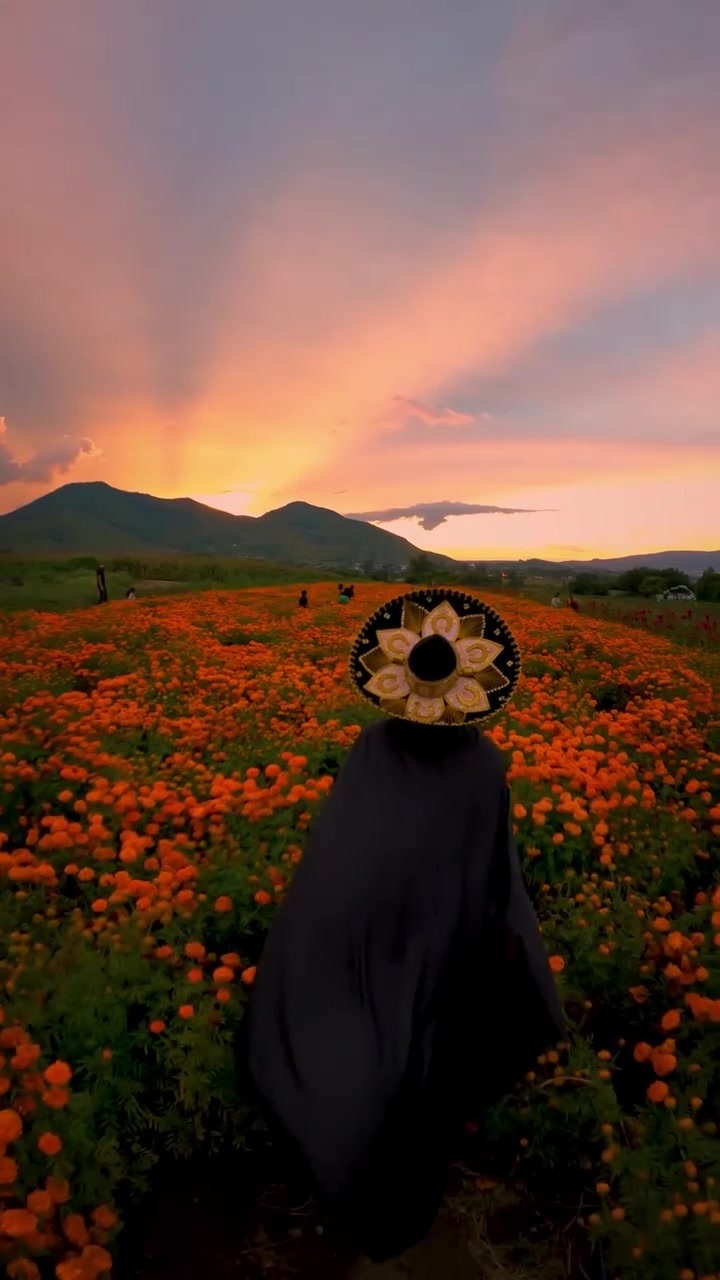
In a field of vibrant orange marigolds, a sombrero-wearing figure stands beneath a radiant sunset, evoking the atmospheric power of the Mexican holiday Día de Muertos. With marigolds as a central visual element, the scene captures a unique visual experience that blends natural beauty and cultural significance. Día de Muertos, or Day of the Dead, is a traditional Mexican holiday honoring deceased loved ones. The marigolds or cempasúchil are a significant symbol in these celebrations, used to guide spirits back to the world of the living.
The Role of Marigolds in Día de Muertos
Marigolds are the primary floral element in the scene. The vibrant and pungent marigolds are considered the “flower of the dead,” they are planted on the graves and used in altars. The orange blossoms are meant to create strong scent trails which guide the spirits from the cemetery to the altar inside the home. In this way, Día de Muertos celebrations bridge the gap between the world of the living and the world of the dead. Marigolds are also an important part of the holiday’s visual narrative. The orange petals create a strong visual contrast against the surrounding greenery and the black-and-white sugar skulls, making them a focal point for both humans and spirits. Marigolds are versatile in their use in an ofrenda — an altar honoring the memory of loved ones. They can be scattered on the altar, around the altar, or used to create a pathway for the spirits to follow from the grave to the altar. Marigolds are also used for decoration. Marigold crowns, wreaths, and garlands are popular elements. Fresh marigolds are often dyed other colors, though not as common or traditional. The narrative of Día de Muertos celebrations is one of remembrance and unity, and marigolds are a primary component.
The Symbols of the Alternative Death
In a world where popular movies present Halloween as the ultimate in aggression and horror, Día de Muertos offers an alternative vision of death. This holiday offers a vision of death as a part of the natural cycle of life. It is a quiet celebration with moments of nostalgia, acceptance, and hope, the holiday focuses on the life that came before death. People make offerings to their loved ones, reflecting the values and values of the memories of the deceased. Rather than the macabre, the holiday is about the enduring love and reverence for the lost. This love is displayed in the form of altars, decorated with offerings of food and drink, personal items, and a regular appearance of the “Callejones,” a path and marigold petals. The altars are where people can visit and commune with their family and friends who have died. The ofrendas — offerings — are also a way to honor the life that came before the loss, a way to say that the life of the deceased is still valid and appreciated. Calls to remember the life of the deceased are especially common among the younger generations, who often create altars for their elders but also enjoy telling a story of their own from their ancestor's founding days. The virtues and stories of the deceased are remembered in song, poetry, and memory, creating a bridge between the living and the dead. There is no fear, no horror, and no terror in the day that the deceased are remembered, but a quiet appreciation for the living and the dead may be achieved.
Materials for the Spirit Realm
The Traditional Sombrero
The sombrero is another important symbolic element. Much more than a fashion accessory, the sombrero is a part of the heritage of Mexican culture. But what makes it distinctive for the Day of the Dead is not only its aesthetic and traditional value but also its meaning: a celebration of a heritage that precedes death. This is the reason why it is often adorned with marigolds. This hat is filled with flowers, not only for aesthetic value, but because flowers hold deep meaning in Mexican culture as a symbol of remembrance.
The Cauldron of Sunsets
The background of the scene features a stunning sunset with colorful clouds and distant mountains. Day of the Dead celebrations often begin at sunset. The sunset is symbolic of the end of the day, but the beginning of the night, where ancestors join their families for celebrations. In a way, this punchy sunset is a metaphor for the end of one’s life, but also their continuation to another world, a world where loved ones meet again. Día de Muertos celebrations almost always include a processional to the cemetery at sunset, where family members clean and decorate the graves of their ancestors.
The Annual Prolongation
The scene also includes the idea of a prolonged life. The idea of the prolongation of life ties into the idea of death as a part of life, rather than an end. During the celebrations, it is common to see imagery that reflects the idea of life prolonging. This is often seen in the form of marigold crowns, paths created by the flowers, and in personally significant elements that are tied to the living. It extends the idea of resurrection, of the living dead spirits walking among the living, and the idea of a prolonged life that extends beyond death. All this is done with the idea of maintaining the memory of the loved ones so that they live on in our hearts and minds, as the living dead continue to live this life.
Embrace the Tradition
The scene is a snapshot of a celebration of life and the day’s central theme of balance: the balance between the living and the dead, between the remembrance of one’s ancestors and forging new paths. This experience is about celebration rather than fear, nostalgia rather than dread, and a deeper understanding of the natural cycle of life and death. During the festivity, family members build private altars in their homes for the deceased ones. The altars are decorated with marigold flowers, photographs, food, and water. The flowers are a significant component because their intense scent is said to guide the spirits back to their homes as the white blooms are intrinsically connected to purity and death. * Location: The most memorable celebration can be had at home, but public celebrations such as cemeteries, churches, and other locations displaying the festivals can provide another perspective. * Altar Design: The altar is the main point of focus. It can include personal items, photographs, flowers, colorful paper cutouts, and all these elements can have a symbolical and practical meaning from personal belongings to favorite dishes of the deceased. * Roles of Family Members: Everyone in the family has a role to play. They participate in the altar decoration, prayer, and rituals. Making traditional foods that the deceased enjoyed can be a part of the ritual. Some choose to tell stories, others to dance, yet all are welcome to celebrate their feelings through music and dance. * With Food and Songs: The celebrations often last for three days, and there is a lot of traditional dancing, singing, and feasting. Families create altars on which they place offerings including food and drink as well as photos and favorite personal belongings of the deceased. The altars often also have three tiers to represent heaven, earth, and the space in between. The highlights of the celebrations include the family and loved ones gathering together to share memories of the deceased, expressing their love and appreciation for those who have died. The highlight includes the music; families and community members gather to enjoy traditional music. These may be classical pieces, contemporary songs, or favorite songs of the deceased. The atmosphere is full of energy, excitement, and celebration.
The Scent of the Festival
In the end, Día de Muertos celebrates life, death, and decay as a part of the whole process of existence. The festivities bring people together in a celebration of life, reminding everyone that death is never the end. The flowers serve as a physical representation of the toll of death and its beauty, while also offering a sense of closure to those who have experienced a loss. The shared experience of these celebrations offers a sense of continuity with the past while looking toward a future of progress.
Questions readers ask
What makes marigolds so important in Día de Muertos celebrations?
Marigolds, or *cempasúchil*, are crucial because their vibrant orange color and strong scent are believed to guide the spirits of the deceased back to the world of the living. They are used extensively in altars and graves to create a visual and olfactory pathway, symbolizing the connection between the living and the dead.
How do marigolds create a visual narrative during Día de Muertos?
Marigolds stand out against the greenery and black-and-white sugar skulls, making them a visual focal point. They are used in altars, called *ofrendas*, to honor the deceased, and can be scattered around, creating a pathway for spirits. Marigold crowns, wreaths, and garlands are also popular decorations, adding to the holiday's aesthetic.
What do the altars, or *ofrendas*, symbolize in Día de Muertos?
Altars are set up to honor and remember deceased loved ones. They include offerings of food, drink, personal items, and marigolds, which serve as a bridge between the living and the dead. These altars reflect the values and memories of the deceased, fostering a sense of unity and remembrance.
Why is the Día de Muertos approach to death different from what we see in popular movies like Halloween?
Día de Muertos presents death as a natural part of life's cycle, focusing on remembrance and unity rather than horror or aggression. It emphasizes the enduring love and reverence for the deceased, with celebrations that include nostalgic moments, acceptance, and hope. This perspective contrasts sharply with the macabre themes often found in popular horror media.
Can marigolds be dyed different colors for Día de Muertos celebrations?
While fresh marigolds can be dyed other colors, this practice is not as common or traditional. The vibrant orange color is most strongly associated with the holiday and is believed to have the strongest spiritual significance.
What is the significance of the path of marigold petals, known as Callejones, in Día de Muertos?
The path of marigold petals, or Callejones, is a visual and symbolic trail that guides the spirits of the deceased from the cemetery to the altar inside the home. It represents the journey of the spirits and is a central element in the holiday’s visual narrative, emphasizing the connection between the living and the dead.
Related deep dives
Similar reads based on topic and creator.

Recent articles
Fresh deep dives from the latest Reels we unpacked.


Comments
Be the first to comment.