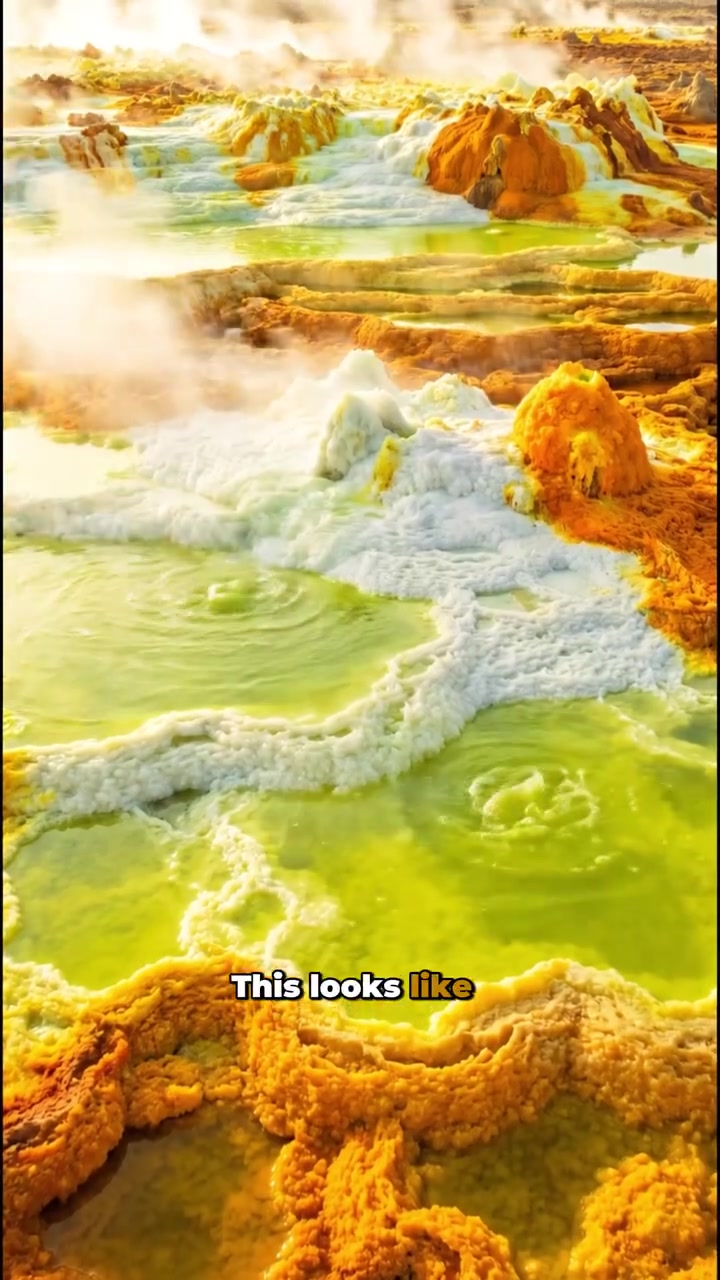
The Dallol volcanic area is a rare, extreme landscape: an otherworldly place where temperatures soar, and acidity threatens to eat through steel. This alien-looking area on Earth, located in Ethiopia, has become an active area of study for astrobiologists trying to understand the limits of life.
Unveiling Dallol
A small volcanic crater called Dallol is home to one of the most acidic, saline, and toxic habitats on the planet. Dallol lies within the Danakil Desert, an area known for its molten volcanoes and boiling salt flats. Dallol's coloration stems from iron, sulfur, and salt, reacting beneath pools of acidic, scorching fluid. Near boiling, the pools are at least pHp 0.13, more acidic than the pH of the electrolyte in a car battery. Although the environmental conditions are far from ordinary, scientists are still debating the boundaries of life. Some researchers have discovered extremophile microbes living in the water. Others report that identical-looking pools are devoid of life. Despite its harsh environment, Dallol lives in the sight of toxic gas pipe lines coming from this active volcano Still, the Danish geologist L. Diesili proposed in 2019 that bacteria could have survived for a long time in the Danakil Depression.
Why Dallol’s Geology is Key in Searching for Life Beyond Earth
Dallol's extreme nature and unearthly visuals begs the question, why are scientists so eager to study it? The study of Dallol has drawn interest from astrobiologists, the scientists who search for life in space. This landscape could provide insights into understanding the potential habitats for life in the solar system—particularly in Mars, as well as icy moons, and other distant worlds.
Rocky Origins
Mars has always been a planet of interest. According to NASA, Mars has a similar mineral composition as Dallol, and this would mean there might be similar acidic environments in the planet. Some geologists believe that the mineral content of Dallol means that their gelatinous water is similar to the one found on Mars. The researcher from Denmark claimed that the lifeforms found in Dallol and in other acid environments could survive on Mars as well.
A Place of Contradictions
The water crystals of Dallol are almost as acidic as the electrolyte in a car battery. Despite these conditions, researchers have found some forms of life there — but there is still debate in the scientific community. Some experts believe that the extremophile microbes found there prove life could survive anywhere, whilst others think the landscape is a "test of survival". Even so, a team of Italian scientists have claimed to have found these extremophiles on Mars.
Geothermal Force
Dallol has been flooded and resurgent, but still there’s a possibility that these extremophiles could have been there for a long time. The continuous geothermal activity due to the eruption of the Erta'Ale volcano, which lies near Dallol, causes constant reshaping of the geographic area. Because of this, the rocks from which scientists collect extremophile microbes may have only recently been exposed to the toxic water. This is why it is possible that the bacteria found there have not been in contact with the water for a long time, but rather have found a way to adapt.
Planetary Testbed
Dallol's extreme conditions have mist of the scientific attention. The reason is that many parts of the solar system could well have acidic environments. These could be in Mars, where the geology resembles that of Dallol, but also in the moons of Jupiter and Saturn. NASA has currently confirmed the existence of vast oceans with water bodies beneath the icy surfaces of the moons of Jupiter, and there could be acidity due to the volcanic activity in these oceans. In 2013, some of the moons of Jupiter were found to have "snowball" like structure with oceanic layers. New research has shown that these oceans could have acidic environments like those found in Dallol. These could be created by the volcanic minerals in the rocky surface below the oceans.
Visit to Dallol
The conditions of Dallol are so extreme that it has become a tourist destination. Tourists have started coming into Dallol for different reasons. The main one is the possibility of seeing extremely filthy water and acidic lakes. Minimal preparation is necessary for a visit. Because of its dry air and scorching temperatures. Even in the hottest months, the pool of water remains in liquid form, which is a surprise for most visitors. Some locals believe that the Danakil Depression, which houses Dallol, is the entrance to the underworld, according to Algerian historian Daniel'l. Because of this, there is a massive possibilities that the place could have an important cultural component and mythical significance.
Questions readers ask
What exactly makes Dallol, Ethiopia, such an extreme environment?
Dallol is incredibly extreme due to its scorching temperatures, highly acidic conditions, and toxic environment. The pools of water have a pH level of 0.13, making them more acidic than a car battery's electrolyte. The area is also known for its molten volcanoes and boiling salt flats, which contribute to its inhospitable nature.
How does Dallol's environment compare to that of Mars?
Dallol's environment is similar to Mars in terms of its acidic and saline conditions, as well as its mineral composition. NASA has noted that Mars has a similar mineral makeup to Dallol, suggesting that there could be comparable acidic environments on the red planet. Additionally, the research from Denmark proposed that lifeforms found in Dallol could potentially survive on Mars.
What are extremophiles, and why are they important in the study of Dallol?
Extremophiles are microorganisms that thrive in extreme environments. In Dallol, some researchers have found extremophile microbes living in the harsh conditions, which suggests that life could potentially exist in similarly extreme environments on other planets, such as Mars. The presence of these microbes in Dallol makes it a crucial study site for astrobiologists.
Why is there debate among scientists about the presence of life in Dallol?
The debate arises because while some researchers have discovered extremophile microbes in Dallol's pools, others have found identical-looking pools that seem to be devoid of life. This contradiction has led to differing opinions on whether life can truly survive in such extreme conditions, or if Dallol is merely a test of survival's limits.
How does the geothermal activity near Dallol affect the search for extremophiles?
The continuous geothermal activity from the nearby Erta'Ale volcano reshapes the landscape, which means the rocks from which scientists collect extremophile microbes may have only recently been exposed to the toxic water. This makes it challenging to determine how long extremophiles might have been present in the area and how they have adapted to the extreme conditions.
What are the implications of finding life in Dallol for the search for life beyond Earth?
Finding life in Dallol suggests that life could potentially exist in similarly extreme environments elsewhere in the solar system, such as on Mars or icy moons. This makes Dallol a valuable site for astrobiologists to study and understand the potential habitats for life beyond Earth, and the extremophiles found there could provide insights into how life might survive in other harsh environments.
Related deep dives
Similar reads based on topic and creator.



Recent articles
Fresh deep dives from the latest Reels we unpacked.




Comments
Be the first to comment.