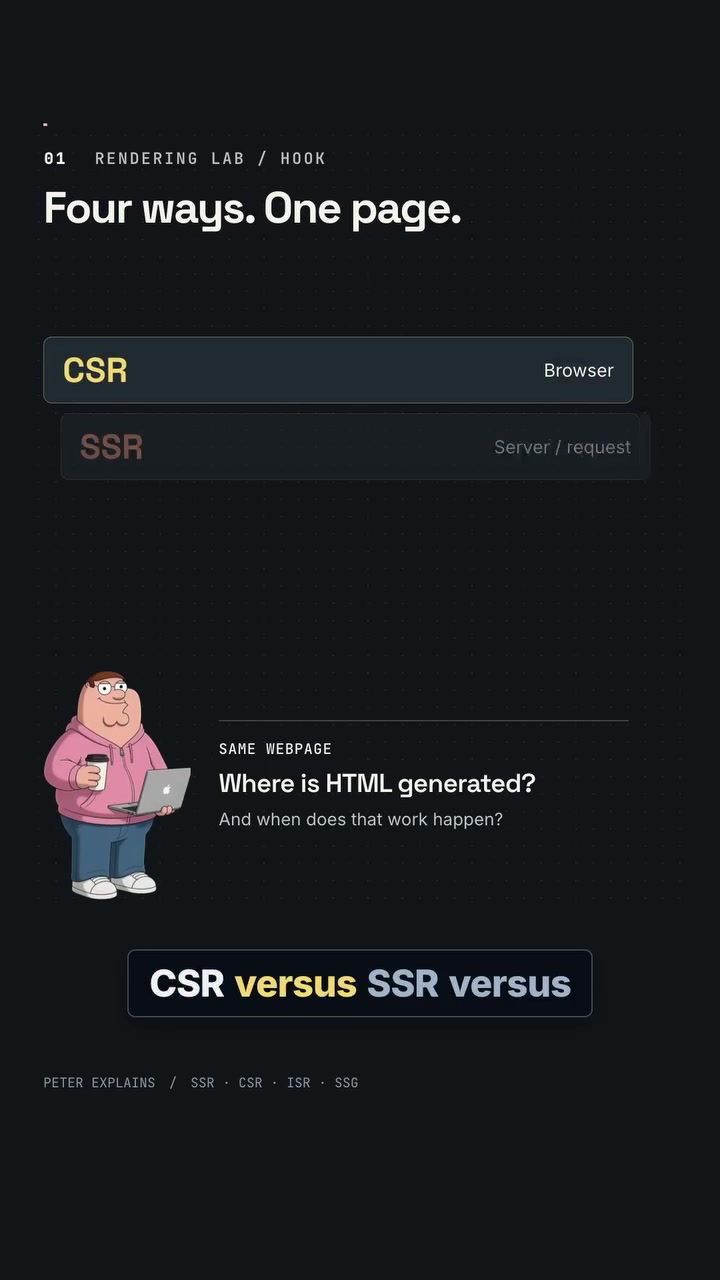
What is a webpage rendering approach?
Four fundamental techniques govern how and when a webpage's HTML is generated: Client-Side Rendering (CSR), Server-Side Rendering (SSR), Static Site Generation (SSG), and Incremental Static Regeneration (ISR). This choice determines how quickly a web page loads and how well it performs. CSR is when the browser builds the page using JavaScript after the initial request. The server sends a minimal HTML shell and a JavaScript file. The browser then downloads and runs the JavaScript, fetches necessary data, and constructs the page on the user's device. This method is ideal for highly interactive applications, but the initial load can feel slow because the browser has to do more work. SSR, on the other hand, has the server generate the HTML for each request. When a user requests a page, the server queries the database, renders the HTML, and sends the complete page to the browser. This approach delivers meaningful content quickly and is beneficial for dynamic pages needing fresh data and good SEO. However, it requires the server to handle rendering for every visitor, which can be demanding. SSG generates pages before any user requests them. During deployment, the framework renders all possible pages into static HTML files. When a user visits, the Content Delivery Network (CDN) serves the pre-generated file with almost no computation required, making SSG extremely fast. But content updates require rebuilding the entire site, which can be costly and time-consuming. ISR is a more efficient version of SSG. It generates static pages ahead of time but allows for selective regeneration. After a set period or revalidation, the framework can regenerate specific pages in the background without rebuilding the entire site. This approach balances the speed of SSG with the dynamic capabilities of SSR and CSR.
The shift towards hybrid rendering
The evolution of web development frameworks has led to a hybrid approach, where different rendering techniques are used within the same application. Modern frameworks like Next.js allow developers to mix and match these methods based on the needs of different pages. For instance, a dynamic dashboard might use SSR, static marketing pages might use SSG, a product catalog might use ISR, and highly interactive components might still rely on CSR within the same codebase. This flexibility is a significant advantage because it allows developers to optimize performance and user experience, tailoring the rendering strategy to the specific needs of each page.
Four paths to HTML
The Welcome Screen
When the small HTML shell plus the JavaScript come to your browser, user interaction with the app becomes a waiting game. The browser downloads that JavaScript, runs React, fetches the data, and builds the page on the user's device. For users, the initial load in CSR can feel slower because the browser has more work to do. The trade-off is that once the page is loaded, it can be more interactive and responsive to user actions.
The Server-Side Workflow
When a user requests a page in SSR, the server generates the HTML first. It might query a database, render the page, and then send the finished HTML to the browser. This approach ensures that users receive meaningful content immediately, which is useful for dynamic pages that need fresh data and good SEO. The trade-off is that the server has to do rendering work for every incoming request, which can be computationally expensive.
The Static Site Lifecycle
In SSG, the framework renders all possible pages into static HTML files during deployment. When a user visits, a CDN can just serve the already generated file. This makes SSG extremely fast, as there is almost nothing to compute on the server side. However, if the content changes, the entire site needs to be rebuilt, which can be costly and time-consuming.
The Incremental Advantage
Incremental Static Regeneration (ISR) builds on the strengths of SSG by allowing for selective regeneration. Imagine a product page generated at 10 a.m. Users keep receiving the fast cached version, and then the product price changes. ISR can generate a fresh version of that specific page without rebuilding every page on the site. This approach balances the speed of SSG with the dynamic capabilities of SSR and CSR, making it a practical choice for many web applications.
Where to start
For developers diving into these rendering techniques, consider the following:
- Assess your needs: Determine if your application requires highly interactive components, dynamic content, or static pages. Your choice of rendering technique will depend on these requirements.
- Explore frameworks: Modern web frameworks like Next.js offer built-in support for CSR, SSR, SSG, and ISR, making it easier to implement these techniques in your application.
- Test and iterate: Experiment with different rendering techniques and measure their impact on performance and user experience. Use tools like Lighthouse to audit your site's performance and make data-driven decisions.
- Consider hybrid approaches: Don't be afraid to mix and match rendering techniques within the same application. This can help you optimize performance and user experience for different parts of your site.
Foresight
Consider the future of web development, where rendering techniques will continue to evolve. Stay informed about the latest developments in web frameworks and rendering technologies, and be prepared to adapt your strategies as new techniques emerge. One way to consider rendering types is to think about the lifecycle from building to deployment time. Once you know the needs of your future app or site, rendering choices become clearer. With these insights, you can make informed decisions about when and where to generate HTML for your web pages, ensuring optimal performance and user experience.
Questions readers ask
Can I mix and match different rendering techniques within a single application, and if so, how?
Yes, modern frameworks like Next.js allow you to use a hybrid approach. You can use SSR for dynamic pages, SSG for static content, ISR for pages that need occasional updates, and CSR for interactive components, all within the same application. This flexibility lets you optimize each page based on its specific needs.
How does ISR differ from SSG, and what are the benefits of using it over traditional SSG?
ISR, or Incremental Static Regeneration, generates static pages ahead of time but allows for selective regeneration. Unlike SSG, which requires rebuilding the entire site for updates, ISR can regenerate specific pages in the background, making it more efficient for sites that need to update content frequently without the overhead of a full rebuild.
What are the main differences between CSR and SSR in terms of performance and user experience?
CSR can feel slower initially because the browser has to download and run JavaScript to build the page. However, once loaded, it can be highly interactive and responsive. SSR, on the other hand, delivers a fully rendered HTML page quickly, which improves initial load times and SEO, but it can be more demanding on the server.
What are the drawbacks of using SSR for a high-traffic website?
SSR can be demanding on the server because it requires generating HTML for each request. For high-traffic websites, this can lead to increased server load and potentially slower performance. However, it's beneficial for pages that need to display dynamic, up-to-date content.
If I choose SSG, how often do I need to rebuild my entire site for content updates?
With SSG, you have to rebuild the entire site for any content updates. This can be time-consuming and resource-intensive, especially for large sites. However, frameworks like Next.js offer ISR as an alternative, allowing for more efficient updates without a full rebuild.
Related deep dives
Similar reads based on topic and creator.




Recent articles
Fresh deep dives from the latest Reels we unpacked.




Comments
Be the first to comment.