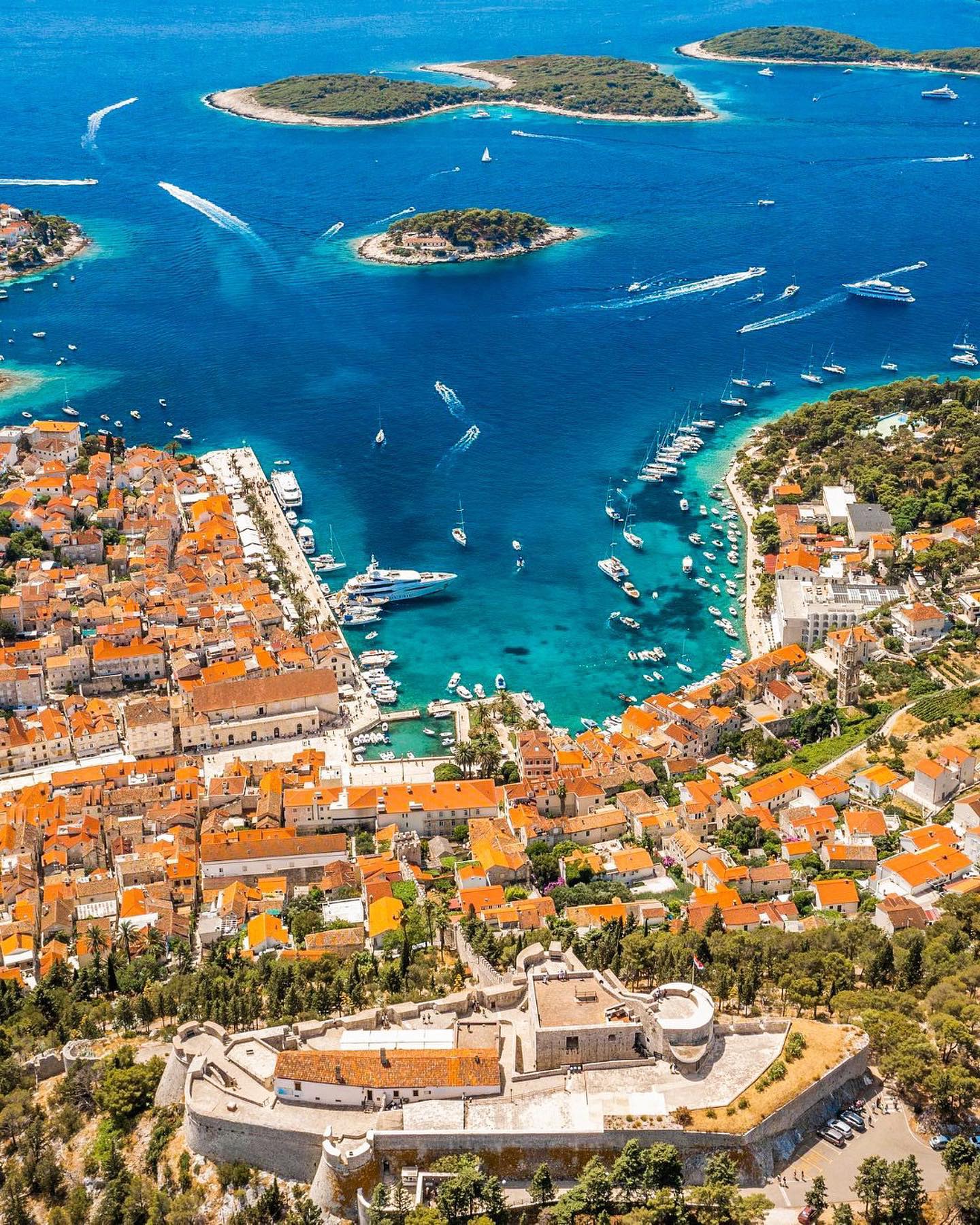
The Splendors from Above
Croats and tourists know the rugged Adriatic coast for its stunning vistas. But the real magic of this coastline only becomes clear from above. As the drone camera hovers over Croatia, a feast of stunning visuals unfolds: beaches so white they outdo imagination, water as turquoise as a postcard, and cliffs plunging into the sea. Like the Brac Islands, some of Croatia's natural beauty is actually made up of multiple islands, which make this a natural sightsee.
Island, Sea, and Sky
Croatia's coastline, often called Dalmatia, is a blend of 78 landmasses, inviting islands, and tiny islets, covering over 1,100 miles — only a bit less than the entire western U.S. coastline. This region doesn't have giant cliffs, active volcanoes, or giant mountains. Instead, Croatia boasts undulating hills and cliffs in chalky white limestone, which can stand breathtaking on their own. Especially from the air. From sea level, some of its beaches and islands have an edge so steep, it seems like the sky is tumbling into the sea. There are small towns and villages nestled along the coast, some modern, some medieval, and some ancient. Harbors act as lungs ventilating the sea breeze to the residents: close enough for ease of access, but also far enough for a sense of isolation. Most of Croatia's Adriatic coastline is located along the Dalmatian coast, creating a breathtaking landscape. To discover the picturesque towns and harbors, one could fly over to the Croatian side of the Balkans. Most of the beaches are dotted with small coastal communities: pearls of secluded towns scattered along the coast. Some, like Hvar or Vis, are insular and self-sustaining, while others, like Split or Dubrovnik, are historic ports. The Adriatic Sea is a gulf-like extension of the Mediterranean Sea, bounded to the southwest by the Strait of Otranto and Italy, by Albania to its southeast, and by tiny but sovereign Bosnia and Herzegovina and Montenegro to the northeast. Located around the Adriatic Sea, there are stunning coastal towns and harbors.
The Tourism Boom
In recent years, Croatia has seen a boom in tourism, with many visitors flocking to its coastal regions. According to Eurostat, Croatia has seen a 21% increase in tourist arrivals between 2019 and now. The stunning aerial views of the Croatian coastline have become a popular means to showcase the natural beauty of the region, attracting tourists from all over the world. This increase in tourism has led to a rise in commercial drone photography in Croatia, a phenomenon that continues to grow.
The Unstoppable Drone Flow
Drone photography has become increasingly popular in Croatia, as it allows photographers to capture stunning aerial views of the coastline that would be impossible to achieve with traditional photography. The drone allows photographers a much greater reach and breadth, letting them capture the landscape's scale, colors, and intricate detail. Shooting drone footage is a high-level skill, requiring the shooter to stay focused on the shot while fully operating a highly agile machine in a windy, coastal environment. Most drones are quadcopters, but despite their names, flights are no longer restricted to the four cardboard corners of a square. Instead, drones come with all six degrees of freedom, meaning that these aerial vehicles move along the x, y, and z axes, but also rotate through the pitch, yaw, and roll axes.
Reaching for the Horizon
The precision of drone photography allows photographers to capture stunning aerial views of the Croatian coastline. With drones, photographers can capture the intricate detail of the coastline, from the jagged cliffs to the turquoise waters and picturesque coves. Drones are flying cameras, which means that the capabilities of a drone flyer to shoot photos and videos is dictated by the camera being used. Higher-quality drones, like DJI's Pro models, use high-quality cameras, allowing photographers to capture stunning aerial views of the coastline that are both crisp and detailed.
The Croatians' Vision for Their Airspace
Croatia's airspace has become increasingly crowded in recent years, as the popularity of drone photography has grown. The increasing number of drones in the air has raised concerns about safety. In 2016, the number of drones in Croatia's airspace increased by 56% from 2016, and the upward trend continues. This increase in drone activity has led to a greater need for regulation and safety measures, with Croatia's Directorate of Civil Aviation (Croatian Aviation Authority) implementing new regulations in 2019 to ensure the safe operation of drones in the country. Drones offer a range of views that normally a photographer wouldn't be able to capture. For instance, a cliff can be fully captured only when photographed from the air, where a drone can position itself parallel to the cliff, hovering vertically. This allows the drone to capture the cliff's vertical face, giving the viewer a clear picture of its height and depth.
How Tourists Can Experience the Adriatic Coast
- Book a Viewing Guide: Tourists looking to experience the stunning scenery of Croatia's coastal towns and beaches from the sky should book a viewing tour from an experienced drone operator.
- Opt for Extravagance: Consider flying to Croatia and renting a luxury villa with a private pool, which would give you a full experience to complement the stunning coastal views.
- Flying the Drone Yourself: If you or your travel companion is experienced in drone photography, consider renting a drone to capture the breathtaking aerial views of the Croatian coastline for yourself.
Questions readers ask
What makes the Croatian coastline so unique when viewed from above?
The Croatian coastline is unique from above due to its blend of white limestone cliffs, turquoise waters, and the intricate layout of its many islands and small towns. This combination creates a stunning visual tapestry that is best appreciated from a bird's-eye view, revealing details like the contrast between the chalky cliffs and the vibrant sea.
How many islands and islets are there along Croatia's Dalmatian coast?
Croatia’s Dalmatian coast consists of 78 islands and islets, stretching over 1,100 miles. This extensive coastline is characterized by its undulating hills and cliffs, which are notably white and made of limestone, offering a breathtaking view from above.
What are some of the notable coastal towns and harbors in Croatia?
Some of the notable coastal towns and harbors in Croatia include Hvar, Vis, Split, and Dubrovnik. These towns range from insular and self-sustaining to historic ports, each offering a unique experience and contributing to the region's rich cultural and historical tapestry.
What has contributed to the recent increase in tourism in Croatia?
The recent boom in tourism in Croatia is largely due to the stunning aerial views of the coastline, which have become a popular means to showcase the region's natural beauty. This has attracted tourists from all over the world, leading to a 21% increase in tourist arrivals between 2019 and now, according to Eurostat.
What are the challenges of drone photography in Croatia?
Drone photography in Croatia, especially along the coastal regions, requires a high level of skill. Photographers must stay focused on capturing the perfect shot while managing a highly agile machine in a windy, coastal environment. Despite the challenges, drone photography offers a unique perspective that traditional methods cannot match.
What is the role of harbors in the coastal towns of Croatia?
Harbors in coastal towns along the Croatian coastline act as vital points of access to the sea breeze, providing a sense of both closeness and isolation. They serve as lungs ventilating the sea breeze to the residents, giving them ease of access while maintaining a sense of seclusion and tranquility.
How have drones changed the way we see Croatia's coastal beauty?
Drones have revolutionized the way we see Croatia's coastal beauty by providing stunning aerial views that were previously impossible to capture. These views have become a popular means to showcase the region's natural beauty, attracting tourists and contributing to the rise in commercial drone photography in Croatia.
Related deep dives
Similar reads based on topic and creator.


Recent articles
Fresh deep dives from the latest Reels we unpacked.


Comments
Be the first to comment.