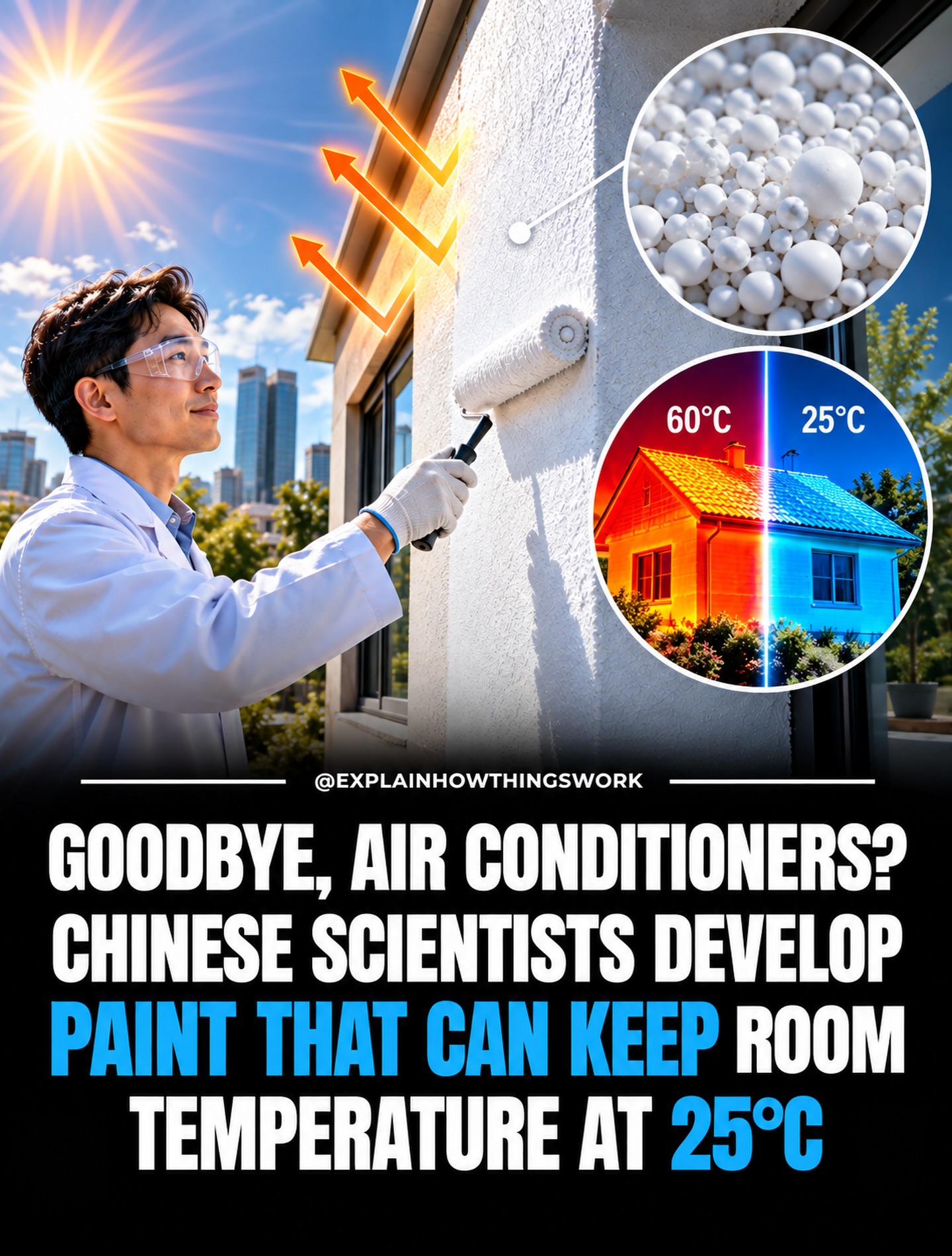
Chinese researchers have developed a paint that can regulate room temperature. Replacing air conditioning in hot conditions, these cooling paints reflect solar heat and keep indoor spaces cooler. But can applying a coat of reflective paint really deliver on its cool promise?
The chilly transformation of the exterior wall
The cooling paint developed by Chinese scientists is more than a new color choice for your home; it’s a technological advance that could transform how we think about indoor climate control. This paint can regulate room temperature to a constant 25°C by reflecting sunlight and reducing the heat absorbed by buildings. Chinese researchers achieved that by creating a paint that works as an innovative exterior wall coating. The reflective paint helps keep buildings cool, but how does it do this? Let’s delve into the mechanics behind it. The key to the cooling paint is its ability to reflect the sun’s rays, preventing heat from being absorbed into a building. The paint uses highly reflective materials — when the sun's rays hit the paint, they bounce off rather than soaking in, which results in much lower temperatures. More than just a cooler appearance, the paint serves as a passive cooling solution, maintaining a much more comfortable temperature — 25°C — without consuming electricity.
The quest for energy efficiency
In a world where energy consumption is a significant concern, the cooling paint serves a more critical role: it could replace or reduce the need for air conditioning. As global temperatures rise, so does the demand for energy-efficient solutions. China has one of the highest rates of air conditioning use. By leveraging cooling paints rather than relying on traditional air conditioning, buildings could see significant energy savings and decreased carbon emissions. Imagine walking into a home where the air conditioning isn't the primary source of coolness. By contrast, a typical room painted with regular paint would quickly rise to 60°C in such hot conditions, meaning the temperature would be 35°C hotter. The contrast is stark and speaks to the potential impact of this cooling paint. This makes the paint not just an alternative, but a revolutionary cooling technology.
Engineering the cooling effect
Reflective materials in action
The paint’s core function lies in its ability to reflect and scatter solar radiation, helping reduce the overall temperature. The coatings contain particles which break down and scatter sunlight, reflecting most of it. Reducing the amount of UV radiation absorbed by the building walls. This makes the buildings immediately cooler.
Smoothing out temperature variations
Cooling paint is a contributor to temperature stability. Contributing to an indoor climate that avoids the dramatic temperature swings that come with air conditioning. Often, spaces with air conditioning can swing wildly from too cool to too warm within short periods. Cooling paint avoids these issues, maintaining a steady and comfortable 25°C.
Enhanced Options for Cooling
The cooling paint can become part of a larger smart-building strategy. As smart cities and eco-friendly buildings become more of a focus, cooling paint also lends a hand. These coatings can be part of a larger strategy to reduce energy consumption and reduce carbon footprint. They can also help reduce the carbon emissions from air conditioning.
Making the switch
For those considering a cooling coat
- Location: Choose a building or home in a hot, sunny climate, where cooling paint will have the most impact. Discover the cooling paint’s effectiveness by testing a small area.
- Application: Apply the paint to the building exterior. The paint can be applied like any other color. The paint’s temperature-keeping properties can then be observed.
- Add-Ons: Combine the paint with additional eco-friendly practices, such as planting shade trees. This can double-down on the cooling effect.
- Time: Monitor the temperature before and after applying the paint. Applying a temperature sensor can highlight any changes. Observing the temperature changes can show improvements in how cool the small area becomes. Consider this information for homeowners and energy-conscious buyers alike. Upgrading the exterior coat of a building can make a significant difference. Those who favor a smart home could find that replacing air conditioning with cooling paint saves energy and money.
Questions readers ask
How does the cooling paint developed by Chinese scientists actually work?
The cooling paint uses highly reflective materials that bounce off the sun’s rays, preventing heat from being absorbed into the building. This results in a much lower temperature, maintaining a constant 25°C indoors, even in hot conditions. The paint’s ability to reflect and scatter solar radiation is key to its cooling effect.
Can this cooling paint really replace air conditioning in hot climates?
The cooling paint has the potential to significantly reduce or even replace the need for air conditioning, especially in hot climates. By keeping indoor spaces at a constant 25°C without consuming electricity, it offers a passive cooling solution that could lead to significant energy savings and decreased carbon emissions. However, its effectiveness might vary depending on the specific climate and building design.
How does the cooling paint compare to traditional air conditioning in terms of energy efficiency?
The cooling paint is far more energy-efficient than traditional air conditioning. It maintains a comfortable indoor temperature of 25°C without using electricity, unlike air conditioning which requires significant energy. This makes it a more sustainable and cost-effective solution, particularly in regions with high air conditioning use, like China.
What makes the cooling paint different from regular paint in terms of temperature control?
Regular paint would cause a room to rise to much higher temperatures, such as 60°C in hot conditions, making the indoor environment 35°C hotter than with the cooling paint. The cooling paint, on the other hand, reflects most of the sun’s rays, keeping the indoor temperature stable and comfortable at 25°C without the need for additional cooling systems.
Can this cooling paint be part of a larger smart-building strategy?
Yes, the cooling paint can be integrated into a larger smart-building strategy. As smart cities and eco-friendly buildings become more prevalent, this paint can contribute to temperature stability and reduced energy consumption. It avoids the dramatic temperature swings often associated with air conditioning, helping maintain a steady and comfortable indoor climate.
Are there any potential downsides or limitations to using this cooling paint?
While the cooling paint offers significant benefits, its effectiveness might vary depending on the specific climate and building design. Additionally, the initial cost and application process of the paint could be factors to consider. However, the long-term energy savings and environmental benefits could outweigh these initial concerns.
How does the cooling paint contribute to temperature stability indoors?
The cooling paint helps smooth out temperature variations by maintaining a steady 25°C indoors. Unlike air conditioning, which can cause dramatic temperature swings, the paint provides a consistent and comfortable indoor climate. It reduces the need for frequent adjustments to cooling systems, contributing to a more stable and pleasant environment.
Related deep dives
Similar reads based on topic and creator.




Recent articles
Fresh deep dives from the latest Reels we unpacked.




Comments
Be the first to comment.