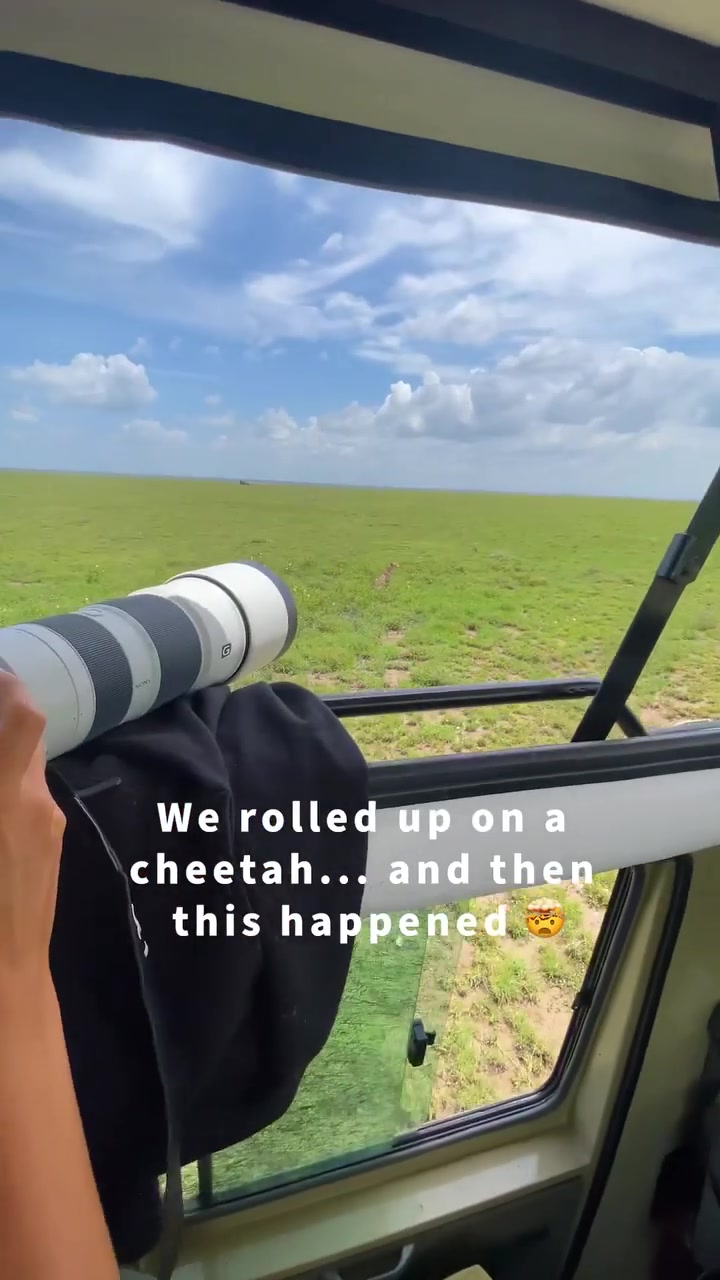
A wild cheetah, up close and personal. During a safari, the big cat leaps onto the top of a vehicle for an unexpected encounter.
Cheetahs: The Wildcat of the Plains
Cheetahs are apex predators of the savannah, known for their speed and agility. They can reach speeds of up to 70 to 75 mph, making them the fastest land animal. They hunt small antelopes, hares, and birds. All the cheetahs have distinctive black "tear marks" stretching from the corner of each eye to the side of the nose—this is believed to be an adaptation to reduce the glare of the hot sun and improve vision during hunts. The cheetah lives on plains and open grasslands. With a lithe body, long legs, and a distinctive pattern of spots and solid black patches on the back, cheetahs are one of the most recognisable big cats. However, their distinctive look is not the only thing that sets them apart. It also holds the record for the fastest land animal, and is a large, slender cat with a long, slender face, slender build, and long legs, modified to facilitate quick movement and speed. Their distinctive "tear marks" are a signature trait that helps deflect the sun's glare and improve their eyesight, while the "cheetah spots" serve as camouflage and help regulate body temperature. Unlike other big cats, cheetahs have unique, semi-retractable claws that provide extra traction for sudden bursts of speed. Another physical feature is the small head and long legs which facilitate running.
The Savannah Safari: Cheetahs in Their Habitat
Cheetahs today have an estimated population of 6,700 individuals. Only around a third of the world's cheetah population is located in protected areas leaving the cheetahs at risk from poaching and from habitat loss. The challenges faced by these big cats and other species are part of a larger problem. The rapidly changing climate is forcing many species out of vulnerable habitats. This makes conservation efforts more urgent. The decline of habitat loss is largely due to humans making the savannah plains uninhabitable for the big cats.
The Enigmatic Behaviour of Cheetahs
The effect that humans have on the savannah does not stop with their habitat, humans also have a profound impact on the behavior of the cheetah. Cheetahs are social animals that live in small groups, referred to as coalitions, consisting of males or males and females. Male cheetahs often form strong bonds with their siblings or other males, while females typically live solitary lives, only associating with males during mating or to protect their young. Notably, cheetahs are known for their flexible social structures, adapting their behavior based on environmental pressures and food availability. An adult cheetah hunts individually, though this can sometimes be difficult. The cheetahs also will often perform a unique hunting technique. This involves a "stalk and chase" method, where they slowly and patiently creep up on their prey before accelerating in a burst of speed to take down their target. Cheetahs also have various vocalizations to communicate with one another or to express alarm or fear. As they are the fastest terrestrial animal, they spend much of their time surveilling the territory from high points or trees. More often than not, cheetahs have to leave their territory when they hunt or when they practice their unique behavior.
When Cheetahs Climb On Top of Safari Vehicles
Approaching a cheetah is an experience unlike any other. We rolled up on a cheetah... and then this happened,...Ok now she's getting closer". The cheetah saw the vehicle as a convenient vantage point or a way to get closer to the camera. It feels a lot like when people would climb onto the roof of a treehouse for a clear view of the sky. The creature's reaction showed a surprising level of curiosity. While it might sound like a simple enough thing, the fact that the cheetah climbed onto the roof of a safari vehicle was a rare occurrence. It is also important to note that this encounter is quite unusual. This event is a testament to how cheetahs are still curious and curious animals, but also that they are not naturally hostile towards humans. Cheetahs are typically wary of humans, preferring to maintain a safe distance. Moreover, they are also curious animals that are always on the lookout for new experiences. However, they are always carrying out their activities in their natural habitat and not doing anything out of character
The Safari Experience
Cheethas are one of the more popular animals to see on a safari. Cheethas often become one of the favorite animals to see on a visit to a safari. They are an exciting animal to see when on safari in South Africa. According to the vision data, many safari-goers are willing to pay a premium to see these magnificent creatures in their natural habitat. While there isn't enough data to prove that it is the cheetah's appearance, it is safe to say that cheetahs add an element of excitement to any safari.
Encountering Cheetahs Responsibly
Safari enthusiasts chasing an adrenaline rush to see a cheetah might need a lesson in safety. If you encounter a cheetah, always prioritize safety and respect for the animal. If you are planning on going on a safari in South Africa, consider the following tips:
- If you encounter a cheetah, remain calm and still. Avoid sudden movements or loud noises that could startle the animal.
- Never approach a cheetah on foot or attempt to feed or touch it.
- Always maintain a safe distance from the animal, and follow the guidelines provided by your safari guide or local wildlife authorities. Stay inside your vehicle when in close proximity to the animal.
- Support conservation efforts by choosing responsible tour operators that prioritize animal welfare and habitat preservation.
Questions readers ask
What makes cheetahs unique among big cats?
Cheetahs are unique for several reasons. They are the fastest land animals, reaching speeds up to 70-75 mph. They also have distinctive 'tear marks' that help reduce glare and improve vision. Additionally, their semi-retractable claws and long legs facilitate quick movement and speed, unlike other big cats.
Why did the cheetah climb onto the safari vehicle?
The cheetah's behavior is hard to pinpoint without more context, but it could be due to curiosity, seeking a better vantage point, or even trying to get a closer look at the tourists. Cheetahs are known for their agility and adaptability, so this kind of behavior, while surprising, is not entirely out of character. The incident highlights the challenges facing cheetahs, including habitat loss and human interaction.
What are the main threats to cheetah populations?
Cheetahs face several significant threats. Habitat loss, due to human activities making the savannah uninhabitable, is a major issue. Additionally, poaching and the effects of climate change, which force many species out of vulnerable habitats, pose serious challenges to their survival. Only around a third of the world's cheetah population is located in protected areas, leaving many vulnerable to these threats.
How do cheetahs hunt and what makes their hunting style unique?
Cheetahs use a unique 'stalk and chase' hunting technique. They slowly and patiently creep up on their prey before accelerating in a burst of speed to take it down. This method is made possible by their exceptional speed and agility, which are facilitated by their long legs, semi-retractable claws, and distinctive body structure. Their hunting style is a testament to their remarkable adaptability and efficiency as predators.
Related deep dives
Similar reads based on topic and creator.



Recent articles
Fresh deep dives from the latest Reels we unpacked.




Comments
Be the first to comment.