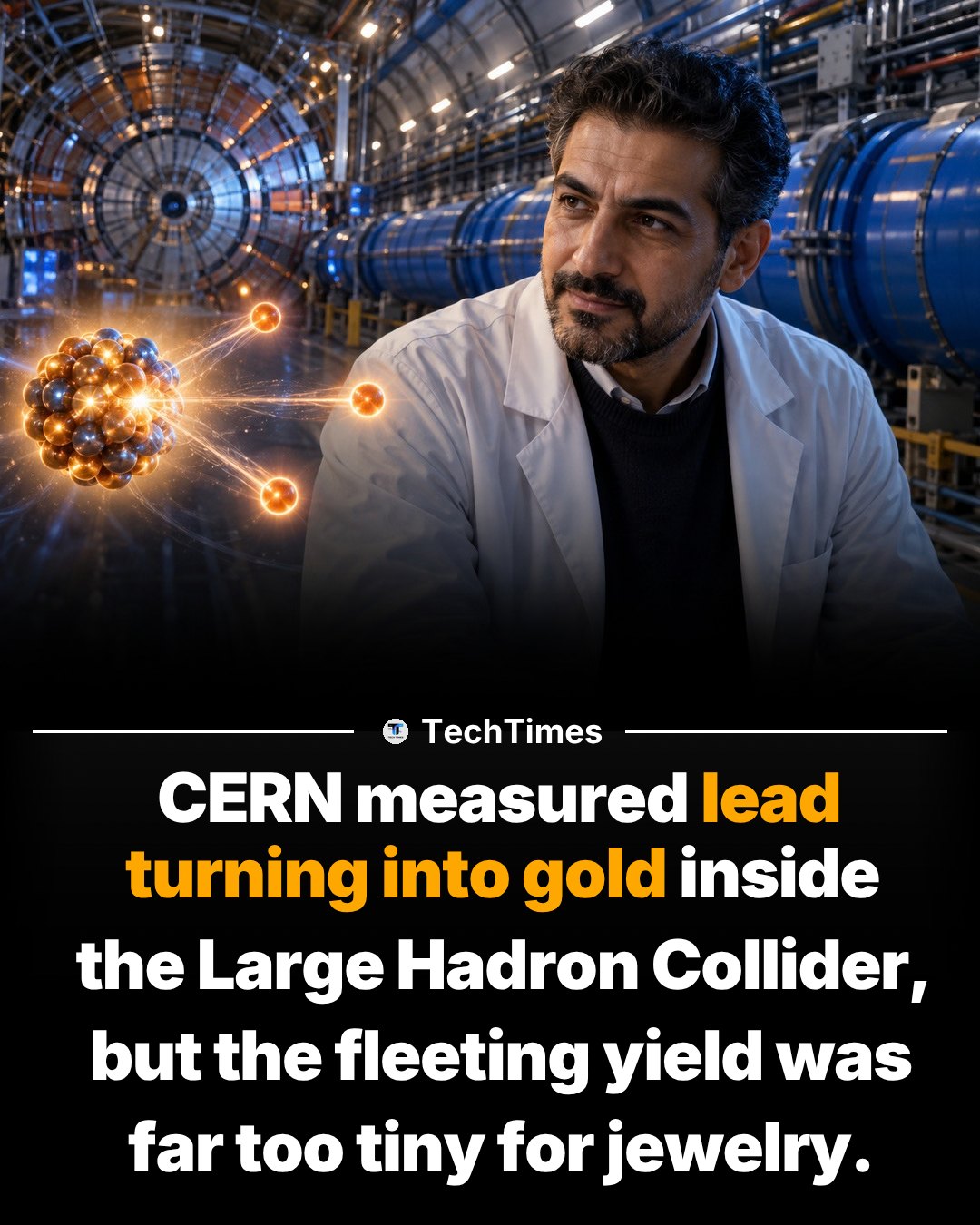
Turning Lead into Gold
CERN scientists recently carried out a groundbreaking experiment at the Large Hadron Collider, succeeding in transforming lead into gold. While vital for confirming theoretical predictions, the resulting yield was incredibly small, estimated as too tiny for jewelry production. The achievement underscores a century-old dream of alchemists and holds potential for new medical and technological advancements. The experiment represents a significant milestone in nuclear physics, showcasing the Large Hadron Collider's transformative capability.
The Alchemical Feat
Transmuted lead is not a new idea—in fact, it is the dream of alchemists for centuries. The element gold is the most malleable and non-toxic metal. It is extremely resistant to corrosion and tarnishing, which makes it valuable. Gold is also a good electrical conductor and has a very high density. This is a chemical element with the atomic number 79. Scientists view gold as a perfect chemical element to study. Scientists at the Large Hadron Collider successfully turned lead into gold within the Large Hadron Collider. The experiment involved splitting the nucleus of a lead atom, then transforming fragments of the nucleus into gold. This involved smashing the lead nuclei (each consisting of 82 protons) and disrupting the nuclear structure. The experiment made the nucleus eject more than protons and neutrons, potentially ejecting fragments that match the atomic structure of gold (with fewer protons than the original lead nucleus). In essence, lead atoms transmuted into gold atoms, though the process also produced other elements. The transformation involves complex nuclear reactions. The collision takes place with a higher density beam of lead ions. The resulting fragments are then analyzed. The fragmentation yields are critical for understanding the stability of different elements and advancing nuclear physics.
Mining the Scientific Gold Rush
Nuclear reactions at high energies can transform one element into another. While the process is not new, achieving it efficiently is a game of precision and scale. The result was so small that it wasn't sufficient for practical applications. However, it marks a validation of the underlying theories that govern nuclear reactions. The Large Hadron Collider, a 27-kilometer circular particle accelerator built by CERN, remains one of the most powerful tools at the disposal of scientists. It enables the recreation of conditions from the Big Bang, offering a glimpse into the fundamentals of our universe, and the study of particles and their interactions.
The Large Hadron Collider’s Unique Role
The Large Hadron Collider has been instrumental in many discoveries. Not only is it one aspect of CERN’s name, but it also is a significant part of CERN’s legacy. CERN stands for Conseil Européen pour la Recherche Nucléaire, or European Organization for Nuclear Research. It is one of the world’s most respected centers for scientific research. This means that when a project is handled at the Large Hadron Collider, scientists have huge expectations. The Large Hadron Collider does not have direct access to the nucleus of atoms. Instead, it uses a beam of protons or heavy ions. The beam o causes a collision between the particles. This then produces a new form of matter, which is sometimes in the form of particles. This is very different from any other form of matter on Earth.
The Alchemist’s Legacy
The Large Hadron Collider’s ability to transmute lead into gold is rooted in the fundamental principles of nuclear physics. The process involves smashing lead nuclei to produce a variety of particles, including gold. The resulting fragments are then analyzed to determine if any gold particles were produced. This experiment is similar to an ancient alchemist’s dream.
The Gold’s Promising Future
The transformation of lead into gold, though minuscule, holds immense potential. At this point, the experiment demonstrated that nuclear reactions could stabilize the new forms of matter. This means that the new forms of matter could potentially be used for medical or technological purposes. However, the experiment only demonstrated the possibility. There is still a lot of work to be done before it can be used for practical purposes. The experiment has been hailed for its scientific impact. This is a huge step forward. The discovery of gold particles could mean that there is a potential for medical advancements. This is because gold is known for its antibacterial properties.
Navigating a Gold Standard
For anyone interested in the transformation of elements, the resources available at CERN are invaluable. The Large Hadron Collider offers to explore some of the most fundamental aspects of nature. The experiments conducted here are at the forefront of modern science.
- Explore CERN’s Resources: CERN offers numerous resources for enthusiasts and professionals alike. It allows researchers to explore complex phenomena such as the Big Bang. There are also plenty of opportunities for public involvement. For example, the public can visit the center for tours or participate in public lectures. These resources allow interested parties to immerse themselves in the pioneering experiments.
- Dive into Nuclear Physics: Understanding the principles behind the transformation of lead into gold requires a solid foundation in nuclear physics. Books like "Nuclear Physics" by W. D. Hamilton and "Introduction to Nuclear Physics" by Kenneth S. Krishnan provide comprehensive introductions to the field. Online courses and tutorials are also excellent resources for beginners.
The Experimental Longevity Of Big Discoveries
The feat achieved by CERN scientists is part of a larger scientific quest to unlock the mysteries of the universe. The Large Hadron Collider continues to push the boundaries of what we know about fundamental particles and forces. While the current result may be small, it paves the way for future discoveries that could revolutionize technology and medicine.
Questions readers ask
How did CERN scientists manage to turn lead into gold?
CERN scientists achieved this by smashing lead nuclei in the Large Hadron Collider, which disrupted the nuclear structure and caused the nucleus to eject fragments. Some of these fragments matched the atomic structure of gold, effectively transforming lead into gold. The process involved complex nuclear reactions and precise control over the high-energy collisions.
Why is this discovery important if the yield is so small?
The discovery is important because it validates long-standing theories in nuclear physics and demonstrates the Large Hadron Collider's capabilities. While the yield is too small for practical applications like jewelry, it opens doors to new medical and technological innovations by proving that such transformations are possible.
Can this process be scaled up to produce more gold?
As of now, scaling up this process to produce significant amounts of gold is not feasible. The yield from the current experiments is incredibly small, and the process requires highly controlled conditions and massive energy inputs that are not practical for large-scale gold production.
What other elements were produced during the experiment?
The experiment not only produced gold but also resulted in a variety of other elements. The high-energy collisions caused the lead nuclei to eject fragments that could form different elements, making the process a complex mix of nuclear reactions and transformations.
How does the Large Hadron Collider facilitate this kind of experiment?
The Large Hadron Collider is a 27-kilometer circular particle accelerator that can recreate conditions similar to those of the Big Bang. This allows scientists to study fundamental particles and their interactions, making it an ideal tool for experiments like turning lead into gold.
What are the potential medical and technological innovations stemming from this research?
The research could lead to advancements in medical imaging and treatment, as well as new materials with unique properties. By understanding how to transform elements at a fundamental level, scientists could develop new technologies that revolutionize various industries.
Related deep dives
Similar reads based on topic and creator.




Recent articles
Fresh deep dives from the latest Reels we unpacked.




Comments
Be the first to comment.