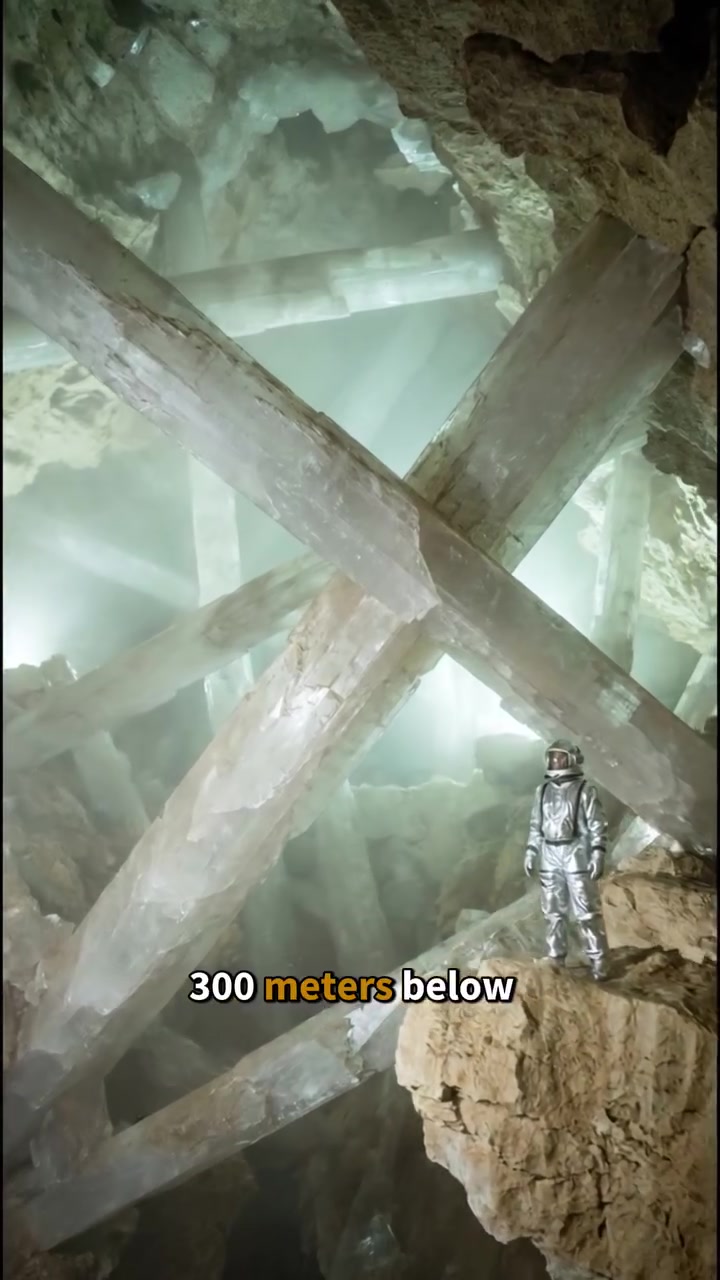
A mere 300 metres below Mexico lies a place called Naica, a cave that hosts crystals the size of buildings. This extreme location is the Cave of the Crystals, and it's as deadly as it is breathtaking. The air inside is so hot and humid that without specialized gear, you'd drown in your own condensing breath. The problem is that no one knows exactly how these massive crystals grew because pumps which drained the water haven't been working. When water flooded again, it flooded all the answers.
Stepping Into the Menacing Beauty of Naica
The Cave of the Crystals in Naica, Mexico, is roughly 300 meters beneath the Earth's surface, a descent that places it 100 metres below an even lower cave system. Here, cavern walls are lined with crystal columns that stretch upwards to the ceiling, some rising 11 meters and tipping the scales at over 50 tons, making them the Earth's largest natural crystals. The crystals' growth period begs the question: How could anything so delicate and fragile grow to such monumental sizes? The answer is in the cave’s unique hydrothermal system. Cristalization requires time and specific environmental conditions. The crystals' extreme slow growth needed millions of years in perfect conditions, with the magma below heating the water to the exact temperature to allow for these crystals to form. Inside the Naica Cave, the water was so hot that it was over 50 degrees and had humidity of 100%. Nearby magma kept the water at just the right temperature, enabling the crystals' century of slow growth. The crystals grow so slowly that in a century, a column thickens only the width of a hair.
The Uneasy Allure of Extreme Environments
Extreme environments, such as caves, hold an uncanny allure. The cave's crystalline beauties attract explorers, scientists, and even NASA researchers. However, these locations are not a playground, but a challenge of our survival. The Cave of the Crystals is not a place for casual visits and has been closed to visitors. Attractions like the Crystal Cave are one-of-a-kind geological wonders, representing the unique conditions that formed and preserved them. They have been explored for scientific discovery, but also to test human endurance and technological limits, whether that be diving deep underwater in cold water, or wearing thick suits and breathing apparatuses in order to explore harsh environments. These environments also offer the scientific community an opportunity to observe how microbial life can thrive in extreme conditions, even under the weight of over 50 tons in crystal form. However, more than just offering extreme exploration, these environments are full of history. It’s not only the history of the crystals’s formation, but also the history of human exploration. The exploration of such environments is a showcase of human curiosity and our capacity to adapt. In this journey of discovery, science and human history entwine, giving us a deeper understanding of the earth and our place on it.
Rooted in Magma, Thriving in Isolation
The crystal formations of the Cave of the Crystals are the result of perfect hydrothermal conditions, sustained by underground magma. The magma heats the mineral-rich water to just the right temperature, allowing the crystals to grow slowly and continuously for over half a million years. The crystals themselves are made of gypsum, a hydrated form of calcium sulfate. The mineral-rich water deposits gradually onto seed crystals, forming the massive columns we see today. However, these formations only grow in the right environmental conditions, and are not at all common.
Ancient Microbes in Extreme Isolation
The most fascinating discovery was by NASA scientists. Bacterial life contained in the preserved crystals was found by NASA scientists for up to 50,000 years. These bacteria were found in tiny bubbles trapped within the crystals, and were so well preserved that they could potentially be revived. These bacteria feed on nothing but iron and sulfur. NASA researchers are most interested in these because these bacteria are so isolated, their evolution into complex life might be informative in finding extraterrestrial life. Because if life can survive in the most extreme conditions on earth, it might be able to survive in other harsh environments such as outer space.
A Wide-Ranging Watery Extremes
Crystals like these are not unusual in the world. They are found in other locations such as Brazil and other countries. These crystals also have this characteristic of measuring between 3 to 4 meters, and 20 centimeters in diameter. Not all the caves have been explored because of the harsh ecological conditions, but also lack of funding. The main issue is that some caves are flooded, requiring complex diving techniques and gear, and other caves are simply too dangerous to enter. Crystals are fascinating for their beauty, and scientists are still uncovering their secrets. It took millions of years for these crystals to become the way they are today. The researchers who first started to explore these caves felt like they were exploring the planets, such as Mars, as these caves were completely alien. Getting to see them in person is a highlight to an adventure.
Adventuring in the Crystal Underground
The harsh conditions of the Cave of the Crystals require specialized equipment and training. Here’s how you would approach exploring such a cave:
- Find a guide: — Specifically trained in cave diving who knows the cave's specific hazards.
- Gear up: — A full diving suit and specialized breathing apparatuses.
- Oxygen and water: — You'll need extra oxygen tanks to manage this cave's high humidity and temperatures.
- Training: — Training on how to handle emergencies and risks that come with cave diving in high temperature and high humidity.
- Stay hydrated and cool: — Drink lots of water before and after the exploration. The extreme humidity makes it easy to dehydrate.
Questions readers ask
What kind of crystals are found in the Cave of the Crystals?
The Cave of the Crystals is home to selenite crystals, which are a type of gypsum. These crystals are known for their transparency and clarity, and they can grow to enormous sizes in the unique conditions found deep in the cave. Some of the crystals in the Cave of the Crystals reach up to 11 meters in height and weigh over 50 tons.
How did the Cave of the Crystals form?
The Cave of the Crystals formed over millions of years due to a unique hydrothermal system. Magma beneath the earth's surface heated water to precise temperatures, creating an environment where crystals could grow extremely slowly. The water in the cave was over 50 degrees Celsius with 100% humidity, which helped the crystals to form and grow to such monumental sizes.
What makes the Cave of the Crystals so dangerous to explore?
The Cave of the Crystals is extremely hot and humid, with temperatures reaching over 50 degrees Celsius and 100% humidity. This environment is so harsh that without specialized gear, explorers can literally drown in their own sweat. Additionally, the cave is located 300 meters below the Earth's surface, making it a challenging and dangerous location to access.
Why is the Cave of the Crystals closed to visitors?
The Cave of the Crystals is closed to visitors because of the extreme environmental conditions inside. The heat and humidity make it nearly impossible for humans to explore without specialized gear, and the risk of injury or death is high. Additionally, the cave's unique and delicate crystal formations could be damaged by human presence, so access is restricted to protect the site.
How do scientists study the Cave of the Crystals if it’s so dangerous?
Scientists study the Cave of the Crystals by using specialized gear and conducting research in short, controlled visits. The extreme conditions make it difficult for humans to explore, so researchers often use robotic equipment or advanced technology to gather data. NASA researchers, for example, have visited the cave to study how microbial life can thrive in such harsh environments, which could have implications for understanding life on other planets.
What is the significance of the crystals in the Cave of the Crystals for scientific research?
The crystals in the Cave of the Crystals are significant for scientific research because of their unique size and the conditions in which they formed. Studying these crystals can provide insights into Earth's geological history and the processes that shape our planet. Additionally, the extreme environment of the cave offers a unique opportunity to study how microbial life can survive in harsh conditions, which could have implications for understanding life on other planets or in extreme environments on Earth.
Related deep dives
Similar reads based on topic and creator.



Recent articles
Fresh deep dives from the latest Reels we unpacked.

Comments
Be the first to comment.