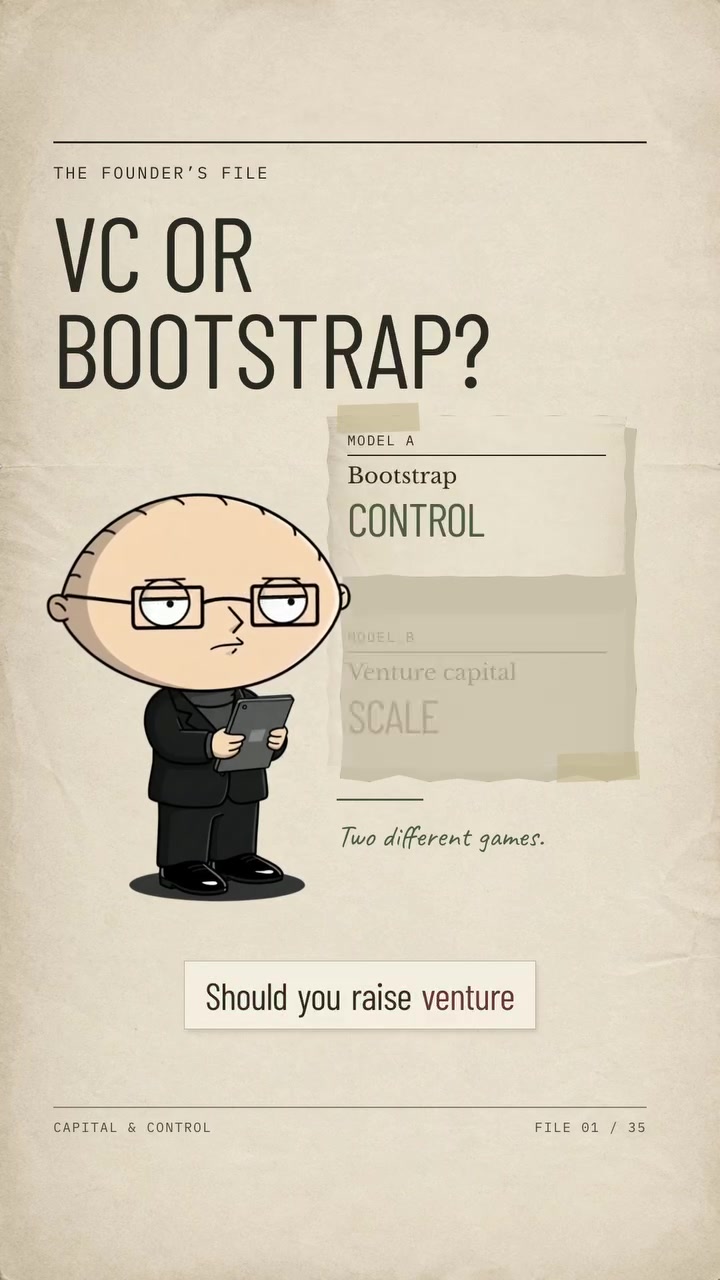
The Startup Dilemma: Bootstrapping vs. Venture Capital
Early in a startup's life, founders face a crucial decision: raise venture capital or bootstrap from personal funds and revenue. Both paths offer different trajectories, neither inherently better. The choice depends on the business vision, market needs, and personal goals.
The Two Games
The decision between venture capital and bootstrapping presents two fundamentally different funding games. Bootstrapping means running a business with personal funds and the revenue it generates. Your startup makes $20,000 in a month. That pays for servers, salaries, and growth. You control the business entirely. There are no investors on the cap table, and no new fundraising rounds every 18 months. Once profitable, you decide whether to keep growing, take dividends, or sell. The downside is that you can only spend what you can afford. If you sell a bootstrapped company for $20 million while owning 90%, you take home an $18 million gross share—before taxes and other claims. In contrast, venture capital involves exchanging cash for equity. Raising $3 million might mean giving up 15% of your company. This accelerates growth, hiring, and expansion even if revenue doesn't yet support it. But investors expect big outcomes to return their fund. In VC, you aggressively grow, raise more capital, and aim for hundreds of millions or billions. Venture capital makes sense in markets where speed is essential. Examples include building a marketplace with a winner-takes-all dynamic. Conversely, a profitable niche like a B2B SaaS with a small team might not need VC.
What Bootstrapping Says About The Market
Bootstrapping is not a lack of ambition. It's a deliberate choice to optimize for control and optionality. If your business can operate leanly and profitably, bootstrapping might make sense. This is especially true if the market isn't large enough to support a venture-scale outcome. Yet bootstrapping in a market where speed is crucial can be risky, as competitors with VC funding can outpace you. Venture capital, on the other hand, optimizes for speed and scale. If your business needs significant capital before it works, and the market supports a large outcome, VC might be the better choice. The key is to match the funding strategy to the business needs and market dynamics, not to view one as more ambitious than the other.
The Practical Difference
Fundamentally, each startup's path is different. Bootstrapping is tied to the revenue your business generates. You keep more control but your resources can limit how quickly you can move. Venture capital, instead, gives you the cash to hire, build, and expand faster. In exchange, you give up some ownership and take on expectations for a much bigger outcome.
Ownership and Exit Strategy
Ownership is a significant factor when comparing bootstrapping and venture capital. The scenario of owning 90% of a company that sells for $20 million versus 20% of a company that sells for $100 million illuminates this difference. Dilution isn't inherently bad; 20% of a billion is more than 100% of nothing. The question is what the capital actually helps you create.
Capital and Control
If a business needs a lot of money before it can work, venture capital might be necessary. However, if speed matters more than profit right now, or if the market is big enough to support a venture-scale outcome, VC makes more sense. Bootstrapping optimized for control, while VC optimizes for speed and scale.
Finding the Right Model
Choosing between bootstrapping and venture capital depends on several factors. If you strongly believe venture capital is essential for the specific project, you must effectively communicate this belief and the reasons behind it.
Market Fit
Ask yourself: Does this business need a lot of money before it works? And Does speed matter more than profit right now? Asking these questions may also lead you to conclude that bootstrapping is the right choice for you. This is because bootstrapping allows you to maintain a strong control of your company, and avoid investors on the cap.
Business Model
The trade-off between bootstrapping and venture capital gets interesting at the exit. Owning 90% of a business that sells for $20 million means an $18 million gross share—before taxes and other claims. But a bigger sale with investors involved doesn't automatically mean a bigger payout for the founder. Dilution and deal terms matter. Bootstrapping is not a lack of ambition, but a conscious choice to optimize for control and optionality. In contrast, venture capital optimizes for speed and scale. Neither is inherently better; the mistake is raising money for a business that never needed it, or bootstrapping a market where being slow means someone else wins.
Market Momentum
The market conditions also play a major role. In a market with winner-takes-all dynamics, such as a marketplace, speed is crucial. Hence, venture capital makes sense. However, in a market that favors profitability and lean operations, bootstrapping might be the better option. If you believe that your business could grow regardless of external capital, bootstrapping might be more suitable. ## Practical Decisions Between these two paths, there is no easy answer, only the right fit for your particular vision. Consider these factors before making a decision:
- Risk tolerance:
- VC : If you think that failure is an inevitability and is okay with it.
- Bootstrap : If you want to have control in your business.
- Time Horizon:
- VC: If you want to build your business quickly and are prepared to deal with the risks.
- Bootstrap: If you would rather develop an internal control system and grow gradually.
- Resource Availability:
- VC: If you believe that your business could grow unprecedentedly and are confident in your ability to attract investors.
- Bootstrap: If you believe that your business could grow without external capital.
Finishing Thoughts
Bootstrapping and venture capital offer distinct paths for startup founders. Bootstrapping provides control and optionality, while venture capital accelerates growth and scale. The key is to match the funding strategy to your business needs and personal goals. Ask yourself: Does this business need a lot of money before it works? Does speed matter more than profit right now? Is the market big enough to support a venture-scale outcome? Answering these questions will help guide your decision. In the end, the goal isn't to raise the most money; it's to choose the funding that fits the business you want to build.
Questions readers ask
What exactly is bootstrapping and how does it work?
Bootstrapping involves running a business using personal funds and the revenue it generates. This means you have complete control over the company and can decide how to reinvest profits or take dividends. However, your growth is limited to what you can afford, and you might need to operate leanly to ensure you don't outspend your income.
How does venture capital work and what are the trade-offs?
Venture capital involves raising funds from investors in exchange for equity in the company. This provides a significant cash injection to accelerate growth, hiring, and expansion. However, it comes with the trade-off of owning less of the company. Investors expect big returns, so you'll need to aim for a large-scale outcome to satisfy their expectations.
Can a startup switch from bootstrapping to venture capital later on?
Yes, some startups initially bootstrap and raise venture capital later on. This hybrid approach can help the founders maintain control during the early stages and then accelerate growth with VC funding. However, the decision to switch should align with the business needs and market dynamics.
How do I know if my startup is better suited for bootstrapping or venture capital?
Consider the market needs and your business vision. If your business can operate leanly and profitably, and the market isn't large enough to support a venture-scale outcome, bootstrapping might be the better choice. Conversely, if your business needs significant capital and the market supports a large outcome, venture capital might be more appropriate.
What are the ownership implications of choosing venture capital over bootstrapping?
Choosing venture capital means giving up a portion of your company's ownership in exchange for funding. This dilution can be significant, especially if you raise multiple rounds of funding. However, the goal is that the value of the company will increase significantly, making the percentage you own more valuable than it would be if you bootstrapped.
What are the risks of bootstrapping in a market where speed is crucial?
If you bootstrap in a market where speed is essential, you might fall behind competitors who have venture capital funding. These competitors can outpace you in terms of growth, hiring, and expansion, which could put your startup at a disadvantage.
How does the exit strategy differ between bootstrapped and VC-backed companies?
For a bootstrapped company, the exit strategy might involve selling the company when it's profitable and you've achieved your goals. In contrast, VC-backed companies often aim for a much larger exit, such as an acquisition or IPO, to provide a significant return on investment for their investors.
Related deep dives
Similar reads based on topic and creator.




Recent articles
Fresh deep dives from the latest Reels we unpacked.



Comments
Be the first to comment.