What it is: Equity and governance
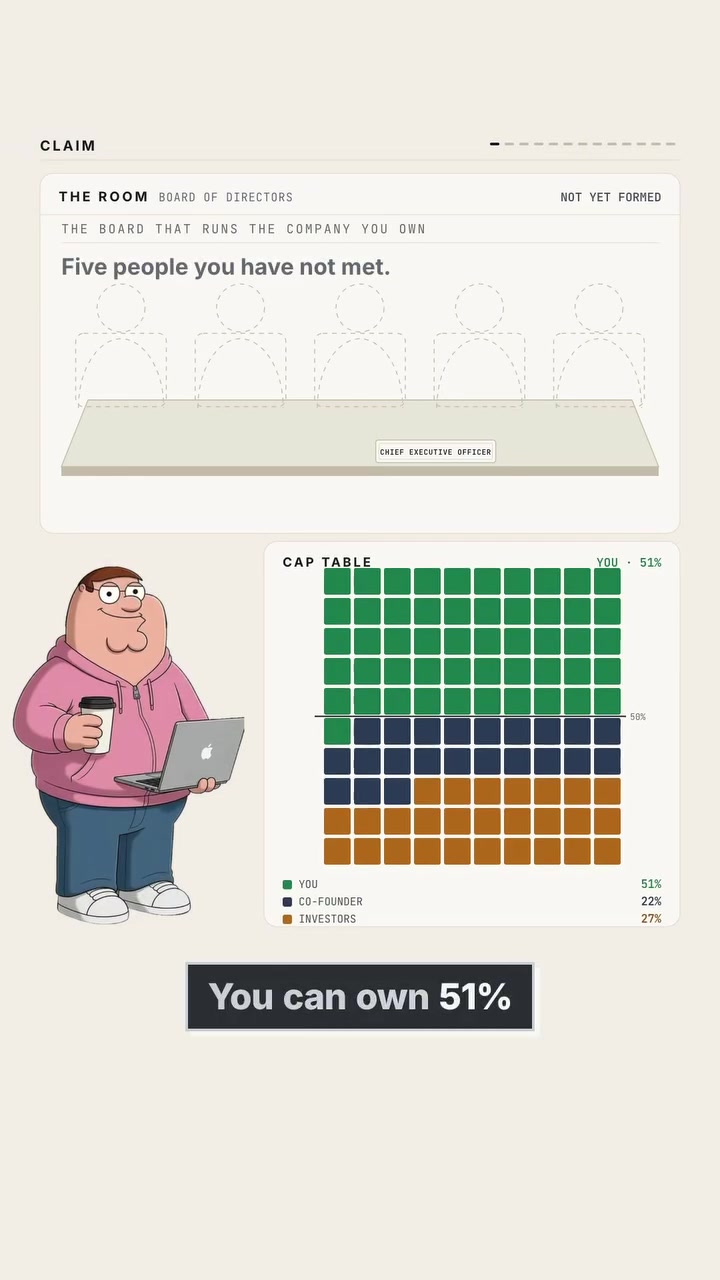
Startup founders often hear about owning a stake in the company they produce. Owning a majority of the shares means owning a majority of the economic gain, often around 51% is considered control. Two different scoreboards exist: the economic scorecard tracked by shares and the operational scoreboard tracked by the board of directors. Shares determine economic ownership: who owns what percentage, who benefits if the company is sold, and who gets shareholder voting rights. But these voting rights are distinctly separate from the board of directors' governance, which controls many of the biggest decisions on how the company is run, including who serves as CEO. Owning a majority of shares does not necessarily translate to operational control. For example, a founder might own 51% of the shares but only hold one or two of the five board votes. The board is composed of various stakeholders which include the founder, co-founder, investors, and an independent director. The voting process to elect the leader and make decisions can be more complicated than simply counting shares. Investment rounds and financing rounds add seats to the board, and these seats are often allocated to investors. As a result, the board may grow and dilute the founder's control, even if the founder retains the majority of the shares.
Separating ownership and control
The division between equity and governance is crucial in understanding the dynamics of a company’s control structure. Investors, especially those who negotiate a board seat in financing rounds, hold contractual board rights. Certain classes of stock may have the right to elect specific directors based on separate votes, preferred shareholders may have separate voting rights, and independent directors may be left in the middle when it comes to board decisions. Founders need to understand that equity and governance are not the same. You might have 51% of the equity and you might think you're in control. However, if three out of five board members vote against you, you are removed from your position. You retain your shares, but lose control.
Seats at the voting table
The Founding Board
Founders and co-founders typically start with a majority control of the board of directors. This control is often represented by three board seats: the founder, the co-founder, and another person the both agree on. The founder and co-founder hold each majority of the board votes and influence the company.
The Investor’s Arrival
When a round of seed funding is raised, the investor often negotiates a board seat. This changes the board composition and dynamics, growing it from three seats to four. As additional rounds of funding are raised, the board may grow further to include more investors. This increases the number of board seats and dilutes the founder's control.
The Power Shift
With multiple investors and independent directors, the board composition can become complex. The founder may retain a significant percentage of equity, but the voting power may still shift. For instance, you might own 51% of the company. With five seats on the board: you, your co-founder, two investor directors, and one independent director- you only control one or two of those votes. The voting on the board can determine who remains as CEO. Your vote to stay, co-founder supporting you but investors and the independent director voting against you could easily remove you from the executive position.
The Power of the Board
The board decision-making power
The board of directors is responsible for making the most important decisions about the company's strategic direction, operations and significant financial agreements. These decisions are not made solely by counting the number of shares. Oftentimes board seats are negotiated by mutual agreement or can be held by preferred shareholders and independent directors.
The independent director
The independent director is often a crucial figure in the board's decision-making process. In the case of a tie vote, the independent director's decision can swing the outcome. The independent director may also be appointed by mutual agreement between the founders and investors, adding a layer of complexity to the board dynamics.
Situation: The Steve Jobs Example
In the 1980s, Steve Jobs, one of Apple's founders and a major shareholder, was pushed out of his operating role despite his significant equity stake. This highlights how ownership alone does not guarantee operational control. It is the board of directors that has the power to make or break a CEO.
Navigating Equity and Governance
Looking forward, founders need to navigate their equity and governance carefully. Every founder, when looking to raise money, needs to ask a series of questions to keep their power.
- Seat composition: how many board seats will there be? Who will appoint each one? Who controls the independent seat?
- Voting rights: what decisions need board approval? What happens in a tie?
- Investment rounds: How much equity is the investor requesting for a seat on the board?
- Operational control: What decisions might dilute your equity more than expected?
Translation to practical approach
Understand your cap table and know who is on the board. Often, while focusing on equity, founders may overlook the governance aspect. Startup governance includes understanding the influence of different classes of stock, the board structure, and the associated voting rights and constraints. Founders should thoroughly understand the board composition, voting rights, and the decision-making process before signing any financing papers. Equity determines how much control a founder has, but governance tells the founder how much power they actually have.
Questions readers ask
If I own 51% of the shares, do I automatically control the board of directors?
Not necessarily. While owning 51% of the shares gives you a majority of the economic stake, it doesn't guarantee control over the board. The board's decisions are made by its members, who can include investors, co-founders, and independent directors. So, even with 51% of the shares, you might only have one or two votes on a five-member board.
How does the board of directors make decisions, and who are the members?
The board of directors typically includes the founder, co-founder, investors, and independent members. Decisions are made through a voting process, where each member has a vote. Investors often gain board seats through financing rounds, which can dilute the founder's control. The board oversees major company decisions, including electing the CEO.
What happens if investors gain control of the board, but I still own 51% of the shares?
If investors gain control of the board, they can make significant decisions about the company's operations, even if you own 51% of the shares. This means they could potentially remove you from your position, even though you retain your economic stake in the company.
How do independent directors fit into the board dynamics?
Independent directors are not affiliated with the company or its major shareholders. They are often brought in to provide an unbiased perspective and ensure good governance. However, their votes can still sway decisions, especially in a closely divided board, so it's important to consider their potential influence.
Can the board of directors be restructured to favor the founder's control?
Restructuring the board to favor the founder's control can be challenging, especially as investors gain seats through funding rounds. However, founders can negotiate terms that limit the number of investor seats or require certain voting thresholds for major decisions, which could help maintain more control. It's crucial to address these points during the funding discussions to ensure the founder's interests are protected.
What are the key differences between equity and governance in a startup?
Equity refers to ownership, which is determined by the number of shares a person holds. Governance, on the other hand, is the process by which the company is run, which is controlled by the board of directors. While equity gives you an economic stake, governance gives you the power to make operational decisions. This distinction can lead to situations where a founder has a majority of the shares but lacks control over the company's direction.
How do different classes of stock affect board control?
Different classes of stock can have varying voting rights, which can significantly impact board control. For example, preferred shareholders might have separate voting rights or the ability to elect specific directors. Understanding these distinctions is crucial for founders, as it can affect their ability to maintain control over the company’s direction, even if they own a majority of the shares.
Related deep dives
Similar reads based on topic and creator.




Recent articles
Fresh deep dives from the latest Reels we unpacked.



Comments
Be the first to comment.