The Tree Lobster's Comeback
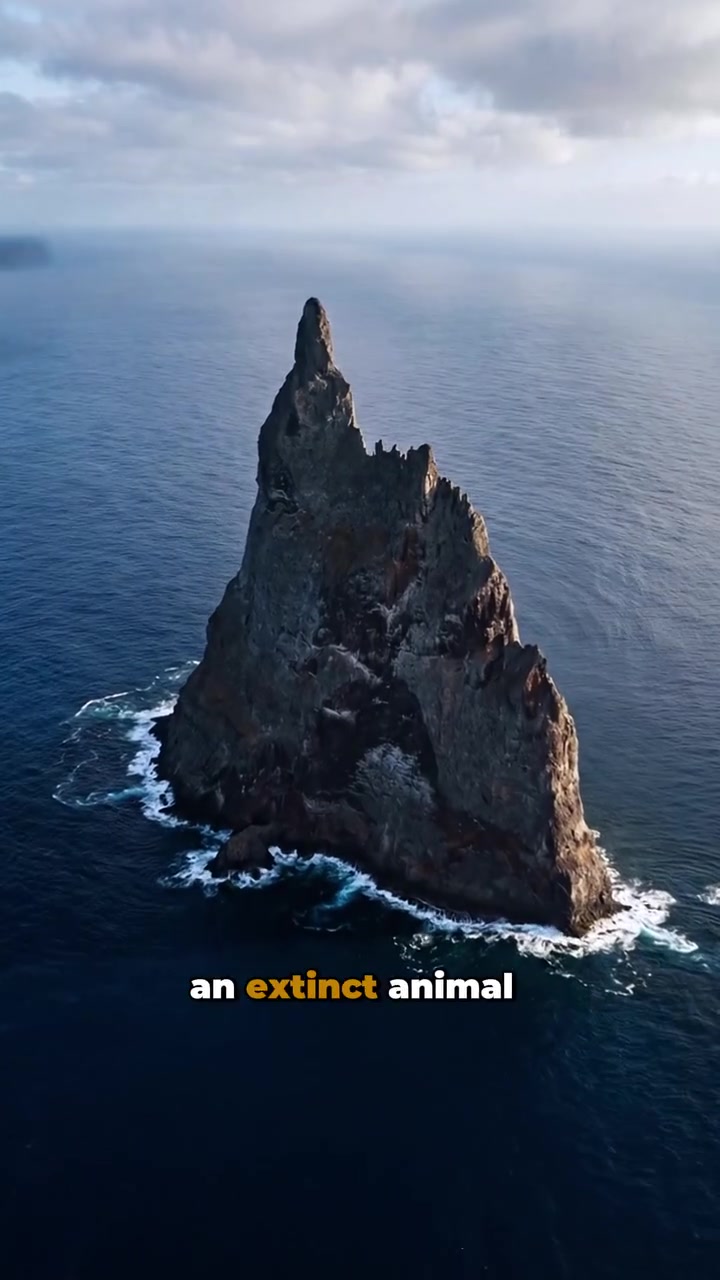
Nearly 1900-foot volcanic rock rising out of the Pacific Ocean -- standing alone, 12 miles from Lord Howe Island, Australia -- is Ball's Pyramid. That barren rock sheltered for 80 years what was thought to be an extinct animal. This is the story of an insect, "the tree lobster", that the locals on a nearby island, could hold in one hand. The creature was declared extinct when rats reached the island in 1918, but the story didn't end there. That barren rock was the only home to the giant black stick insect on Lord Howe Island before its near-apocalyptic population decline. The insect's population essentially vanished after rats invaded the island, but a few managed to make it across 12 miles of open ocean to a rock. Scientists later discovered 24 of these insects on the rock where they were clinging to survival, hiding under a single shrub.
Spire of Life
Ball’s Pyramid towers nearly 1900 feet, a lonely spire of volcanic rock. The dramatic cliffs and ocean views of its location suggest a place of isolation, rather than life. Yet, beneath the sheer cliffs, a rickety shrub clinging for life has offered shelter to a species that seemed condemned for extinction. This was a world away from the nearby Lord Howe Island, but once connected by a supply ship that ran aground and brought rats to the island. The insect population there crashed in two years, and the tree lobster seemed like a distant memory. Yet, it wasn't. Since 2001 a few insects were found alive, and they are now thriving, thanks to conservation efforts. 24 insects have given life to over 20,000 since 2003. The incredible resilience of isolated species is shown in this rocky column. The tree lobster's story reflects the broader struggle of ecosystems. Many species teeter on the brink of extinction, only to fight back with resilience and a bit of luck.
The Enduring Mystery
Ball's Pyramid seems to have answered the question, "How do you bring a species back from extinction?" But how did these insects get to the Pyramid in the first place? The details of their journey across the open ocean have never been determined. Two things make this a mystery. Firstly, the insects’ heavy, awkward bodies, resembling branches, make them poor swimmers. Secondly, the distance between the island and the Pyramid is enormous, and Ball’s Pyramid has no beach. Despite these barriers, a few insects managed to survive the journey, showing their incredible resilience. Scientists speculate that the insects might have been washed onto the rocky shores. However, it’s also possible that the natural driftwood that often floats on the sea currents, helped carry the insects across the open ocean. Potential wind patterns might also have played a role, although it is still an enigma how they managed this feat. Given the sheer cliffs and lack of a beach, the insects must have faced an immense challenge to make it to the rock.
The Resilience of the Tree Lobster
Tiny colonies have clung to life on Ball's Pyramid. Their DNA confirms they are an exact match to the last tree lobsters from Lord Howe Island. In 2003, Melbourne Zoo used just two insects to start a breeding program. They found success with the insects' nests, nurturing them to capacity and releasing these insects into the wild. Two new colonies were discovered on Ball's Pyramid in 2026. As the rats on Lord Howe Island have been eradicated, the tree lobster is ready to return to its original home. This recovery is one of the greatest success stories in conservation.
Now That Rats are Gone
With Lord Howe Island's rat population eliminated, it is now possible to reintroduce the tree lobster to its original home. That elimination of rats would allow scientists to reintroduce the tree lobsters to its original environment. The insects will be able to thrive on the island and move around freely. This would represent an immense step in recovering the island’s ecosystem, which was devastated by the rats.
What to Seek in a Coastal Mystery
Trail along the oceans of the world but stay in the vicinity of Australia. It wouldn’t be impossible to stumble on the impressive Ball’s Pyramid. Visitors might not expect to find a thriving wildlife sanctuary. The local seal and seabird colonies thrive on the rocky spire. With time and dedication, there’s a chance to glimpse the tree lobsters as they head back home. Ball's Pyramid is a remote sanctuary, and the tree lobsters’ story was rediscovered in the 21st century. The ongoing mystery of how these insects reached their remote refuge offers a timeless beacon of what scientists might one day find thriving in the wild, currently unjustly presumed extinct.
Questions readers ask
What exactly is a tree lobster and why is it significant that it was found on Ball's Pyramid?
The tree lobster, scientifically known as Dryocopus australis, is a large stick insect that was thought to be extinct. Its significance lies in the fact that it was rediscovered on Ball's Pyramid, a remote volcanic rock, after being presumed extinct for nearly a century. This discovery highlighted the resilience of the species and the importance of conservation efforts.
How did the tree lobsters survive on Ball's Pyramid for so long without any food or water?
The tree lobsters on Ball's Pyramid were able to survive by hiding under a single shrub, which provided them with some shelter and protection. They also likely fed on the leaves of this shrub, as well as any other vegetation that may have been present. The harsh, isolated environment of Ball's Pyramid also meant that there were no predators or competitors for resources, which may have contributed to their survival.
How did scientists get to Ball's Pyramid and how did they find the tree lobsters?
Scientists reached Ball's Pyramid through a challenging and dangerous climb. They discovered the tree lobsters by carefully searching the rocky terrain and under the shrubs that grow on the pyramid. This discovery was a result of meticulous exploration and a bit of luck, as the insects were well-camouflaged and hidden.
Why did the tree lobster population on Lord Howe Island crash so dramatically?
The tree lobster population on Lord Howe Island crashed dramatically due to the introduction of rats, which came to Lord Howe Island on a ship that ran aground. Rats are known to prey on insects and their eggs, and the absence of natural predators on the island allowed their population to explode, which led to the near-extinction of the tree lobsters.
What is the current status of the tree lobster population, and what efforts are being made to ensure their survival?
Today, the tree lobster population has grown from the 24 insects found on Ball's Pyramid to over 20,000. Conservation efforts, including breeding programs at Melbourne Zoo, have been instrumental in this recovery. These efforts involve careful breeding and monitoring to ensure the genetic diversity and health of the population.
How did the tree lobsters manage to travel from Lord Howe Island to Ball's Pyramid, given the challenges of their physical form and the distance?
The exact method by which the tree lobsters traveled from Lord Howe Island to Ball's Pyramid remains a mystery. Scientists speculate that they might have been washed ashore by ocean currents or carried by driftwood. The insects' heavy, awkward bodies make swimming unlikely, adding to the enigma of their journey.
What can the survival story of the tree lobster teach us about conservation and the resilience of species?
The tree lobster's survival story underscores the importance of persistence in conservation efforts and the incredible resilience of some species. It shows that even when a species is thought to be extinct, there may still be small, isolated populations that can be saved. This highlights the need for continued exploration and protection of even the most remote and seemingly barren environments.
Recent articles
Fresh deep dives from the latest Reels we unpacked.




Comments
Be the first to comment.