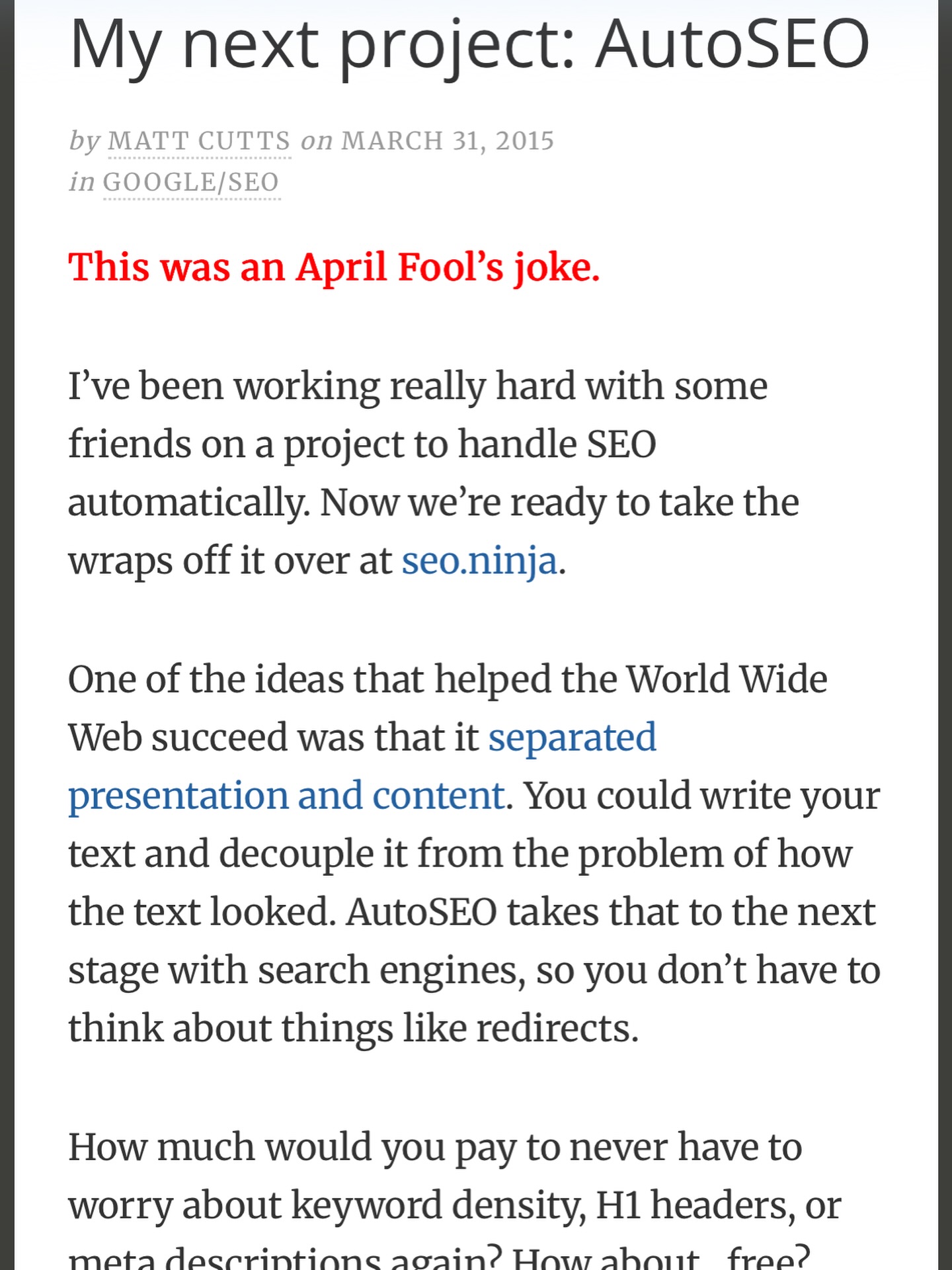
In 2015, Matt Cutts — then head of webspam at Google — announced AutoSEO on April Fools Day. It was a joke, but it got real. The idea? Automate the mundane tasks of SEO, making it easier for anyone to rank. It was not designed to outrank its creators, but to be a tool that could be used by everyone.
The Irony of AutoSEO
The irony of AutoSEO is palpable. Here was Google’s former head of webspam, known for combating unethical SEO practices, proposing a tool to automate SEO tasks. The joke got its laugh, but the concept was rooted in reality, aiming to help users automatically generate page titles, meta descriptions and even rewrite entire pages. In SEO circles, the idea of automation is no longer a joke. Google itself has filed a patent to automatically create these elements for webpages. What makes AutoSEO especially intriguing is its basis in a fundamental concept of the web. The project took inspiration from the World Wide Web’s own design: separating presentation from content. Just as you can write text without worrying about how it looks on web pages, AutoSEO promised to let you create content without worrying about SEO details like redirects and meta descriptions.
The March of Automation
SEO has always been a blend of art and science. That's what makes the rise of automation in the SEO sphere compelling - not just a claim to efficiency, but a technological evolution. Today, automation isn't just about optimizing keywords and meta descriptions. Google’s patent hints that the future could see a fully automated layer for webpage creation. Tools exist to automatically generate content, images, or code. Why not SEO? With everyone automating SEO, both formally and informally, automation and AI are poised to become the primary forces of SEO. The revelation that Google itself has patented this automation is a sign of how deeply digital creativity and algorithmic efficiency are becoming intertwined within the SEO industry.
The Core Conceit
AutoSEO First Impressions
At its core, AutoSEO was a tool designed to handle the repetitive and often tedious tasks involved in optimizing a webpage for search engines. The project wasn’t a complex AI but rather a targeted tool meant to simplify the SEO process. It aimed to automate keyword density, header optimization, and meta descriptions, offloading these tasks from human marketers. One of AutoSEO's key features was the decoupling of content creation from SEO considerations. This decoupling aims to make content creation more efficient and less concerned with SEO mechanics. AutoSEO’s promise was that you wouldn’t need to worry about how your content is labeled internally anymore.
The Engine Behind AutoSEO
However, at the heart of autoSEO was a purview of website ranking. Meta descriptions, title tags, H1 headers, and even the content generation were the main targets of this automation mechanism. The concept of decoupling content from presentation was initially used to separate content creation from layout, but AutoSEO was more. It relied on the idea that content and SEO optimization can be separated. This idea underscores the complexity of SEO: an art and a science. To ensure efficiency, Google proposed to go one step further, suggesting how they could handle keyword density and header optimization. Automating the mechanics of keyword density and header optimization aims to solve this problem.
What Happened to AutoSEO?
AutoSEO was revealed on 31st March 2015 by Matt Cutts, and while it was marketed as an April Fool’s joke, it was based on a real concept. Unfortunately, there’s no active trace of the tool itself, so it’s unclear whether the idea ever came into fruition outside of the announcement. Edward.Builds' notes explain that the idea still holds, and it’s not an April Fool. Since it’s related to SEO, Google has implemented many of the concepts of AutoSEO with evolving technologies. Automating the SEO tasks could be the future. With no further development from Matt Cutts, the original idea has been integrated into evolving technologies.
The Forever Debate of SEO Automation
Automation is Not a Panacea
While automation is changing the SEO landscape, it's not a silver bullet. The idea of separating content from presentation is a fundamental concept that has made the web highly accessible and efficient. However, applying this idea to SEO is more complex. Even the source says "You can't separate content from presentation, unlike the original WWW design." It can create a black box where optimizations are hidden in complex algorithms and automated processes. Effectively, you may optimise but at the cost of transparency. Automation, while powerful, may only be part of the SEO process's solution.
The Human Touch in Automation
But automation also isn't about replacing humans. Instead, it's complementary and efficient. The ability for users to automate repetitive SEO tasks means more resources for strategic thinking, creative content, and customer engagement. Even Google, the patent holder, emphasizes the importance of combining human creativity with machine efficiency.
The Future of SEO Automation
The potential of SEO automation lies in the balance. It could mean fewer repetitive tasks and more creative inputs. This is supported by Matt Cutts' vision and Google’s patent on creating page content, meta descriptions, and titles. The automation of SEO tasks not only offers massive efficiency gains but may also provide a more standardized and inclusive approach to SEO. With marketers focusing on content that drives traffic, automation does the job of optimizing it for search engines.
The Power of Decoupling
Curious about what to do with this knowledge? If you're a developer or an SEO enthusiast, consider these tips to ease your workload and increase your efficiency.
- Separate Content and SEO: Creating a content management system that allows for clear separation of content from SEO details like meta tags, headers, and redirects can be beneficial. This can let you focus on content creation without worrying about SEO aspects. Develop automated tools that can handle repetitive tasks like meta description generation or keyword optimization.
- Automate Repetitive Tasks: Even small automation can help. Use tools for tasks like generating meta descriptions, keyword optimization, and header tagging. This frees up time to focus on strategic planning and creative work. However, it’s important to balance automation with human oversight to ensure the content aligns with your brand voice and audience needs. Many SEO tools like SEMrush, Ahrefs, and Moz already offer automated solutions for such tasks.
- Focus on User Engagement: Combine SEO automation with strategies that enhance user experience. High-quality content, engaging site design, and valuable user interactions can drive traffic and improve SEO rankings. Make sure that any automation keeps these goals in mind. Rather than a futuristic pipe dream, Google's AutoSEO hints at a future where automating SEO tasks could become a reality. This isn’t about AI taking over SEO, but rather about using technology to enhance human creativity and strategic thinking. The idea has been reiterated by patents and by third-party tools that automate SEO tasks. By incorporating automation thoughtfully, you can create a more efficient, strategic, and user-focused SEO strategy.
Questions readers ask
What exactly was AutoSEO and why did Matt Cutts create it?
AutoSEO was a tool announced by Matt Cutts on April Fools' Day in 2015. It was originally a joke, but the concept was to automate repetitive SEO tasks like generating page titles and meta descriptions. Cutts, then Google's head of webspam, created it to highlight the potential of automating mundane SEO tasks, making it easier for anyone to rank higher in search engines.
How does AutoSEO relate to the idea of separating content from presentation in web design?
AutoSEO took inspiration from the web's design principle of separating presentation from content. Just as web design allows you to write text without worrying about its appearance, AutoSEO aimed to let you create content without worrying about SEO details like redirects and meta descriptions. This decoupling was meant to make content creation more efficient.
What tasks did AutoSEO automate, and how did it simplify the SEO process?
AutoSEO was designed to handle tasks like optimizing keyword density, header optimization, and generating meta descriptions. By automating these tasks, it aimed to offload the repetitive and tedious aspects of SEO from human marketers, allowing them to focus more on content creation and less on the mechanics of SEO.
Is automation in SEO a new concept, or has it been evolving over time?
Automation in SEO has been evolving for some time. While tools like AutoSEO might seem novel, the idea of automating SEO tasks has been around for a while. Google itself has filed patents to automatically create elements for webpages, indicating a growing trend towards integrating automation and AI into SEO practices.
What are some of the core features of AutoSEO, and how do they work?
AutoSEO's core features include automating meta descriptions, title tags, H1 headers, and even content generation. The tool was designed to decouple content creation from SEO considerations, allowing users to create content without worrying about how it is labeled internally for search engines. This decoupling aims to make the content creation process more efficient.
How does the idea of decoupling content from SEO optimization reflect the complexity of SEO?
The idea of decoupling content from SEO optimization underscores the dual nature of SEO as both an art and a science. By separating these elements, AutoSEO aimed to streamline the process, making it easier for users to focus on creating high-quality content while the tool handles the technical SEO aspects. This approach highlights the complexity and multifaceted nature of SEO.
Related deep dives
Similar reads based on topic and creator.




Recent articles
Fresh deep dives from the latest Reels we unpacked.


Comments
Be the first to comment.