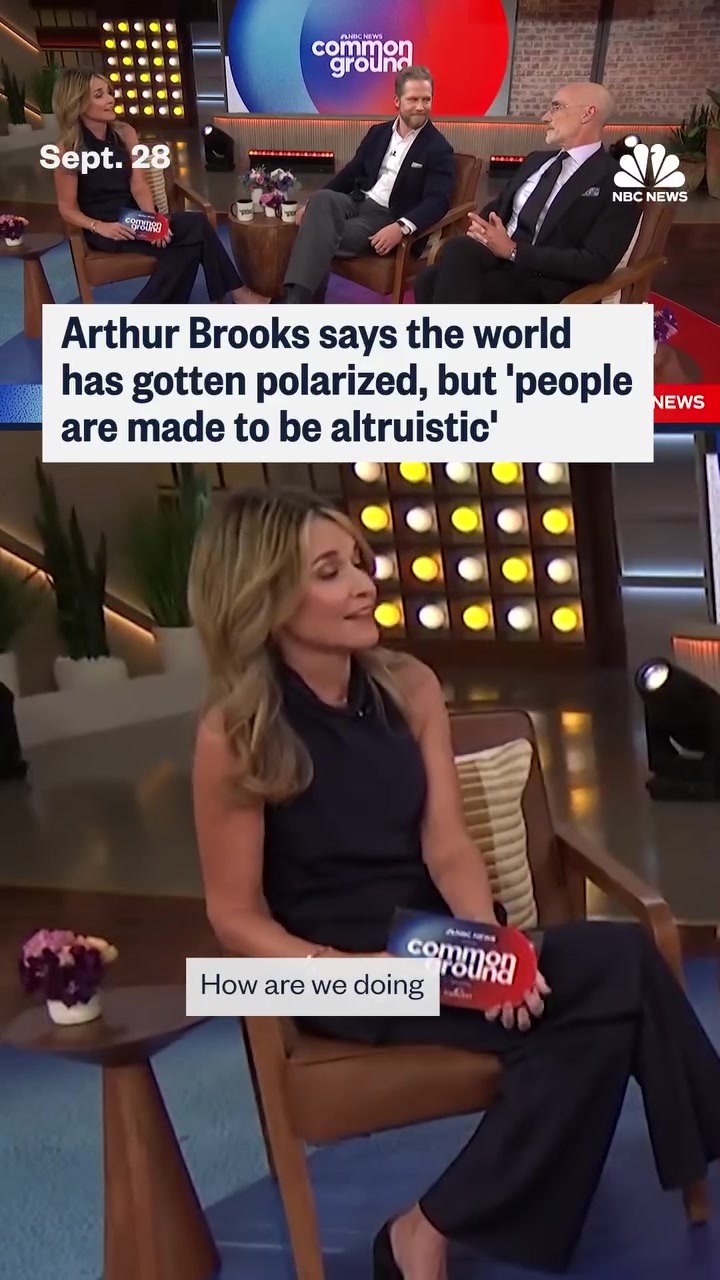
The Evolutionary Case for Human Altruism
A prominent evolutionary biologist argues that people are inherently designed to be altruistic, opposing the conventional view that humans are fundamentally selfish. Arthur Brooks "I'm somebody who's looking at the science and evolution," he states, "and what we find is that people are made to be altruistic, including to people that they don't even know." The phrase is a stark contrast to the current societal zeitgeist. Aside from Brooks' core claim on altruism, researchers explore another question: Why are people lonelier than before, and what can be done to remedy the issue?
The Discordance
The world is increasingly polarized, and it's not just about politics. People under 30 say no one knows them well, technology has polarized people politically, and it has made us lonelier. Technology is supposed to bring us together, but it has made us lonelier. Technology isn't the only culprit, though. He says "Let's be honest, the political system is not exactly helping matters under the circumstances." This is causing people to follow their animal instincts and be selfish, while the other side of the equation is choosing moral aspirations, something he calls "the divinity inside humans". Brooks believes the world is in a state of alarming discord and recommends steps to remedy it. Brooks presents his scientific opinion that despite the trends, he is hopeful, recommending people "take the issues and the matters into our own hands and get us back to a sense of community where our moral aspirations can be predominant over these animal impulses."
The Divinity
Brooks considers the human ability to choose moral aspirations "the divinity inside humans." He argues this makes humans different than other species. This "divinity" is the power of a person to choose the moral path, in spite of the selfish animal instincts. This capacity for altruism seems to be the only thing that can bring people together. People are more politically polarized and alone, but Brooks believes that the core essence of altruism inside of humans can help remedy the issues.
Navigating the Choices
Alfred Korzybski said, "There are two ways to slide easily through life: to believe everything or to doubt everything; both ways save us from thinking." If we can't trust everything, where should we put our faith? Brooks uses the duality of human nature to answer this question. "It makes us different than any other species," he says. Kolzysbki talks about the way that people navigate choices in life, while Brooks uses human nature to explain human instinct.
The Opposing Side
However, if humans are inherently altruistic, then why is society increasingly divided? This is the question that begs to be answered. Brooks believes that our moral aspirations can be the solution to these issues, but he does not clarify what the solution is. However, he does express a certain optimism. "We need to take the issues, the matters…and get us back to a sense of community where our moral aspirations can be predominant over these animal impulses." He says, but he remains hopeful. Humans have an innate desire to be altruistic, to choose the moral path, but it is unclear where the solution lies.
Actionable: Taking Brooking into the community
This is a murky topic and requires a certain amount of skepticism. Brooks has his heart in the right place, that much is clear, but when you consider that some people want to be selfish, the whole concept of the humanity of humans is called into question. Regardless, nurturing community, sharing a common interest, and taking responsibility for the issues and owning the matters are steps in the right direction.
Questions readers ask
What does Arthur Brooks mean when he talks about humans being wired for altruism?
Arthur Brooks, drawing from evolutionary science, suggests that humans are naturally inclined to act selflessly, even towards strangers. This perspective challenges the idea that people are primarily driven by self-interest. He believes this altruistic nature is a fundamental aspect of human evolution.
How does technology contribute to the loneliness and polarization that Brooks discusses?
Brooks points out that while technology is meant to connect us, it often has the opposite effect, increasing loneliness and political polarization. This is partly because it can create echo chambers and reduce face-to-face interactions, leading to a sense of disconnection and isolation.
What does Brooks mean by 'the divinity inside humans' and how does it relate to our ability to choose moral aspirations?
By 'the divinity inside humans,' Brooks refers to the unique human capacity to choose moral and altruistic actions over selfish instincts. He believes this ability to make moral choices sets humans apart from other species and can help overcome societal polarization and loneliness.
How does Brooks suggest we can combat the increasing loneliness and polarization in society?
Brooks encourages individuals to take personal responsibility for fostering a sense of community. He suggests that by prioritizing our moral aspirations over selfish instincts, we can create a more connected and compassionate society. This involves actively working to build community and overcome the divisive forces at play.
How does Brooks's view on human nature differ from the conventional view?
Conventionally, many people believe that humans are primarily self-interested. Brooks, however, argues that humans are inherently altruistic, driven by a desire to help others, even strangers. He supports this view with evolutionary science, suggesting that this altruism is a fundamental part of our nature.
Recent articles
Fresh deep dives from the latest Reels we unpacked.




Comments
Be the first to comment.