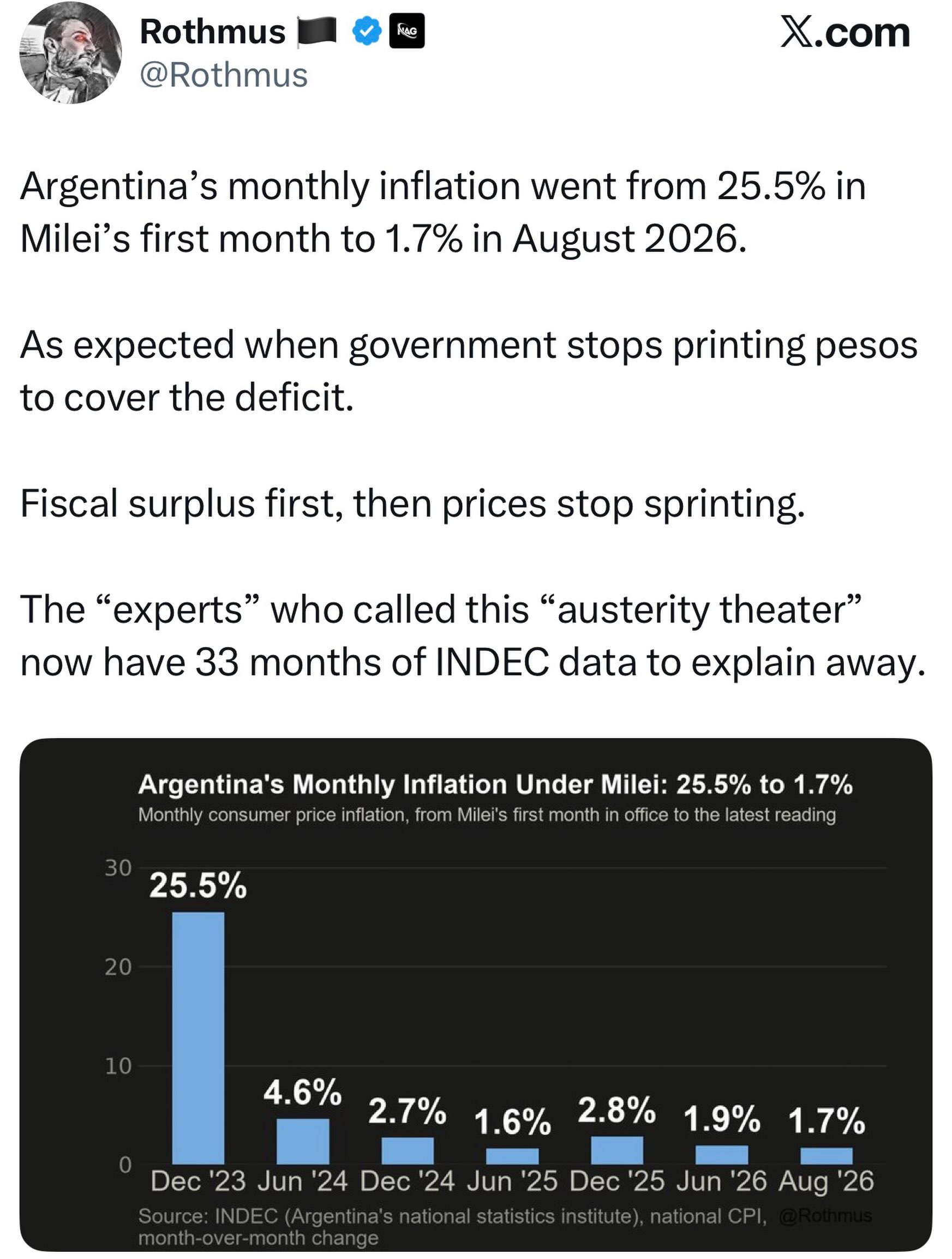
Argentina’s inflation rate plummeted from 25.5% in December 2023 to 1.7% by August 2026, a dramatic shift under Milei’s administration that underscores the impact of fiscal policy on economic stability. The transition from rampant inflation to price stability is attributed to the government ceasing to print pesos to cover deficits, a radical departure from previous economic strategies. This rapid transformation has significant implications for Argentina’s economic framework and global policy discussions.
The Milei Inflation Pivot
The Milei administration’s economic policy aims to address Argentina’s inflation crisis by fostering a fiscal surplus. Milei’s approach deviates from conventional economic policies by emphasizing austerity rather than government spending to stimulate the economy. The strategy included halting the practice of printing money to cover budget deficits, which was a significant contributor to the country’s dramatic inflation. This austerity wasn't just a short-term fix but was actually a catalyst for long-term economic reforms. The core of Milei's economic policy is that a surplus has to be achieved before prices can stabilize. This helps create a more stable economic environment. Anyone looking at the INDEC statistics sees that this is backed by data.
The New Economic Reality in Argentina
The steep decline in inflation aligns with broader economic indicators showing Argentina’s fiscal position stabilizing over 33 months. Milei’s approach challenges traditional macroeconomic theories that often prioritize stimulus spending over deficit reduction. The shift underscores a growing trend in economic thought that emphasizes fiscal discipline as a precursor to price stability.
The Fiscal Surplus as Economic Anchor
Milei’s administration has made a significant pivot to focus on a fiscal surplus. The data shows it works. By limiting government spending, inflation has plummeted dramatically. This is a stark contrast to traditional economic policies. The government’s move to stop printing pesos to cover deficits highlights a fundamental shift in economic policy because it shows a politically controversial move to actually keep spending in check, as opposed to government spending as a solution.
The Steep Inflation Decline
As exhibited by the bar chart accompanying this analysis, the inflation rate dropped from a staggering 25.5% in Milei’s first month to a much more manageable 1.7% by August 2026. This decline is particularly notable because it shows stabilization rather than slow decline. The economic policy has reduced month-over-month inflation to nearly flat. The chart shows significant drops in inflation from 25.5% to 4.6% within the first six months. This rate continued to drop down to around 2% within a year. From the data, this steady decline indicates that Milei is actually changing the financial behavior of the country, not just inducing a temporary dip. The strategic measures of his administration have been effective in lowering the inflation rate.
How Milei’s Policies Change Economic Thinking
Milei’s focus on austerity challenges the prevailing economic orthodoxy that centers around government spending as a tool to create jobs and stimulate the economy. Instead, his administration emphasizes austerity and a total halt to deficit spending, which in turn creates stability. This austerity is “austerity theater” type criticizers claim, but his administration noticeably shows little inflation increase for months. Because Milei’s approach goes against the conventional wisdom, it has faced significant criticism but has also shown that an alternative strategy can be effective.
Expert Reactions and Counterarguments
Economic experts initially dismissed Milei’s approach as “austerity theater,” a term that implies a superficial and ineffective strategy. The 33 months of INDEC data, however, paint a different picture. The consistent decline in inflation rates from December 2023 to August 2026 underscores the effectiveness of Milei’s policies. While the expert criticism remains, it lacks both the context and the data to dispute the results.
See the Milei Policy in Action
For those interested in seeing the impact of Milei’s economic policies, the statistics and graphs are publicly available from INDEC. The data trends align with the broader push for fiscal responsibility and austerity measures. Reducing government spending and printing money creates a strong fiscal surplus to stabilize prices, a notable shift. Geo-politically, there's economic possibility in a fiscally sound Argentina.
Observe the Fiscal Transformations Over 33 Months
There are 33 months of data publicly available summarizing Milei’s time in office. For the citizen to understand the effects, INDEC publishes the data showing the fiscal deficit and surplus monthly, the price inflation monthly, and other economic indicators. This data makes it easy to see the cause-and-effect of Milei's policies.
Evaluate the Cost-Cutting Measures
The biggest component of the cost reduction since Milei took office is the drop in inflation. Under his tenure, the central bank has stopped printing the money to cover the budget deficit, restricting the flow of currency to a controlled amount. This has helped stabilize the economy by ensuring that prices are cheaper.
Watch for Policy Influence in Other Countries
While the Milei administration's economic reforms have been controversial, they offer a blueprint for countries grappling with high inflation and economic instability. The economic measures taken by Argentina to reduce inflation and stabilize the currency could provide a roadmap for other nations. The fiscal surplus achieved through these measures creates a stable economic environment.
The Pivot to Austerity
The Milei administration provides a testament to the effectiveness of austerity measures in tackling inflation. While it remains controversial, the data supports the policy effectiveness. The experience of Argentina under Milei encourages further study in economic policy reform. Arguably the most critical economic takeaway is that stopping inflation requires more than just spending.
Questions readers ask
What specific reforms did Milei implement to achieve this dramatic drop in inflation?
Milei's reforms focused on halting government spending and money printing. He implemented austerity measures to achieve a fiscal surplus, which is the key to price stability. This approach contrasts with traditional economic policies that often rely on stimulus spending.
How does Milei’s approach differ from previous economic policies in Argentina?
Previous policies often involved printing money to cover budget deficits, which contributed to high inflation. Milei's approach is radically different, emphasizing fiscal discipline and austerity to achieve a surplus before stabilizing prices.
Can the fiscal surplus achieved by Milei’s administration be sustained in the long term?
The data shows that the fiscal surplus has been effective in stabilizing the economy over 33 months. However, sustaining this in the long term will depend on continued adherence to austerity measures and avoiding the temptation to revert to deficit spending.
What are the broader economic indicators that support this inflation decline?
The decline in inflation is supported by broader economic indicators showing Argentina’s fiscal position stabilizing. This includes a reduction in month-over-month inflation to nearly flat, indicating long-term economic stability rather than a temporary dip.
How do Milei’s policies challenge traditional macroeconomic theories?
Milei’s policies challenge the conventional wisdom that stimulus spending is necessary for economic growth. Instead, his approach prioritizes deficit reduction and fiscal discipline, which has led to significant price stability and a fiscal surplus.
Is there any risk that these reforms could lead to other economic issues, like high unemployment or reduced government services?
The austerity measures could potentially lead to short-term economic pain, such as reduced government services or higher unemployment. However, the long-term benefits of price stability and a stable fiscal position may outweigh these initial challenges. The data from INDEC shows that these reforms are working.
What does the bar chart showing the inflation rate decline tell us about the effectiveness of Milei’s policies?
The bar chart shows a steep decline in inflation from 25.5% to 1.7% over two years, indicating that Milei’s policies are effective in stabilizing the economy. The chart also shows significant drops in the first six months, with a steady decline to around 2% within a year, suggesting long-term changes in financial behavior rather than a temporary dip.
Recent articles
Fresh deep dives from the latest Reels we unpacked.




Comments
Be the first to comment.