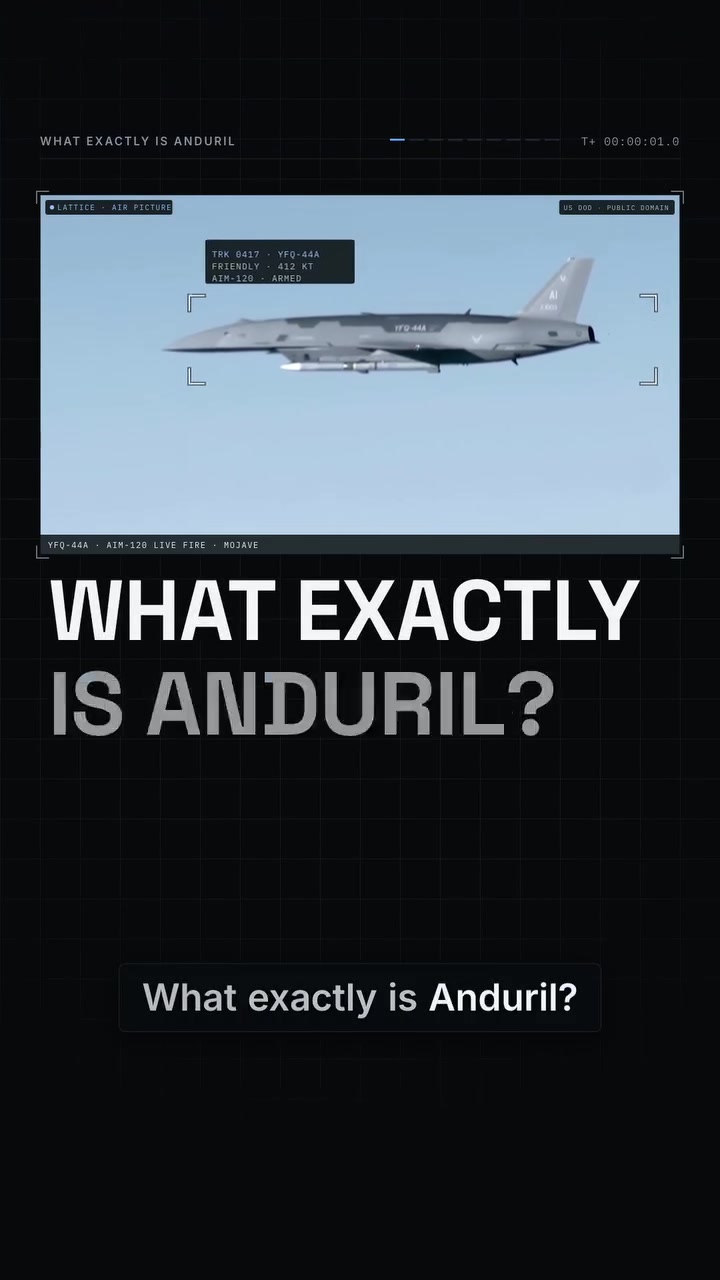
Anduril Technologies is a defense contractor that has attracted attention for its forward-thinking approach to military hardware. They are creating a new model by combining software, AI, and autonomous systems. For instance, Anduril’s Lattice software integrates data from thousands of sensors, processing it to identify and track objects and threats in real-time — all while allowing the human operator to oversee actions.
Anduril's core idea
“The US and its allies' current defense structure needs a major overhaul, and Anduril is positioned to deliver that transformation,” said the narrator. "The idea for this company was born when we realized that modern technology development methods could solve problems that have long plagued military hardware production" — such as single-user control or one-off hardware solutions. Anduril began by connecting disparate data sources into a cohesive platform. The Lattice software acts as a central nervous system, splicing together data from radars, cameras, and other sensors. More hardware, like the Ghost drone or Barracuda missiles, are built around Lattice to strengthen the network. However, Anduril's distinguishing characteristic is its emphasis on autonomous systems. They create autonomous drones and vehicles, such as the Ghost, Roadrunner, and Barracuda, and incorporate them into the defense ecosystem. The company is careful not to frame Lattice as an all-powerful AI. In the transcript, the narrator clarifies the AI's role: “But humans still in the loop.” A human operator remains in control, supervising the system and making final decisions, while AI apps help direct the swarm of autonomous systems in the field. For example, when a single sensor, such as a military vehicle, detects a target, Lattice swiftly locates, tracks, and shares that intelligence with the larger system. It then offers the operator several options for a response, which the human operator approves.
Its place in a changing defense landscape
While traditional military hardware often involves decades of development and billions of dollars for individual platforms, Anduril aims to produce affordable, autonomous systems at scale. This approach may help enable modern defense strategies; for example, swarming autonomous systems could overpower an opponent with sheer numbers, unlike single, high-value targets. This new approach faces few competitors. Established defense companies focus on traditional hardware, with large budgets and lengthy timelines, while early AI startups work more on cybersecurity systems.
The software that ties it all together
The most important part of Anduril's AI and autonomy isn't the missiles; it is the software underneath. "Lattice is like an operating system, but for military hardware." The software integrates data and controls in one place. But it does more than merge data. It helps the operator by combining data from thousands of sensors into actionable insights. This software is crucial to Anduril's success, integrating diverse hardware into a unified, AI-driven system.
The importance of AI to Anduril's strategy
Anduril's AI systems do not function independently. There is also a human layer for final decisions. As the narrator states, "Covert AI has its own engine for decision policy, which it supplies to the mission autonomy middleware." They also discuss the importance of manufacturing, noting that "Modern defence requires huge numbers of modern defence systems, not one incredibly expensive platform."
Arsenal software-driven factories
But it’s not just about the AI and autonomy. Lattice also connects things on the ground, including ground vehicles and surveillance systems. Anduril’s approach extends to its manufacturing model. It’s experimenting with the large-scale production of AI-driven sensors and autonomous systems, including missile systems. These are produced in what Anduril calls "arsenal software-driven factories," which use AI and automation to churn out military equipment at a fraction of the traditional cost and time. This is important because modern walls need large numbers of affordable autonomous systems, not a tiny number of very expensive platforms. But Anduril isn’t just trying to change military manufacturing; it wants to change how militaries think about defense.
Hardware components
Anduril builds a variety of hardware that integrates with its Lattice software, including drones, underwater vehicles, and surveillance systems. For instance, Ghost drones and Barracuda missiles can work together through the Lattice platform. It's worth noting that earlier in the timeline shown, Anduril's hardware was linked to space tech and VR headsets. More recently, though, these references have been dropped from the timeline. This marks a shift in the company’s focus over the years.
Getting started with Anduril's defense tech
Plugging into Anduril’s defense ecosystem does not require a massive budget or years of development. Instead, you can start with the Lattice software. There are several key systems that users can begin with, such as Ghost drones — autonomous drones that can be used for surveillance and reconnaissance. Roadrunner — an autonomous aircraft that can deliver supplies or conduct surveillance. Fury — a fighter-style aircraft that can be used for air-to-air combat or ground attack. Barracuda — a family of cruise missile-like systems that can be used for precision strikes. Dive and Copperhead — underwater vehicles that can be used for underwater surveillance and reconnaissance.
A look at the battlefield
The battlefield of the future will be a complex web of sensors, data, and autonomous systems, all interconnected through an AI-driven operating system. The sensors, which can come from different manufacturers and operate separately, are connected by Lattice. Lattice takes data from thousands of sensors, combines it into one picture, and helps identify objects or threats, then shares that with other systems. A human operator supervises how they respond. That is the core vision. There is not one person controlling one drone, but one person overseeing many autonomous systems working together.
The investment conclusion
Palantir did it for data, and SpaceX did it for space travel. Anduril is trying to do it for defense. It’s transforming military hardware from large, manually operated machines into a network of software-defined autonomous systems. It's not just about the drones or the missiles; it's about the entire eco-system of connected, autonomous systems working together. If Anduril can deliver on its mission, it promises to revolutionize military hardware. If not, it might seem like a costly gamble. Either way, it's an approach that will continue to gain attention in the defense industry.
Questions readers ask
What kind of hardware does Anduril Technologies specialize in?
Anduril Technologies focuses on autonomous hardware like drones and missiles. They develop and integrate systems such as the Ghost drone, Roadrunner, and Barracuda missiles, all of which are designed to work together within their AI-driven defense ecosystem.
How does Anduril’s Lattice software work with autonomous systems?
Lattice software acts as a central nervous system, integrating data from various sensors and hardware to provide real-time threat tracking. It processes information from radars, cameras, and other sensors, identifying and tracking threats, and then offers the operator several response options which the human operator approves.
What role does human oversight play in Anduril’s autonomous systems?
While Anduril’s systems are highly autonomous, human oversight is crucial. A human operator remains in control, supervising the system and making final decisions. The AI assists by directing the swarm of autonomous systems and providing actionable insights, but the human operator has the final say in any response.
How does Anduril's approach differ from traditional defense contractors?
Anduril differs from traditional defense contractors by focusing on affordable, autonomous systems produced at scale, rather than single, high-value targets. Their approach aims to overpower opponents with sheer numbers, leveraging modern technology and AI to address long-standing challenges in military hardware production.
Can Anduril's technology be used for applications outside of defense?
The article does not specifically address non-defense applications, but Anduril's technology, particularly the Lattice software, could potentially be adapted for civilian uses that require real-time data integration and autonomous systems, such as disaster response or environmental monitoring.
What kind of challenges does Anduril's technology aim to address in military hardware production?
Anduril's technology aims to solve issues like single-user control and one-off hardware solutions. By integrating AI and autonomous systems, Anduril seeks to create a more cohesive and responsive defense ecosystem, making military hardware more effective and adaptable.
Related deep dives
Similar reads based on topic and creator.




Recent articles
Fresh deep dives from the latest Reels we unpacked.




Comments
Be the first to comment.