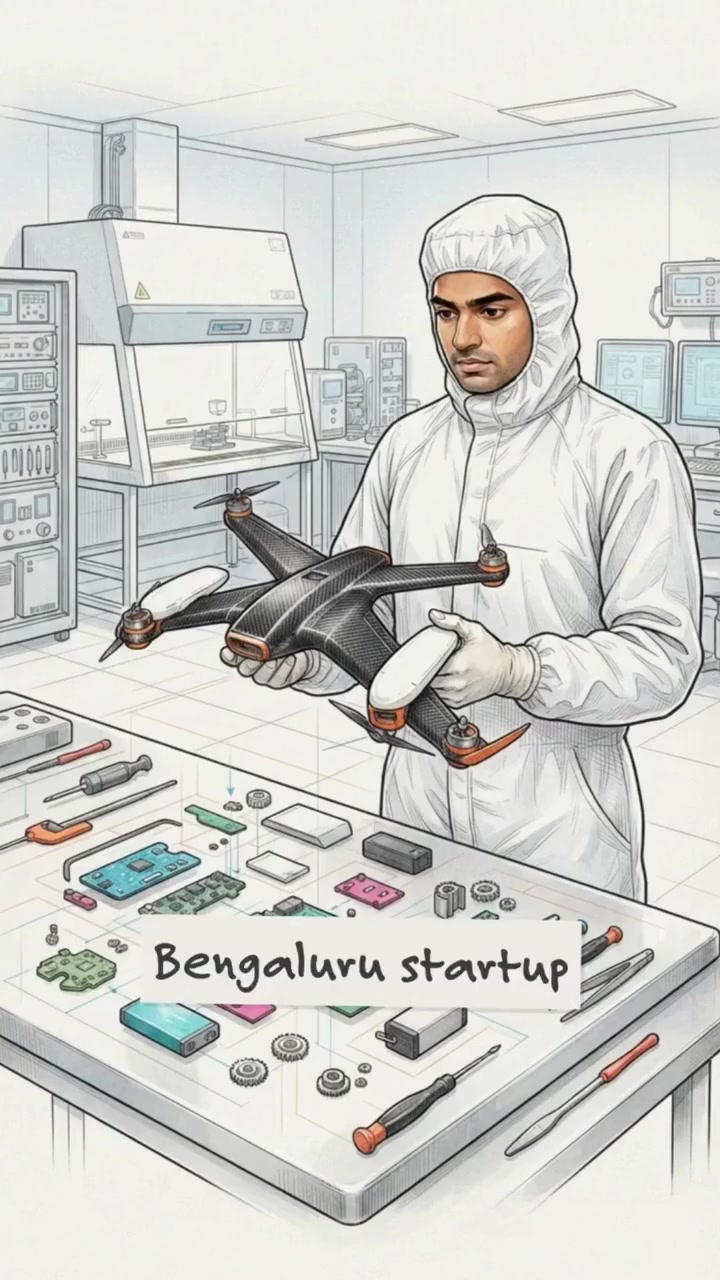
Namancharya Pushpural, with his startup Airbound, is trying to reverse the economics of delivery. The Bengaluru entrepreneur aims to design drones that cost less to fly than trucks — making drone delivery cheaper than any road-based alternative. The significance of the company's drone was proven when DoorDash registered astonishing faith in the Bengaluru startup. DoorDash invested $37M in Series A funding at an undisclosed valuation to build a new autonomous drone delivery infrastructure network.
The Physics of a Tail Sitter Drone
Drone delivery startups usually emphasize size, weight, or the distance drones can travel per trip. Airbound's tailored aeroacetics instead. Standard delivery drones struggle with the "mass penalty" — using a 10 kilogram drone to carry just 2 kilograms of cargo. Airbound instead employes proprietary carbon-fiber construction to shrink the airframe weight down to 1.5 kilograms. While previous designs might sacrifice lift, stability, or range the lighter airframe, Airbound's design — a "blended wing body tail sitter" — fixes that trade-off.
A Spotlight on Unprecedented Intrastructure Investment
Airbounds' carbon fiber design and unique takeoff methods are engineering marvels. But they're part of an economic strategy backed by a sky-high valuation and a 9-figure investment.
Airbound's Unique Liftoff Strategy
Airbound solves problems with takeoffs and landings. The tail sitter shape launches vertically like a rocket. Then it rotates midair and flies horizontally with airplane-like efficiency. This blend of vertical launch and horizontal flight is called a “tail sitter.”
The Magic of Carbon Fiber
The aerodynamics aren't the only magic trick. Airbound uses proprietary carbon fiber manufacturing techniques to create frames that are lighter and stronger. This reduces the dead weight, making space for larger payloads. The company's drones are able to reach far while carrying relatively big payloads (1 kilogram) while weighing only 1.5 kilograms. Imagine fitting a pizza delivery into a lightweight drone that can fly 40 kilometers.
Drone Delivery's Environmental Potential
Drones can save fuel by avoiding traffic and flying direct routes. Over time, this could also reduce the cost of fuel and carbon footprint. If Airbound can execute, drones could could dramatically reduce congestion, pollution, and delivery costs. This would be especially valuable in dense urban areas. The cost-benefit ratio could pave the way for future cities which may not need delivery trucks at all.
Startup Suggests: Consider the Infrastructure
Navigating a cityscape isn't a simple task for drones even if they're built to carry a heavy payload. Its easy to forget how startup entrepreneur Naman Push tells viewers can turn vertigo into precision. Drone delivery isn't close to maturing. But funding interests show a future where drone infrastructure could be as crucial as roads. Automating drones for complex tasks in cities may require real-time systems that handle avoidances and rerouting issues. They will also need drone stations and specialized charging or swap stations. Cities may have to rethink how they handle airspace and public safety.
Questions readers ask
What makes Airbound's drone design unique compared to other delivery drones?
Airbound’s drones are designed as 'blended wing body tail sitters,' which means they launch vertically like a rocket and then rotate midair to fly horizontally like an airplane. This unique design helps them avoid the 'mass penalty' issue, where a drone has to carry its own weight, reducing efficiency. The drones are made from proprietary carbon-fiber frames that are both lightweight and strong, allowing for larger payloads.
How does Airbound's drone design help in reducing delivery costs?
Airbound’s drones are designed to be more cost-efficient than traditional delivery trucks. By using a lightweight carbon-fiber frame and a unique tail sitter design, the drones can carry payloads more efficiently, reducing fuel costs and operational expenses. The vertical takeoff and horizontal flight method also allows for more efficient navigation through urban areas, avoiding traffic and reducing delivery times.
What are the environmental benefits of using Airbound's drones for delivery?
Airbound’s drones can save fuel by flying direct routes and avoiding traffic, which reduces the carbon footprint. Over time, this could significantly lower the cost of fuel and emissions, especially in dense urban areas. If widely adopted, drone delivery could dramatically reduce congestion, pollution, and delivery costs, paving the way for more sustainable urban logistics.
How does DoorDash’s investment in Airbound impact the future of drone delivery?
DoorDash’s $37 million investment in Airbound signals a significant turning point in the drone delivery industry. It indicates a strong belief in the potential of drone delivery to revolutionize the logistics sector. With this investment, Airbound can further develop its technology and infrastructure, potentially leading to a future where drone delivery is as common as road-based alternatives.
What challenges does Airbound face in implementing drone delivery in urban areas?
Airbound must navigate complex cityscapes and develop real-time systems to handle avoidances and rerouting issues. They will also need to establish drone stations and specialized charging or swap stations. Cities may need to rethink how they handle airspace and integrate drone delivery into their infrastructure. Airbound acknowledges these challenges and is working on solutions to ensure precision and safety.
Related deep dives
Similar reads based on topic and creator.

Recent articles
Fresh deep dives from the latest Reels we unpacked.




Comments
Be the first to comment.