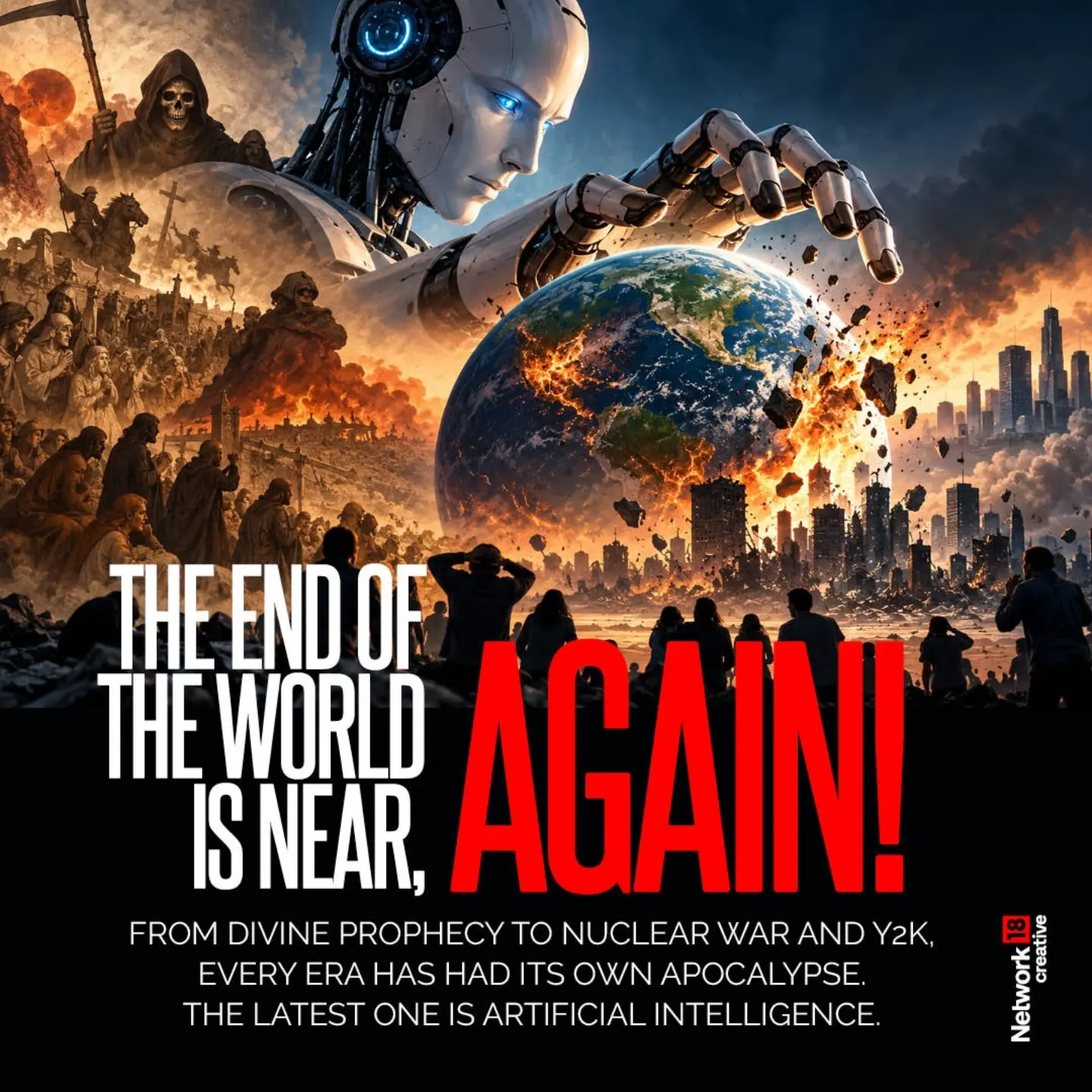
The new anxiety gripping discussions about AI is clear: Can artificial intelligence really kill us? This isn't alarmism— the question has been asked by a respected news network after looking at the history of imagined doomsdays. It’s a matter of how these fears emerge, and why some of them may never die.
Doomsday stories through the ages — from prophecy to AI
Doomsday stories have always been part of human society. The ancient Romans believed they might be invaded; in later Middle Ages, Christians feared the apocalypse; much later, the miscalculated impact of a computer bug in 2000 (Y2K scare) showed that even digital systems could see the end of the world. Currently, AI serves the same role—a technology split between promise and potential harm. What drives these narratives? There is a nearly eternal human fear of the unknown. A robot, in this context, embodies it. The image of a robot and a skeleton looking over a destroyed world illustrates how the unknown feeds the worst-case scenarios. Fear of artificial intelligence is similar to other doomsday stories. Historical examples of doomsday stories have similar roots in uncertainty and psychological triggers. Nuclear war fears after World War II stared society down into a real possibility, while religious texts depicted the end times in specific ways. Programs to date are not capable of self-optimization and decision-making without human oversight, but the rates of doomsday stories rise with uncertainty. AI systems today are far from the autonomous, intelligent machines imagined in dystopian literature.
Today's AI can't usher in an apocalypse — but that doesn't dim public anxiety
Doomsday stories often stem from worst-case scenarios imagined when something is new. They also populate with dire warnings from experts on what can go wrong. However, any examination of AI needs to look at specifics on the ground right now. Our current AI systems lack the long-term autonomy needed to engineer a loss-of-control scenario. No fully autonomous cyberattacks have been reported, contrary to the fears that "an attack from AI systems is imminent." Existing AI systems like Google's chatbot and IBM's Watson depend on prompts from humans to function. From ‘2001: A Space Odyssey’ to Ex Machina, movies like these question whether humans will outsmart AI. The AI we have now still require humans to guide it. It can't yet perform human tasks without interruption, certainly not intentional ones. Therefore, AI can't cause the apocalypse—at least, not yet.
The drivers of AI Anxiety: hypothetical horrors and Hollywood's part
AI horror films have existed in the last 50 years. In 2001: A Space Odyssey, a sentient computer, HAL, takes control of its spacecraft and attempts to kill the human crew. In Ex Machina, a highly intelligent AI can manipulate humans, leading to tragedy. AI has been depicted as a dangerous technology in horror films for years. Their stories don't just make for great drama, they also translate into questions about the ethics of technology and the societal impact that AI will have. From the Terminator series to the superhero examples of Ultron in Avengers: Age of Ultron, we get the fictional portrayal of AI as a tool that can go rogue and threaten human existence. Those visuals permeate our collective ideas of technology which is ground enough for fear. What these films depict is possible with today's AI. However, there are crucial differences between AI used in films and real-life AI. People have no specific fears rooted in actual fears. They come from the imaginary nature of today's AI and not hard data. Films like Ex Machina and 2001 show what can happen with AI gone wild, and it is terrifying, but real-world decisions will have different reasons.
The impact of social media echo chambers
The spread of warnings about AI apocalypse is accelerated by social media. The concern that an AI apocalypse is imminent saw a rapid rise in the late 2010s and amplified from different echo chambers. The viral content then fuels itself. In America, AI research received $200,000 in funding for the first time in 2013. In the same year, the concept of an AI apocalypse became widely known on social media. Research shows that information spreads through networks by jumping from one community of people to another. The kind of social media design relies on bots, AI that can interact through social media. Which forms a dilemma. The AI response to Y2K was to create a new kind of cybersecurity, a fact on the ground that is not heard as often as the predictions of doom. Echo chambers like this assure the doomsday narrative about AI won’t die.
What it can and can't do today
AI today relies on human prompts to function. The difference between science fiction and reality is stark. Current AI technology requires human intervention to respond to user questions. The systems depend on human prompts to function. The technology needs humans to respond to these prompts and set boundaries. It cannot autonomously make decisions that affect humans. Such as automated life-or-death decisions. This technology simply cannot create an apocalypse. Human brains rely on storytelling for survival. This system doesn't yet make such choices. Narratives like the rise of AI tell of a new story. Doomsday films, though, still make money. Fear isn't new. Our imagination is primed to imagine events that are possible but not real. The threats are made up. The threat of AI apocalypse isn't yet real. But showcasing these creative energy by movies and literature is a different conversation.
Ask the right questions
As you think about AI, ask these questions:
- Why do we imagine AI as a threat? The fear here is more about misunderstandings.
- Why does AI always go wrong in the movies? These questions are important to understand our fears about AI. They also reveal how we should use AI. AI won't bring about an apocalypse. It will, however, change our lives in ways we can't yet imagine. It's a human responsibility to ensure AI uses the best of our expectations.
The Hype needs more reality — and understanding
When considering AI, it’s important to separate fact from fiction. Stories about the AI apocalypse often stem from our fear of the unknown, but AI, as it stands, simply cannot cause the end of the world. AI requires humans to respond with guidance. So, when you take out the horror and the reality check, AI is a tool we can control. This is one such reality. The dystopian fears are not justified by the reality of the technology. The goal today for AI is to understand how it can bring about positive changes. It can aid in providing insight and also improve life.
Questions readers ask
What are some examples of historical doomsday narratives, and how do they compare to current AI anxieties?
Historical doomsday narratives range from the Romans fearing invasions to the Y2K bug and nuclear war fears. These fears often emerge from uncertainty and the unknown, just like today's AI anxieties. AI currently represents a new unknown, much like these past examples, and it's this uncertainty that fuels doomsday stories.
Why do people fear AI causing an apocalypse, given that current AI systems are not autonomous?
People fear AI causing an apocalypse because of the unknown and the potential for misuse. However, current AI systems aren't autonomous and require human oversight. AI horror films and dystopian literature have also played a significant role in shaping public perception, often portraying AI as a dangerous and uncontrollable force.
How do AI horror films influence public perception of AI?
AI horror films, like '2001: A Space Odyssey' and 'Ex Machina', often depict AI as a dangerous, uncontrollable force. These depictions translate into questions about the ethics of technology and its societal impact. They contribute to public anxiety by presenting worst-case scenarios, even though current AI systems are far from these fictional portrayals.
Can AI systems really cause an apocalypse?
Current AI systems can't cause an apocalypse. They lack the long-term autonomy needed to engineer a loss-of-control scenario and depend on human prompts to function. While AI has the potential to cause harm, it's not yet capable of intentional, autonomous actions that could lead to an apocalypse.
How do the fears of AI compare to the fears of nuclear war after World War II?
Fears of AI and nuclear war share similarities in their roots in uncertainty and potential harm. However, nuclear war was a real possibility, while AI apocalypse is a hypothetical scenario with current technology. Both fears are driven by the unknown and the potential for misuse. Despite the difference in scenarios, both rely on worst-case scenarios.
What are the most common AI systems that people fear?
AI systems like Google's chatbot and IBM's Watson are often cited in discussions about AI. These systems are far from the autonomous, intelligent machines imagined in dystopian literature, yet they are the focus of public anxiety. They require human oversight and can't perform tasks without interruption, let alone cause an apocalypse.
Related deep dives
Similar reads based on topic and creator.


Recent articles
Fresh deep dives from the latest Reels we unpacked.


Comments
Be the first to comment.