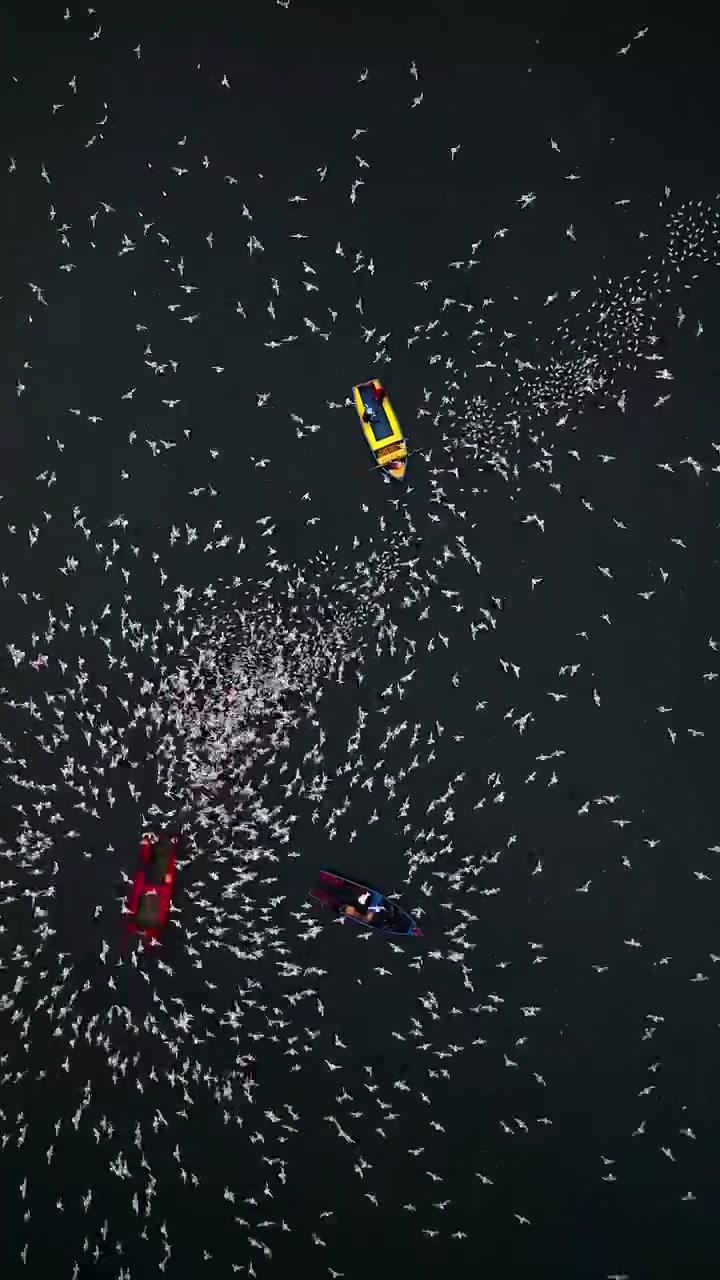
The marvels of flight are often too familiar to notice, but seagulls in mass can produce a mesmerizing spectacle. What’s striking is less the individual birds than the expansive patterns they form as they swoop and turn around small boats.
The Dance of Birds and Boats
Seagulls are common coastal birds that inhabit the world’s oceans, lakes, and seas. But a large group of seagulls becomes a "flock," which can consist of up to hundreds or thousands of individual birds in flight. The name “seagull” is a misnomer—these birds are not exclusively associated with the sea. However, they prefer coastal areas, where food is abundant. They feed on fish, mollusks, and even trash. Seagulls are omnivorous birds, eating a vast range of food. This includes insects, small birds, eggs, seeds, and crabs. They have adapted to live in diverse environments, such as city parks and riverbanks. The adaptability of these birds is fascinating, as they can thrive in any environment when there is a readily available food source. Seagulls exhibit a complex social structure, living in colonies and often seen in large numbers around the fishing boats. Seagulls work together to swoop, turn and fly in intricate patterns, often around objects encouraging schooling fish to the surface. By doing so, seabirds use their strength in numbers to round up prey into a swarm of birds. This can be an effective hunting strategy for the birds, pushing prey to the water surface for easy access. The coordination involved is built into their nature, as birds must work together to hunt and stay safe. They follow each other to make collective decisions to move as a group. The seagulls use their coordinated movement to search for food and avoid predators. The ability of the birds to swarm together in large numbers is crucial for their survival in the wild. However, when it comes to human activity, they often cause a nuisance by stealing fish from fishermen and accumulating on boats. The scene of boats surrounded by seagulls creates an intriguing dynamic, blending the natural world with human activity. Boats provide a large and stable structure that attracts the birds. They search for food and inhabit these structures, often staying in close proximity to them. Whether it's a fishing boat or a pleasure boat, their presence becomes a part of the seascape, attracting gulls. The interaction is fascinating, as it showcases the coexistence of different life forms. But there is also a less charming side to the interaction, as the birds become a nuisance to people on boats. They interfere with activities on the boat, often scavenging for food or nesting.
The Seagull Dilemma
Seagulls are a vital part of the natural world, but their presence on boats creates a dilemma. They are often seen as a nuisance, and that is sometimes deserved. They can be aggressive, often stealing food and causing damage to boats. Many fishermen experience frustration when gulls steal their catch, and the sight of these birds is also an indicator of human trash. However, seagulls' scavenging behavior helps keep the beach clean, reducing the amount of trash. The gulls take away plastic bags and other garbage from the beach. In essence, they perform a necessary function in the ecosystem. However, it is important to consider the implications of the behavior of these birds. It is essential to remember that seagulls have a role to play in maintaining the natural balance. This makes the presence of these birds intriguing, but it's also a nuisance. The delicate balance between the benefits and drawbacks of seagulls on boats is a topic worth exploring.
The Nature of Attraction
The natural charm of seagulls and boats comes from the birds' foraging behavior and the boats' location. The birds are often attracted to boats because they provide a stable source of food. They follow the boats to feed on the fish that the vessels catch. The sight of seagulls swarming around the boats is intriguing, as it showcases the relationship between human activity. This is a natural phenomenon, where birds are attracted to the boats to feed on the fish that the boats catch. Scraps and trash left on boats or at coastal beaches attract many gulls. The birds are a common sight around boats that are heading for the fish market. Here, birds follow the fish vessels to feed on any scraps of fish left over. There are many reasons why boats attract gulls, including the regular supply of food, and the birds' scavenging behavior.
Migratory Patterns
One reason the boats attract seagulls is because of their migratory patterns. The birds congregate in large numbers around boats, especially during migration. While moving to breed in the Arctic, the birds' interactions become more visible. Then, they concentrate around boats, especially during feeding time. The sight of these birds is fascinating, and it showcases the beauty of migration and the harmony between the natural and human worlds. The migration of seagulls is a fascinating phenomenon, as it showcases the beauty of nature. The birds travel long distances, migrating north and south with the change in seasons. The migrating birds exhibit a strange relationship with boats, following them for food.
The Impact
What an extensive flock of seagulls does when near a boat or in water is fascinating. The birds form a vast swirl of motion and create a cloud of birds. When near a boat, they swarm the vessel, circling around it. The impact of the seagulls on the boat often depends on how close the vessel is to the shore. When the birds approach a boat, they often fly in a coordinated manner. The sight of these birds in motion is an intriguing spectacle, showcasing the beauty of nature. When in motion, the birds create a stunning display of synchronized movement. They approach a boat in a coordinated manner, circling and descending around it.
Avoiding Seagull Distract
The sight of seagulls congregating around boats is fascinating but can also be a nuisance. They interfere with activities on the boat, often scavenging for food. These birds should be discouraged from approaching boats—preferably from feeding them, as it creates dependency and nuisance. Boaters can take certain steps to stay safe and avoid attracting the birds.
- Store trash carefully and ensure it is secured in a watertight bag. The birds will often scavenge through trash for food. Proper trash management is essential to keep the birds from approaching boats.
- Prevent spilling food and fish scraps. The birds are attracted to these scraps, so it’s important to keep the area clean. This can prevent the birds from being attracted to the boats.
- Keep a watchful eye out. If you notice seagulls getting too close, create a disturbance to deter them.
- Cover food screened containers when on the deck.
- Steer clear from areas with high bird activity.
The Balance
The scene of a boat surrounded by a flock of seagulls is one of the most fascinating spectacles. The sight of the birds and boats together showcases the harmony between the natural and human worlds. However, it also highlights the delicate balance between the benefits and drawbacks of this interaction. The birds perform a necessary function in the ecosystem. But they also can also cause a nuisance to people on boats. The sight of a boat surrounded by a flock of seagulls is one of the most fascinating spectacles. The birds and boats' relationship showcases the harmony between the natural and human worlds.
Questions readers ask
What makes the aerial displays of seagulls around boats so captivating?
The spectacle is captivating because of the coordinated movements of hundreds or even thousands of birds. They form intricate patterns as they swoop and turn around boats, creating a mesmerizing ballet that's both visually stunning and a testament to their cooperative hunting strategies.
Why do seagulls prefer to gather around boats?
Boats provide a stable structure and a reliable source of food. Seagulls are opportunistic feeders and often follow fishing boats to scavenge for discarded fish or to steal catches. This behavior is part of their adaptability and survival strategy. Additionally, boats can act as a resting spot for these birds.
How do seagulls coordinate their movements in such large groups?
Seagulls coordinate their movements through a complex social structure and collective decision-making. They follow each other to make decisions as a group, allowing them to hunt more effectively and stay safe from predators. This coordination is crucial for their survival and helps them form the intricate patterns seen during their aerial displays.
Can seagulls be harmful to boats and their occupants?
Yes, seagulls can cause nuisances to boats and their occupants. They often steal food from fishermen, cause damage to boats, and can be aggressive. However, they also play a role in keeping beaches clean by scavenging trash and reducing litter.
Is there a way to prevent seagulls from stealing food on boats?
Preventing seagulls from stealing food can be challenging, but there are some strategies. Keeping food covered, using deterrents like nets or reflective surfaces, and cleaning up trash can help reduce their attraction to boats. However, these methods may not be entirely effective due to the birds' adaptability and persistence.
How do seagulls benefit from their interaction with boats?
Seagulls benefit from boats as they provide a reliable source of food and a stable structure for resting. By following boats, especially fishing boats, seagulls can easily access discarded fish and other food sources. This interaction is part of their adaptive behavior, allowing them to thrive in various environments.
What role do seagulls play in the ecosystem, despite being seen as a nuisance?
Seagulls play a vital role in the ecosystem by keeping beaches clean and reducing litter. They scavenge on trash, including plastic bags and other garbage, helping to maintain a cleaner environment. Their scavenging behavior, while sometimes a nuisance to humans, contributes to the overall health of coastal areas.
Related deep dives
Similar reads based on topic and creator.



Recent articles
Fresh deep dives from the latest Reels we unpacked.

Comments
Be the first to comment.