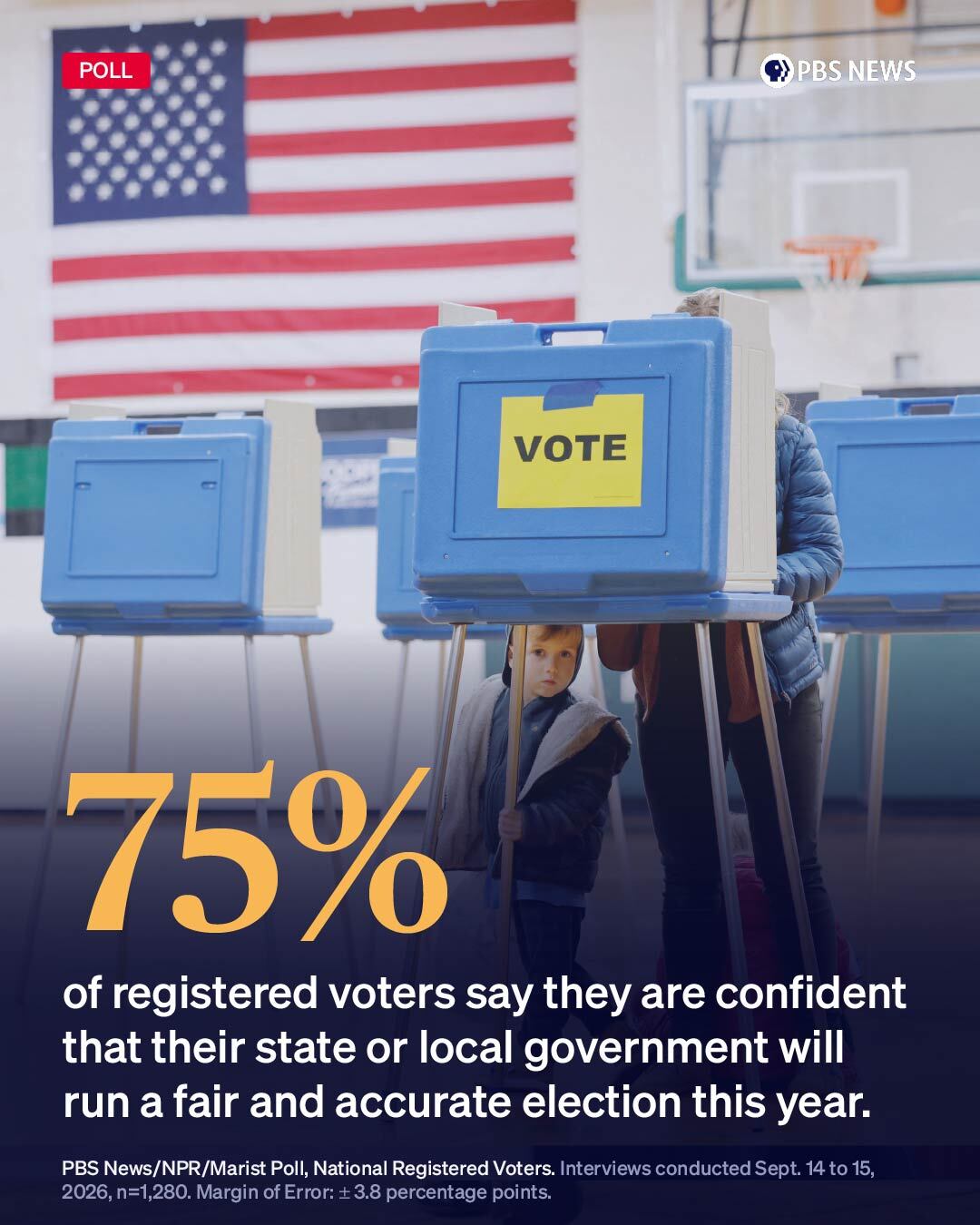
A large new study released by PBS News, NPR, and Marist shows that 75% of registered voters are confident that their state or local government will run a fair and accurate election this year. The poll conducted between September 14 and 15, 2026, surveyed 1,280 voters a continuous sample of the voting public. The election confidence level is 75%. Marginal error 3.8%.
Election confidence polls in an era of mistrust
The public's confidence in the fairness of elections is one of the most debated topics. In these times, polls like this are extremely important. The high confidence in election fairness indicates that despite the various challenges in the recent past, voters appear to have a degree of trust in the process. Such a measure is important because it gives insight into the public's perception of the integrity of the electoral process. It reflects the public voice about the importance of the fairness of the election.
The voter confidence poll: details and methodology
Powered by the efforts of PBS News, NPR, and Marist, the poll conducted an extensive survey of 1,280 registered voters. The survey covered two days from Sep 14th to Sep 15th, 2026, gathering a comprehensive snapshot of voter sentiment. With a margin of error of ± 3.8 percentage points, the poll provides a reliable indicator. The polling group had asked if registered voters were confident that their state or local government would run a fair and accurate election this year. Out of the 1,280 registered voters, 75% responded positively, while the remaining indicated a lack of confidence.
Confidence vs distrust
The poll of voters is clear: 75% of registered voters are confident in the fairness of the upcoming election. As elections have become a focal point for political debate, the high confidence level marks a significant trend. In the face of heightened political tensions and the proliferation of misinformation, the survey points towards significant faith in the electoral process. This confidence may play a role in influencing voter turnout and overall civic engagement. This is particularly important because elections and democratic processes rely on public trust.
Messaging in the numbers
The poll's clear message is that confidence in the election process appears to be strong. The 75% figure is a substantial affirmation of trust in the election process. Beyond the numbers, the poll provides a glimpse into the mindset of the voting public. "The confidence level compared to recent elections and prior years is higher," PBS News reported when referencing the 75% of voters. The poll indicates a reassuring level of trust, The result suggests that the public, in general, finds the upcoming election to be fair and accurate. This can have significant implications. The message is that a strong majority of voters believe in the integrity of the upcoming election process," the PBS News/NPR/Marist Poll report said.
Diving into the margin of error
The margin of error in the poll is ± 3.8 percentage points. This statistic adds credibility to the findings. This is important because it shows the precision of the survey. It allows for a margin of interpretation. Statistically, the actual confidence level could be between 71.2% and 78.8%. The margin of error in polling is crucial. It tells us that despite the high confidence, a small proportion of voters may still have doubts. Understanding this margin can help in interpreting the overall sentiment more accurately and in planning for any potential concerns.
Practical tips for interpreting and understanding voter polls
Understanding the results of a voter poll involves considering several factors. The first step in interpreting surveys like this one involves understanding the polling methodology. The following pointers can make this easy:
- Survey Size and Margin: Check the size of the sample. Mapping the margin of error to the sample size tells a lot. The survey of 1,280 registered voters is extensive. The margin of error is ± 3.8 percentage points—this details tell you a lot about the accuracy of the survey.
- Questioning Approach: Evaluate the questions asked. The poll only asked one specific question: if the responding voter was confident that their state or local government would run a fair and accurate election. Identifying their confidence is important. This gives the poll a lot of credibility.
- Transparency and Context: Verify the methodology and transparency. Recognize the contributors. In this case, the poll is a collaborative effort by PBS news, NPR, and Marist making it credible.
- Trends Over Time: Compare the results of this poll with previous similar surveys. This will tell you a lot. In this case, comparing it to other polls will tell you if the poll done is accurate and the trend has been bouncing.
- Consider the Implied Meaning: The voter confidence ties a lot into the upcoming election. The 75% confidence reflects the public's faith in the upcoming election. Understanding what the confidence reflects is important. Voter opinion polls are important. They are important because they tell us what the public thinks. All of these factors can be analyzed to understand the results of a poll. Knowing more about the poll will be important in understanding the poll results further.
Final Thoughts
This is important as it provides a snapshot view of the public sentiment. The poll provides a clear and quantifiable data point: 75% of registered voters are confident in the integrity of the upcoming election. This vote of confidence reflects a high public trust in the electoral process. Such surveys about voter confidence can help shape public discourse and inform policy decisions.
Questions readers ask
What exactly does the 75% confidence level mean in the context of this poll?
The 75% confidence level means that three out of four registered voters surveyed believe that their state or local government will conduct a fair and accurate election this year. This figure is a strong indicator of public trust in the electoral process, despite recent challenges and debates about election integrity.
How was the survey conducted, and who was involved?
The survey was conducted by PBS News, NPR, and Marist. It involved 1,280 registered voters over two days, from September 14 to September 15, 2026. The poll asked voters if they were confident that their state or local government would run a fair and accurate election this year, with a margin of error of ± 3.8 percentage points.
Why is the margin of error important in this poll?
The margin of error is important because it provides a range within which the true percentage of confident voters likely falls. In this case, a margin of error of ± 3.8 percentage points means that the actual confidence level could be as low as 71.2% or as high as 78.8%. This helps to understand the precision and reliability of the poll's findings.
What does this high level of confidence tell us about the public's perception of election integrity?
The high level of confidence suggests that a significant majority of voters trust the electoral process, despite recent challenges and political tensions. This trust is crucial for democratic processes, as it can influence voter turnout and overall civic engagement. The public's confidence in the fairness of elections reflects a belief in the integrity of the system.
How does this poll compare to previous years' confidence levels?
According to PBS News, the 75% confidence level in this poll is higher than in recent elections. This indicates a growing or sustained trust in the election process compared to previous years, which is a positive sign for democratic stability and public engagement.
What are the implications of this high confidence level for the upcoming election?
The high confidence level can have significant implications for the upcoming election. It suggests that a strong majority of voters believe in the integrity of the process, which can lead to higher voter turnout and greater civic engagement. This trust is essential for a smooth and accepted electoral outcome.
Recent articles
Fresh deep dives from the latest Reels we unpacked.




Comments
Be the first to comment.