Toba Supervolcano - Earth's Sleeping Giant

Imagine a volcano so massive that its eruption could plunge the Earth into a decade-long winter, threatening the very survival of our civilization. Sounds like science fiction, right? But the Toba supervolcano in Indonesia is a ticking time bomb, and scientists are sounding the alarm. With a history of catastrophic eruptions, the last one occurring around 74,000 years ago, Toba's been quiet for far too long. Recent studies have revealed increased seismic activity and gas emissions, sparking fears that the sleeping giant may be stirring. As the global population grows more interconnected and vulnerable, the stakes have never been higher - and understanding Toba's secrets is crucial to preparing for the unthinkable.
The Awakening of a Legend

Imagine a volcano so powerful that its eruption could change the course of history. That's exactly what happened with Lake Toba, located in Sumatra, Indonesia, around 74,000 years ago. This massive crater lake is a remnant of one of the most massive volcanic eruptions in Earth's history - a supervolcanic eruption that shook the planet to its core.
The eruption was a behemoth, with a Volcanic Explosivity Index (VEI) of 8, placing it among the largest known explosive eruptions the Earth has ever seen. To put that into perspective, the 1980 eruption of Mount St. Helens had a VEI of 5, making the Toba eruption roughly 1,000 times more powerful! The sheer scale is mind-boggling - 2,800 cubic kilometers of material were blasted into the atmosphere, covering vast areas in a thick blanket of ash. In fact, the Indian subcontinent was smothered in a layer of ash about 5 cm thick, a testament to the eruption's immense power.
You're probably wondering what makes this eruption so significant. For one, it's considered a "supervolcano" - a rare breed of volcano capable of producing eruptions with ejecta volumes greater than 1,000 km³. These events are so massive that they can affect global climate patterns, leading to "volcanic winters" that can last years, even decades. The Toba eruption is a prime example, with some scientists suggesting it may have contributed to a bottleneck in human evolution, impacting global populations.
Uncovering the Eruption's Fury

The Toba eruption was no ordinary volcanic event. Imagine the entire Indian subcontinent shrouded in darkness for weeks - that's the kind of impact we're talking about. This colossal explosion lasted for 9-14 days, with five distinct magma bodies activated within a few centuries before the eruption, creating a ticking time bomb beneath the surface.
The Ignimbrite Phase: A Blast into the Stratosphere
The eruption's ignimbrite phase was the pièce de résistance - reaching a height of 32 km, spewing ash and gas into the stratosphere. To put that into perspective, commercial airplanes fly at around 10-12 km altitude. The sheer force of the eruption would have sent shockwaves through the Earth's atmosphere, affecting global climate patterns. The ashfall covered an area of over 38 million square kilometers - that's roughly 1/10th of the Earth's surface.
You can still see the remnants of this massive eruption today. The Toba caldera, located in Sumatra, Indonesia, is a staggering 100 km long and 30 km wide. It's a testament to the raw power that lies beneath our feet. The eruption would have released massive amounts of sulfur dioxide, leading to a global cooling effect, potentially even triggering a volcanic winter.
- The eruption's impact would have been felt globally, with ash potentially affecting the Indian monsoon patterns
- The Toba catastrophe theory suggests this eruption may have caused a significant reduction in human population
- Geologists have identified the eruption's layers in sediment cores from across the region
Climate Chaos Unleashed
The Toba eruption was no ordinary event - it's believed to have triggered a severe human population bottleneck around 74,000 years ago. Imagine a world where most of humanity didn't make it through a single disaster. That's the kind of impact we're talking about here. Researchers have found evidence suggesting that the global human population dwindled to mere thousands, struggling to survive in isolated pockets.
The culprit behind this catastrophic event? A volcanic winter, of course! The massive eruption spewed enormous amounts of ash and aerosols into the stratosphere, blocking sunlight and causing widespread cooling. We're talking temperatures dropping by as much as 3-5°C globally, with some areas experiencing up to 10°C cooling. That's huge! The effects would've been felt for years, maybe even decades. The Earth's climate was already in a state of flux, with the last ice age looming on the horizon.
The Perfect Storm
The Toba eruption was more than just a one-off disaster - it was a catalyst that pushed the Earth's climate into overdrive. The planet was already on its way to an ice age, and Toba was like the final nail in the coffin. The increased glaciation and reduced temperatures would've had a devastating impact on early human populations, making survival an uphill battle.
- Global temperatures dropped significantly, affecting ecosystems worldwide
- Sea levels were already low; the volcanic winter would've made things worse
- The impact on biodiversity would've been immense, with many species struggling to adapt
The Toba eruption serves as a stark reminder of the power of nature and the fragility of our existence. Who knows what other secrets lie hidden in the Earth's geological record, waiting to be uncovered?
Geological Legacy
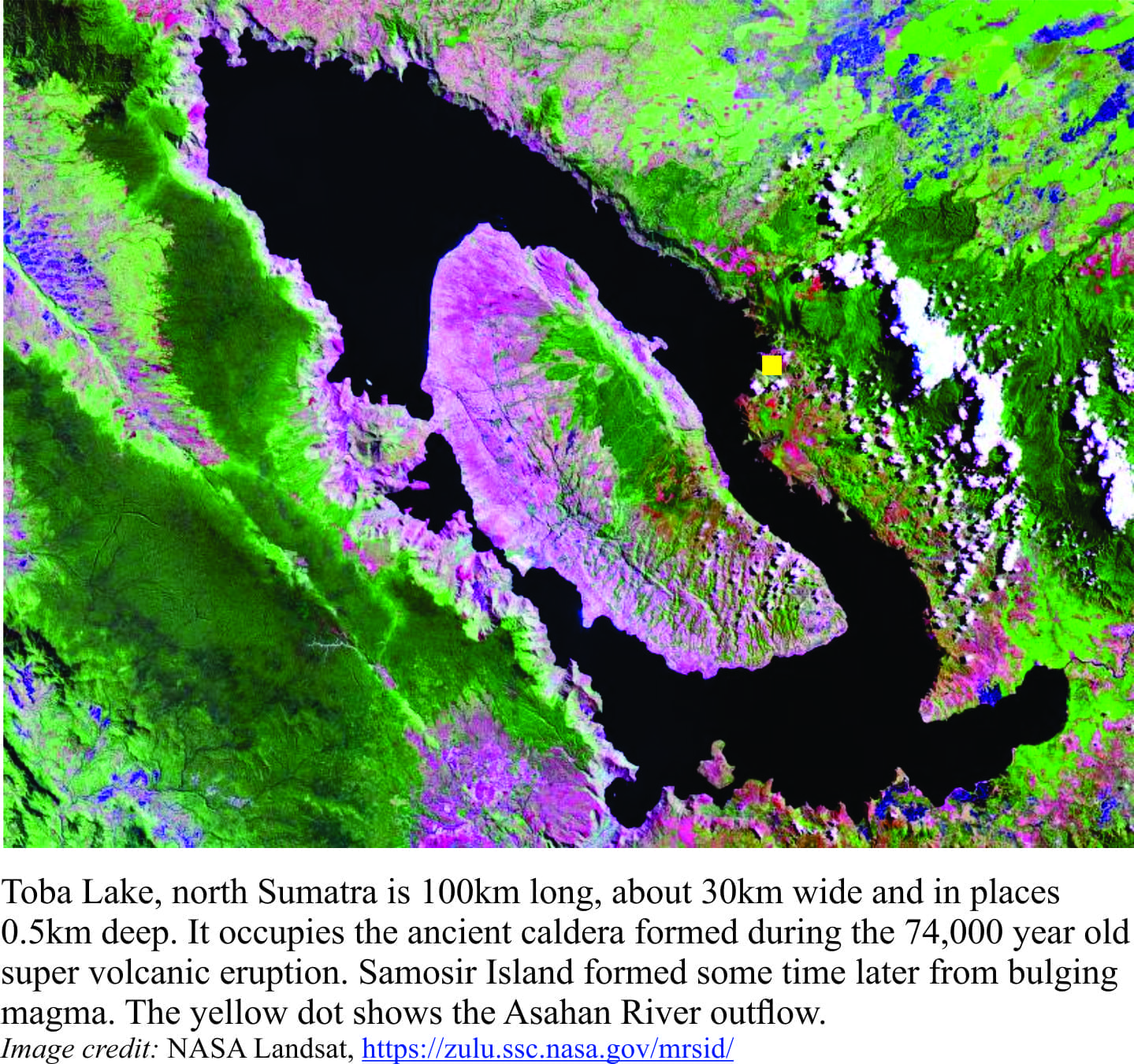
Let's dive deeper into the aftermath of that massive eruption. You're looking at a caldera that's roughly 100 km long and 30 km wide - that's Lake Toba, one of the largest lakes in Southeast Asia. It's a staggering example of nature's power, and it's all thanks to the supervolcano that lay dormant beneath it.
The Caldera's Formation
So, what happened after the eruption? Well, the ground above the emptied magma chamber collapsed, forming a massive depression - the caldera. Over time, this depression filled with water, creating Lake Toba. It's a remarkable process that's still visible today. The lake's maximum depth is around 505 meters, which is pretty impressive.
The Resurgent Dome
Now, let's talk about the resurgent dome in the center of the lake. This dome is a result of the Earth's crust trying to rebound after the massive eruption. It's like the Earth is trying to heal itself. The dome is a testament to the immense power of the supervolcano, and it's still growing today. You can see the dome's impact on the lake's landscape - it's a pretty cool example of geological activity.
Imagine being on the lake's shores, feeling the earth beneath your feet, and knowing that you're standing on the site of one of the most powerful eruptions in human history. It's a humbling experience, to say the least. The geological legacy of the Toba supervolcano is a reminder of the awe-inspiring forces that shape our planet.
The resurgent dome is also a sign that the supervolcano is still active, still moving beneath the surface. It's a reminder that the Earth's surface is dynamic, constantly changing. And who knows? Maybe one day, we'll learn more about the secrets that lie beneath Lake Toba's surface.
Scientific Significance
The Toba eruption is a goldmine for scientists studying the Earth's geological history. It's like having a window into the past, showing us just how powerful volcanic eruptions can impact the climate. By analyzing the ash and gases released during the eruption, researchers have been able to reconstruct the event in incredible detail.
Climate Impacts
The Toba eruption is believed to have caused a global cooling effect, potentially dropping temperatures by as much as 3-5°C (5-9°F) for several years. That's huge, especially considering the eruption happened around 74,000 years ago, during a time when humans were still developing complex societies. Some scientists think the eruption might have even caused a bottleneck in human population, putting our species in a tough spot.
Studying Toba's effects can help scientists better understand the Earth's systems and develop strategies for mitigating the impacts of future eruptions. For instance, researchers like Dr. Michael Rampino have used Toba as a case study to understand how volcanic eruptions can influence global climate patterns.
Ongoing Research
Toba's a reminder of the immense power of geological forces, and there's still so much to learn. Ongoing research is helping us understand the mechanisms behind supervolcanic eruptions, which could ultimately help us predict and prepare for future events. You're seeing scientists explore new techniques, like analyzing ancient DNA and sediment cores, to piece together the story of Toba and its impact on our planet.
- The eruption's effects on global climate patterns
- The potential for future supervolcanic eruptions
- Advances in monitoring and prediction techniques
Preparing for the Future
So, what can we do to prepare for a potential Toba super-eruption? Scientists are working tirelessly to monitor the volcano's activity, and researchers like Dr. Christine Lane, a volcanologist at the University of Cambridge, are studying the history of Toba's eruptions to better understand what might happen next.
You might be wondering how this affects you. Well, if Toba were to erupt again, the impact would be catastrophic - think massive global cooling, failed crops, and widespread disruptions to our modern infrastructure. But by understanding the risks, we can start preparing for the unimaginable. For instance, experts suggest that developing crops resistant to extreme weather conditions and creating global food reserves could help mitigate the effects of a super-eruption.
Key Strategies for Resilience
- Improve monitoring systems for volcanic activity
- Develop emergency preparedness plans for global catastrophes
- Invest in climate-resilient infrastructure and agriculture
The Toba supervolcano is a reminder that we're living on a dynamic planet, and there's still much to be learned. By staying vigilant and working together, we can turn the unpredictability of nature into an opportunity for resilience. As volcanologist Dr. Lane puts it, "The best way to predict the future is to study the past." You're part of a global community that's shaping the future - let's make sure we're prepared for whatever comes next.
The question is: are you ready for the unimaginable?







Comments ()