Single Photon Teleportation - Breaking the Speed Limit

Imagine sending information faster than the speed of light, defying the cosmic speed limit that Einstein's theory of relativity sets. Sounds like sci-fi, right? But here's the deal: scientists have been experimenting with single photon teleportation, and the results are blowing minds. In 2020, a team achieved a record-breaking teleportation distance of 1,200 km using a technique called quantum teleportation. This isn't just a cool trick – it's a game-changer for secure communication and computing. With quantum computing on the horizon, understanding single photon teleportation is crucial for the next tech revolution. Let's dive into the fascinating world where quantum mechanics meets teleportation, and explore how it's shaking up our understanding of space and time.
The Quest for Quantum Communication

You've probably heard of quantum computing and its mind-bending potential, but there's another quantum frontier that's just as exciting: quantum communication. And at the heart of it lies single photon teleportation – a phenomenon that's been making waves in the scientific community. Imagine transferring information from one point to another without physically moving it. Sounds like sci-fi, right? But it's real, and it's happening now.
The idea of quantum teleportation was first proposed by Anton Zeilinger and his team back in 1997. They demonstrated it using entangled photons, showing that quantum information could be transferred without physical transport. Since then, researchers have been pushing the limits, achieving distances of over 1,200 kilometers in space. That's like sending a message from Mumbai to New Delhi in an instant.
The Power of Single Photons
Single photon teleportation is crucial for quantum communication because it allows for secure information transfer. Think of it like sending a secret message that's impossible to intercept. Any attempt to eavesdrop would disturb the photon's state, alerting the sender. This is the principle behind quantum key distribution, a method being used to create unbreakable encryption.
But there's a catch – current technology still has limitations. Distances are limited, and error rates are high. As physicist Jian-Wei Pan puts it, "The challenge is to push the boundaries of quantum communication, making it practical and scalable." And that's exactly what's driving researchers forward.
- Entangled photons are the key to quantum teleportation
- Distances of over 1,200 kilometers have been achieved
- Quantum key distribution enables secure encryption
The potential is huge, and we're just scratching the surface. From secure banking transactions to unhackable communication networks, single photon teleportation is set to revolutionize the way we transfer information. And that's what we'll explore in this article – the breakthroughs, challenges, and future of this quantum technology.
The Science Behind Photon Teleportation
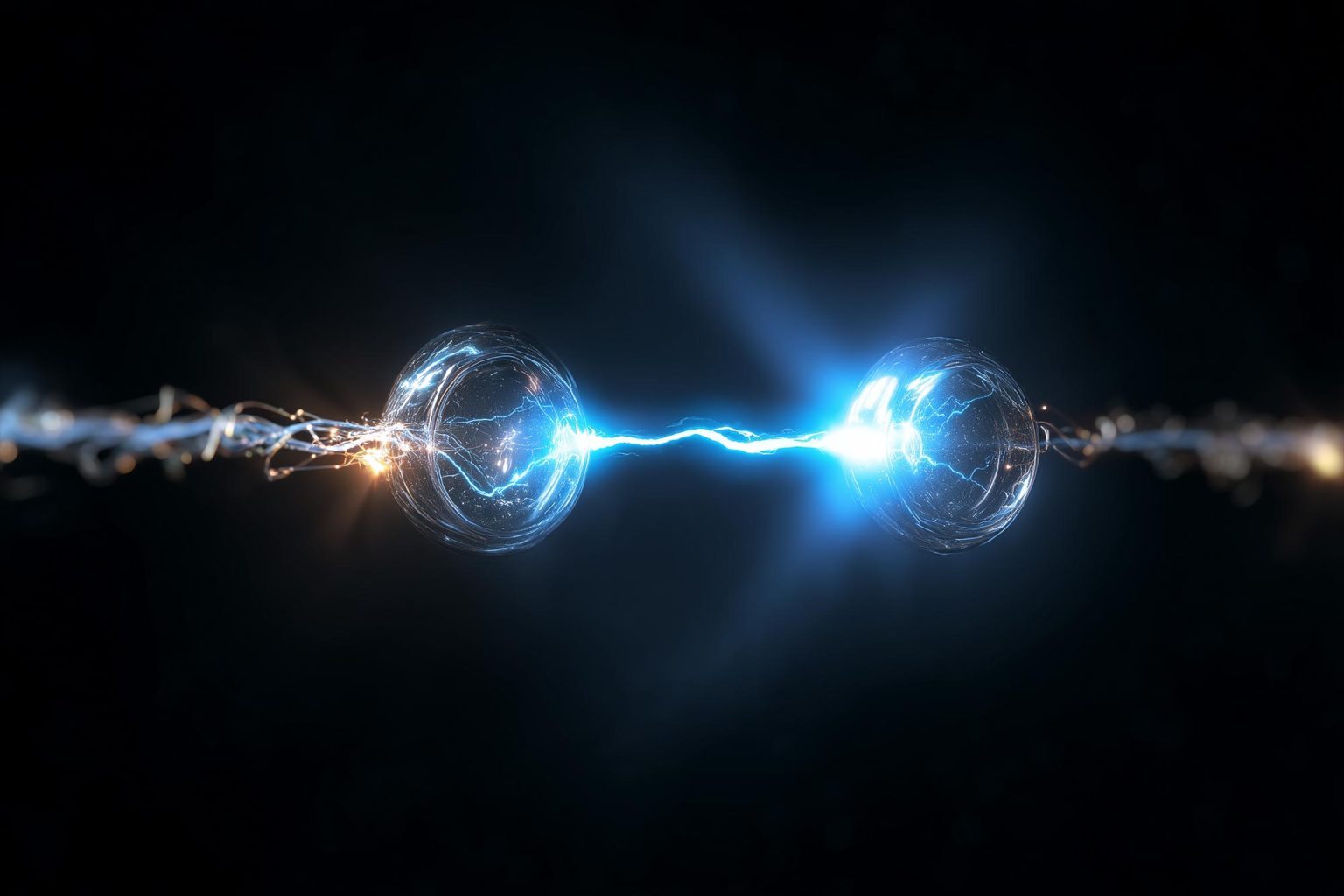
You've got to understand quantum entanglement to grasp how photon teleportation works. It's a phenomenon where two particles become connected in a way that lets them share info instantaneously, no matter the distance. Think of it like having two dancers moving in perfect sync – if one spins, the other spins too, instantly.
Quantum Entanglement: The Magic Link
This is where things get wild. In 1997, Anton Zeilinger's team in Austria did an experiment where they entangled photons and sent them to different locations. They found that measuring one photon affected the other, even when separated by 10 km. This isn't just cool – it's the foundation of quantum teleportation.
Here's how it works: entangled photons are created and sent to two places, let's call them Alice and Bob. If Alice wants to send a message to Bob, she uses her photon to encode the info, and Bob's photon gets the message instantly.
Photon Encoding and Decoding
Encoding is done using something called polarization – think of it like the orientation of a light wave. Let's say Alice wants to send a secret message. She encodes her photon with specific polarization states, like horizontal or vertical. Bob's photon, being entangled, instantly reflects this state. He decodes it using a special detector, and voila, the message is transferred.
Experiments like the ones done by Jian-Wei Pan's team in China have shown this works over long distances, even through space. They're pushing the limits of how far we can teleport photons – literally breaking records.
- Entangled photons are created and separated
- Alice encodes her message onto her photon
- Bob decodes the message using his entangled photon
- The message is transferred instantaneously
The implications are huge – we're talking secure communication channels, quantum computing, and maybe even more. The science is solid, and the potential is massive.
Applications in Secure Communication
You've probably heard of quantum key distribution (QKD), the holy grail of secure communication. It's a method of encrypting data using quantum mechanics, making it virtually unhackable. Single photon teleportation is a key enabler of QKD, allowing for secure key exchange over long distances.
Real-World Applications
For instance, the Chinese space station Tiangong-2 demonstrated QKD with a satellite, achieving secure communication over 700 km. That's some serious quantum magic, folks! This breakthrough paves the way for a global quantum network, where data is transmitted securely using single photons.
Imagine a world where your financial transactions, personal data, and even voting systems are secured by the principles of quantum mechanics. That's the promise of single photon teleportation. Companies like IBM, Google, and Microsoft are already investing heavily in quantum tech, and secure communication is a major focus area.
- Quantum key distribution for secure key exchange
- Secure data transmission for sensitive applications
- Potential for a quantum internet, enabling secure global communication
The potential applications are vast, and we're just scratching the surface. As Anton Zeilinger, Nobel laureate in physics, puts it, "Quantum teleportation is a key component of quantum information science, and it's going to revolutionize the way we communicate."
With single photon teleportation, we're not just breaking the speed limit – we're breaking the encryption barrier, too.
Overcoming Technical Challenges
So, you've seen the potential of single photon teleportation - it's like having a Star Trek-style transporter for information. But, as with any cutting-edge tech, there are some serious challenges to overcome. Let's dive into the main hurdles researchers are tackling right now.
Photon Loss and Noise Reduction
Photon loss is a biggie. Think of it like trying to hear a whisper in a hurricane - it's tough to separate the signal from the noise. Researchers are working on ways to minimize this loss, like using specialized fibers that preserve photon states. For instance, a team at the University of Science and Technology of China achieved a record-low loss rate of 0.2 dB/km in 2022.
Noise is another issue - it's like trying to have a conversation in a crowded café. Techniques like quantum error correction and advanced filtering are being developed to mitigate this. It's a tough job, but scientists are making progress.
Scalability and Reliability
Right now, single photon teleportation works, but it's a bit like having a prototype - it's impressive, but not exactly practical for everyday use. Scaling up is key. Researchers are exploring ways to integrate these systems into existing tech, like fiber optic networks. It's a complex puzzle, but the payoff would be huge.
- Developing more efficient photon sources
- Improving detector sensitivity
- Enhancing entanglement generation
There's still a lot of work to be done, but the future looks bright. With advancements in materials science and quantum computing, we're getting closer to making single photon teleportation a reality.
As we push these technologies forward, we're not just breaking speed limits - we're opening doors to new possibilities in communication and computing.
Real-World Implications
You've seen how single photon teleportation can break the speed limit, but let's talk about what this means for you. Imagine a world where data transmission is virtually unhackable - that's the promise of quantum communication, and it's closer than you think. Companies like Google and IBM are already investing heavily in quantum tech, and teleportation is a key piece of the puzzle.
Data Security: The Holy Grail
Traditional encryption methods rely on complex math problems, but quantum computers can potentially crack these codes in seconds. Quantum key distribution (QKD), on the other hand, uses the principles of quantum mechanics to create secure keys. With single photon teleportation, you can transmit these keys across vast distances without physical transport, making interception virtually impossible. China's Micius satellite, for example, has already demonstrated QKD over 1,200 km away!
Quantum Computing: The Next Frontier
Teleportation also has the potential to revolutionize quantum computing. By transferring quantum states, you can perform calculations exponentially faster than classical computers. This could solve complex problems in fields like medicine and finance, leading to breakthroughs in areas like cancer research and climate modeling.
- Cryptography: Unbreakable encryption for secure communication
- Computing: Exponential speedup for complex calculations
- Materials Science: Simulation of complex molecular interactions
The implications are vast, and researchers are exploring interdisciplinary collaborations to harness this tech. Physicists, computer scientists, and engineers are working together to create a quantum future. You're looking at a new era of innovation, and it's happening now.
The Future of Quantum Teleportation
You're probably wondering what's next for quantum teleportation. Let's dive into the exciting advancements and potential breakthroughs that'll take this technology to the next level. Researchers are working tirelessly to improve the fidelity of quantum teleportation, and we're seeing significant progress. For instance, a team from the University of Science and Technology of China achieved a record-breaking quantum teleportation distance of 16 kilometers (10 miles) in 2016. As technology advances, we're on the cusp of some incredible breakthroughs. One area to watch is the development of quantum repeaters. These devices will enable quantum information to be amplified and retransmitted, effectively extending the range of quantum teleportation. Imagine being able to send quantum information across hundreds or even thousands of kilometers without degradation. That's a game-changer for quantum communication. Applications beyond communication are also being explored. Quantum teleportation could revolutionize quantum computing by enabling the transfer of quantum information between different parts of a quantum computer. This could lead to more powerful and efficient computing. Quantum teleportation might even play a role in quantum cryptography, securing sensitive information in ways that are virtually un-hackable. Some potential applications include:
- Secure data transfer for financial transactions and sensitive information
- Quantum-based secure communication networks for governments and organizations
- Enhanced quantum computing capabilities for complex problem-solving
The future of quantum teleportation is exciting, and you're part of this journey. As researchers push the boundaries of what's possible, we'll see new and innovative applications emerge. With the potential to transform industries and secure our data, quantum teleportation is an area to keep a close eye on. So, what's the takeaway? Quantum teleportation is more than just a fascinating phenomenon – it's a technology with the potential to revolutionize the way we communicate and process information. Buckle up; it's going to be a wild ride!





Comments ()