Out of Africa Theory - Unraveling Human Migration
Imagine tracing your ancestry back tens of thousands of years, and finding that everyone originated from a single continent - Africa. Sounds like a plot twist, right? But that's exactly what the Out of Africa Theory proposes, and it's reshaping our understanding of human history. With recent breakthroughs in genetic research, like the 2020 discovery of ancient human fossils in Greece and China, scientists are piecing together the puzzle of human migration. As climate change and global connectivity blur borders, understanding our shared roots has never been more relevant. Let's dive into the fascinating journey that led Homo sapiens to conquer the world.
The Cradle of Humankind
You're about to embark on a journey through time, tracing the roots of humanity back to its birthplace – Africa. The Out of Africa Theory suggests that modern humans, Homo sapiens, originated on this continent around 300,000 years ago. But what makes scientists so sure about this? Let's dive into the evidence. Fossil records have been a treasure trove of information, with discoveries like Lucy in Ethiopia and the Omo fossils providing crucial insights into human evolution. You might've heard of the famous fossil "Mrs. Ples" from South Africa, but the story of human origins is still unfolding. Recent finds in Morocco's Jebel Irhoud have pushed the boundaries of human history even further, revealing fossils that date back to around 300,000 years ago. So, what do these fossils tell us? They show a pattern of evolution that points to Africa as the cradle of modern humans. But fossil records are just one piece of the puzzle. Genetic evidence has also played a significant role in shaping our understanding of human migration patterns. Studies have shown that genetic diversity is highest in Africa, suggesting that humans have been living there for longer than anywhere else. You might wonder, how do scientists track human migration patterns? One way is by studying mitochondrial DNA, which is passed down from mother to child. By analyzing these genetic markers, researchers have reconstructed the journey of early humans out of Africa and across the globe. For example, the mtDNA haplogroup L3 is believed to have originated in East Africa around 60,000-70,000 years ago, marking the beginning of human migration to other parts of the world. The evidence is compelling, and experts like Dr. Chris Stringer and Dr. Brenna Henn have contributed significantly to our understanding of human origins. As we explore the Out of Africa Theory further, you'll see how these early human migration patterns shaped the course of human history. Dive deeper: [What role did climate change play in human migration?]((link unavailable)) [How did early humans adapt to new environments?]((link unavailable)) [What are some of the latest discoveries in human evolution?]((link unavailable))
The Great Migration

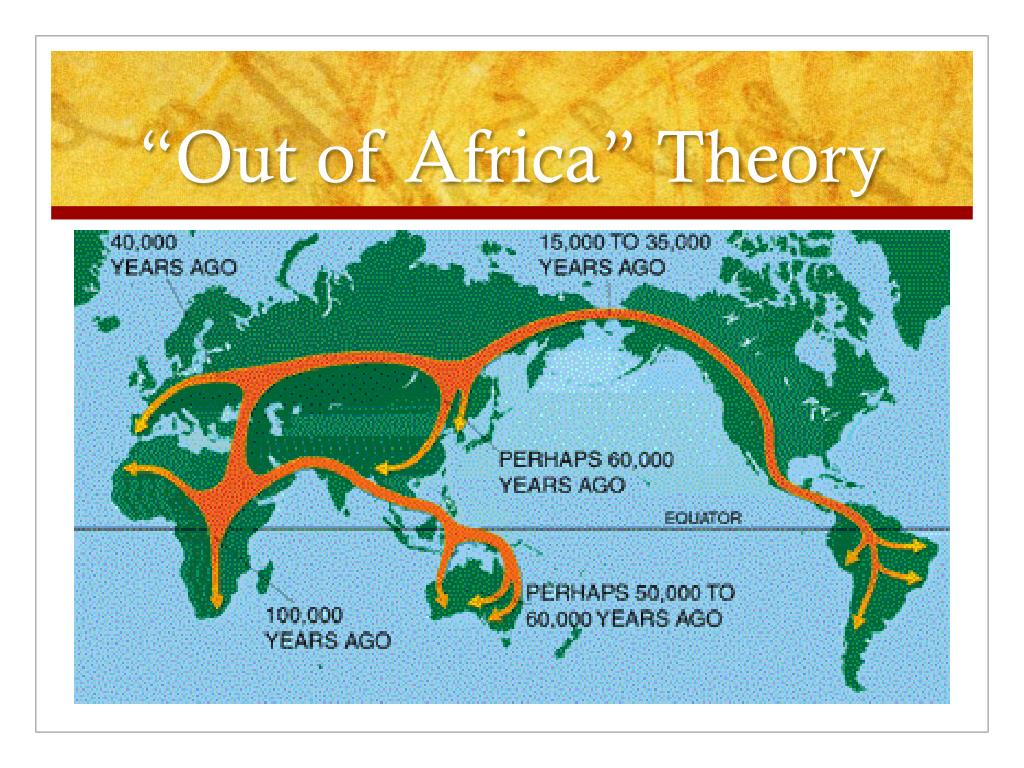
The human migration out of Africa is one of the most significant events in our species' history. It's believed that around 60,000 years ago, a small group of Homo sapiens began their journey from the Horn of Africa, specifically the region now known as Ethiopia, Djibouti, and Eritrea. This initial group likely consisted of just a few hundred individuals, but their movement would change the course of human history forever.
Timeline of Human Migration
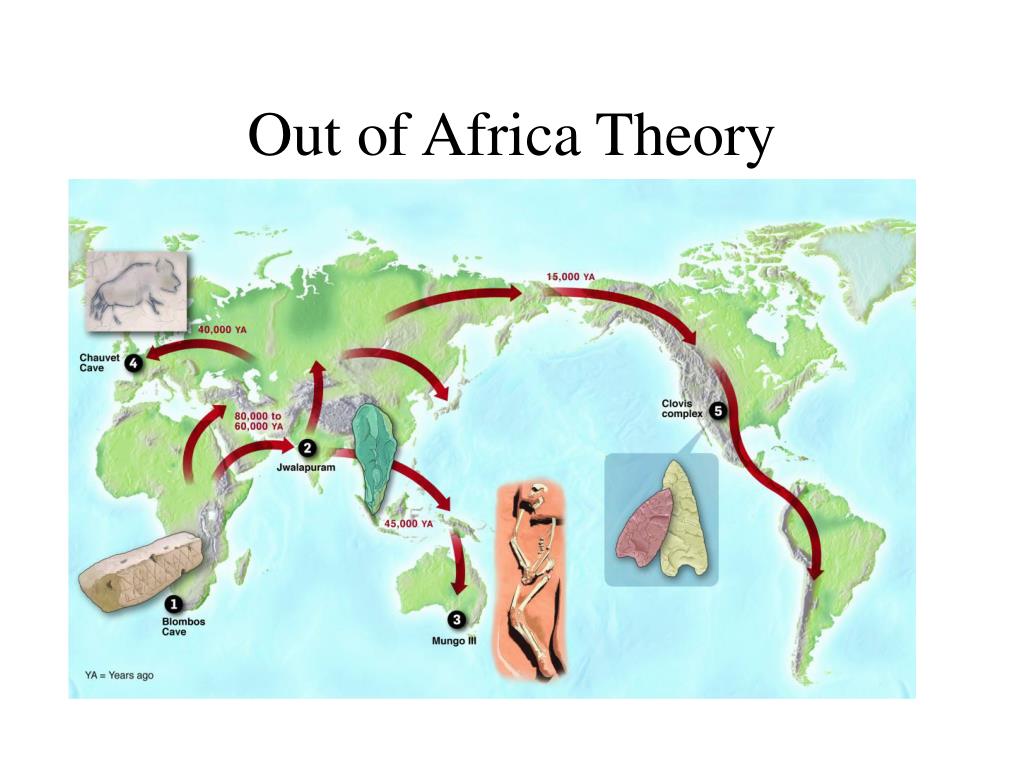
The migration is thought to have occurred in waves, with early humans spreading rapidly across Asia and eventually reaching Europe around 40,000 years ago. Here's a rough breakdown:
- 60,000 years ago: Initial migration out of Africa
- 50,000 years ago: Humans reach Asia and Australia
- 40,000 years ago: Humans arrive in Europe
- 15,000 years ago: Humans reach the Americas
The routes taken by these early migrants are still debated among scientists, but most research points to two main paths: the coastal route along the Indian Ocean and the Nile corridor through the Middle East. The coastal route would've taken them through present-day Yemen, India, and Southeast Asia, while the Nile corridor would've led them through Egypt and into the Levant.
The impact of this migration on global population dynamics was profound. As humans spread across the globe, they encountered new environments, adapted to local conditions, and eventually developed distinct cultures and languages. Today, you can see the genetic legacy of these early migrants in the DNA of populations worldwide.
For example, studies have shown that modern-day Europeans and Asians share a common ancestor who lived around 40,000 years ago, while Africans have a more diverse genetic profile reflecting their longer history on the continent. It's a testament to the incredible journey that took us from a small group in Africa to a global population of over 7 billion people.
Genetic Legacy
You've probably heard that we're all connected, but the Out of Africa theory takes this to a whole new level. Genetic studies have revealed that every human being outside of Africa shares a common ancestry with a small group of Homo sapiens who left the continent around 60,000 years ago. It's like we're all part of one big family tree, with Africa as the roots.
Genetic Diversity and Human Migration
The genetic diversity of African populations is staggering – they're the most genetically diverse humans on the planet. In fact, studies have shown that African genomes contain more genetic variation than the rest of the world's population combined. This makes sense, given that humans originated there. As small groups of humans migrated out of Africa, they carried a limited set of genes with them, resulting in a loss of genetic diversity. For example, the Khoisan people of southern Africa have some of the most divergent mitochondrial DNA lineages, reflecting their ancient roots.
The impact of human migration on indigenous populations is significant. As modern humans encountered other hominin species like Neanderthals and Denisovans, there was interbreeding, leaving behind a genetic legacy. Today, many people outside of Africa carry Neanderthal DNA in their genomes, a testament to these ancient encounters. Aboriginal Australians, for instance, have DNA from Denisovans, showing that there's been a complex history of migration and mixing.
Tracing Ancestral Roots
Thanks to advances in genetic technology, it's now possible to trace your ancestral roots back thousands of years. Companies like 23andMe and National Geographic's Genographic Project have made it easier to explore your genetic heritage. You can discover your mitochondrial haplogroup, which can reveal your ancient maternal lineage. For example, haplogroup L is the oldest human mitochondrial DNA lineage, dating back to Africa around 150,000 years ago.
- African populations have the highest genetic diversity
- Modern humans interbred with Neanderthals and Denisovans
- Genetic technology can trace ancestral roots
Fossil Footprints
You're probably wondering what kind of fossil evidence supports the Out of Africa theory. Let's dive into some fascinating discoveries that have shed light on human migration and evolution. One of the most significant finds is the Laetoli footprints in Tanzania, discovered by Mary Leakey in 1978. These 3.6 million-year-old footprints are some of the oldest evidence of human-like species walking on two legs. The Laetoli footprints show a surprising similarity to modern human footprints, with a distinct heel strike and toe push-off. This suggests that early humans, or more specifically, early hominins like Australopithecus afarensis, had already developed a form of bipedalism. You can imagine these early humans walking across the African savannah, searching for food and shelter. Other key fossil discoveries in Africa include Lucy, the 3.2 million-year-old skeleton found in Hadar, Ethiopia, in 1974 by Donald Johanson. Lucy's fossil remains provide crucial evidence of human evolution, with a mix of ape-like and human-like features. Then there's the fossil finds at Lake Turkana in Kenya, where Richard Leakey's team discovered Homo habilis fossils dating back to around 2.8 million years ago. Fossil evidence like these discoveries has significant implications for human origins research. For one, it confirms that Africa is indeed the cradle of humanity. The fossils found in Africa show a clear pattern of human evolution, from the early hominins like Australopithecus to the emergence of Homo sapiens around 300,000 years ago. You're looking at a timeline of millions of years, with human-like species evolving and adapting to their environments.
Piecing Together Human Evolution
- Fossil record shows a gradual development of human-like traits
- Africa's climate and geography likely played a role in shaping human evolution
- Fossil discoveries continue to refine our understanding of human origins
These discoveries have far-reaching implications for our understanding of human migration and evolution. As more fossils are discovered and analyzed, our picture of human origins becomes clearer. You're witnessing the unfolding story of human history, and it's an exciting time to be exploring these questions.
Cultural Evolution
As humans migrated out of Africa, they carried with them not just their genes, but also their cultures, languages, and technologies. It's fascinating to think about how these early humans adapted to new environments and developed new ways of living. For instance, the discovery of fire control around 1.5 million years ago revolutionized their diets, allowing them to cook food and expand their culinary options.
Early Human Culture and Technology
You might be surprised to learn that early humans were already using complex tools and language systems. The Langauge of Lunga, for example, is believed to be one of the oldest surviving languages, with roots dating back to the early human migration. Similarly, the development of stone tools like the hand axe (around 1.76 million years ago) showcases their ingenuity and adaptability.
The impact of migration on cultural development was profound. As humans encountered new environments and resources, they innovated and adapted, leading to a explosion of cultural diversity. The Aboriginal Australians, who arrived on the continent around 65,000 years ago, developed unique tools like the boomerang, perfectly suited to their environment.
Global Cultural Diversity Today
Fast forward to today, and you can see the legacy of this migration in the staggering cultural diversity across the globe. Papua New Guinea, for example, is home to over 800 languages, while the Inuit in the Arctic have developed a culture intricately linked to the harsh, icy landscape. The global diaspora of humans has resulted in cultures as varied as the Japanese tea ceremonies, Indian Bollywood dances, and Brazilian Carnaval celebrations – each a testament to human creativity and adaptability.
There's no denying the profound impact of human migration on our collective cultural heritage. As you explore the world, you'll find echoes of our shared African ancestry, woven into the fabric of every culture, waiting to be discovered.
Challenging the Theory
You've seen how the Out of Africa Theory has shaped our understanding of human migration, but here's the thing: it's not set in stone. New evidence and alternative theories are shaking things up, and the debate on human origins is far from over.
New Kids on the Block
Recent studies have thrown some curveballs at the Out of Africa Theory. For instance, the discovery of ancient human fossils in China, like the Donaluo 1 fossil, has sparked questions about the single origin theory. Mitochondrial DNA studies also suggest that some modern humans may have originated from multiple regions, not just Africa. Chris Stringer's Multiregional Origin theory is gaining traction, proposing that Homo sapiens evolved from different archaic human populations in various parts of the world.
The fossil record in Asia, particularly in China and Indonesia, shows a mix of archaic and modern human traits, throwing another spanner in the works. The story's getting more complex, and researchers are digging deeper.
The Debate Continues
So, where does this leave us? The debate's far from settled. Geneticist Rebecca Cann's work on mitochondrial DNA supports the Out of Africa Theory, while others argue that the genetic data's more nuanced. The discovery of interbreeding between modern humans and Neanderthals adds another layer of complexity. You're looking at a puzzle with pieces still falling into place.
- New fossil finds in Greece and Bulgaria hint at early human presence outside Africa
- Advances in genetic analysis are rewriting human history
- Future research might uncover more about our complex origins
The Out of Africa Theory's still a strong contender, but the story's evolving. As research progresses, we're likely to see a more detailed picture of human migration emerge.
Mapping the Future
You're probably wondering what's next in the story of human migration. As genetic research continues to advance, we're gaining unprecedented insights into our past – and it's helping shape our future. Take the work of geneticist David Reich, for instance, who's uncovered groundbreaking information about ancient human populations.
The Power of Genetics
Advances in genetic research are revolutionizing our understanding of human history. With tools like CRISPR and next-gen sequencing, scientists can now analyze ancient DNA and track migration patterns with remarkable precision. This isn't just about satisfying curiosity; it's about unlocking new avenues for medical research and personalized healthcare.
The implications for human health are significant. By understanding how our ancestors adapted to different environments, we can gain insights into genetic diseases and develop targeted treatments. For example, researchers have linked genetic variants associated with high-altitude adaptation in Tibetans to a reduced risk of chronic mountain sickness.
- Genetic research informs personalized medicine and disease prevention
- Ancient DNA analysis reveals new insights into human migration patterns
- Future research will likely focus on the intersection of genetics, environment, and culture
As we map the future of human migration and evolution research, we're not just tracing our past – we're shaping our future. The question is, where will our species go next? With climate change, urbanization, and technological advancements reshaping our world, the next chapter of human migration is being written. Buckle up, because it's going to be an incredible ride.











Comments ()