Göbekli Tepe - Ancient Temple Rewrites Human History
Imagine stumbling upon a 13,000-year-old temple that challenges everything we thought we knew about human history. That's exactly what happened with the discovery of Göbekli Tepe in southeastern Turkey, a site that's rewriting the timeline of civilization as we know it. Recent research suggests that carvings on the temple's stone pillars may represent the world's oldest known lunisolar calendar, dating back to around 9600 BCE. This groundbreaking find not only pushes back the origins of organized religion and social complexity but also redefines the relationship between humans and their environment. Let's explore how Göbekli Tepe is redefining our understanding of human history.
The Dawn of Civilization

You've probably heard the story of human progress: hunter-gatherers eking out a meager existence, until agriculture and cities came along, and voilà, civilization as we know it was born. But what if that's not quite right? Enter Göbekli Tepe, a game-changing archaeological site in southeastern Turkey that's flipping our understanding of history on its head.
Dated to around 9500 BCE, Göbekli Tepe is like nothing you've seen before - a sprawling, ancient temple complex that's pushing back the timeline of monumental architecture by thousands of years. The brainchild of Klaus Schmidt, the lead archaeologist, the site's been meticulously excavated, revealing T-shaped pillars, intricate carvings, and a sheer scale that'll leave you wondering what else is out there, waiting to be discovered.
The Temples That Challenge Conventional Wisdom
The thing about Göbekli Tepe is, it's not just old - it's revolutionary. The traditional narrative has it that complex societies, agriculture, and settled communities came first, and then we got religion and monumental architecture. But Göbekli Tepe says, "Hold up, let's rewind." This place suggests that maybe, just maybe, spirituality and communal gatherings were the spark that ignited the fire of civilization, not the other way around.
According to Ian Hodder, director of Stanford's Archaeology Center, "Göbekli Tepe changes everything we thought we knew about the origins of human societies." The site's massive stone pillars, some weighing up to 20 tons, were carved and transported by hunter-gatherers, forcing us to rethink our ideas about the capabilities of early humans.
So, what does this mean for our understanding of human history? For starters, it means we've got a lot more to learn. As archaeologist Lee Clare puts it, "Göbekli Tepe is just the tip of the iceberg - there's a whole world of discovery waiting beneath our feet."
Ancient Monuments in the Wilderness

Göbekli Tepe, which translates to "Potbelly Hill" in Turkish, is a mind-blowing archaeological site that's rewriting history. You're looking at the world's oldest known temple complex, dating back a staggering 11,000 years. That's right, these ancient structures pre-date Stonehenge and the Pyramids of Giza!
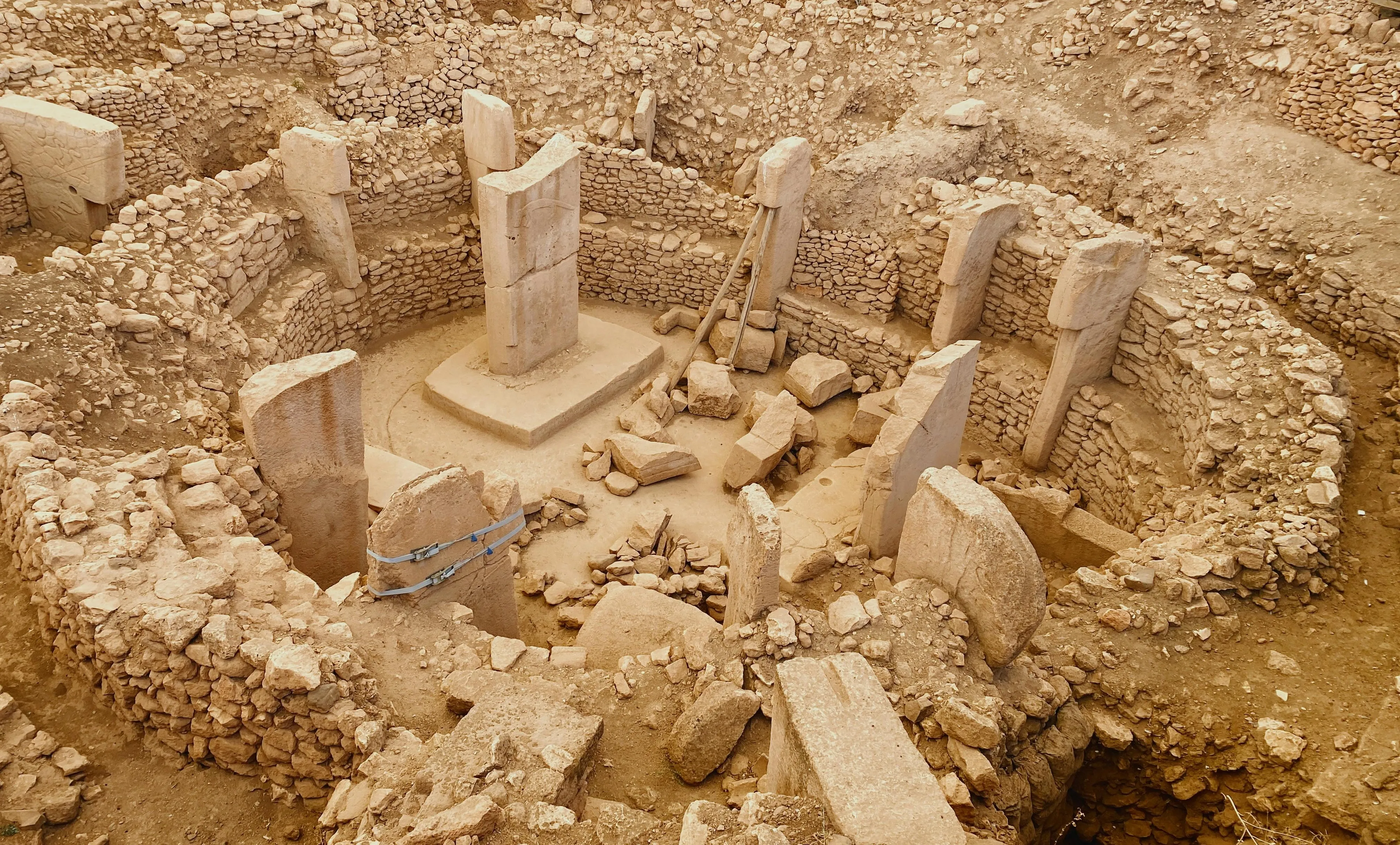
The site features massive T-shaped stone pillars, some weighing up to 20 tons and standing 5-6 meters tall. Just imagine the engineering prowess required to construct these behemoths, considering the limited technology available back then. The pillars are arranged in circular structures, with intricate carvings of animals and abstract symbols etched into them. You'll spot foxes, snakes, and even a few human-like figures, all meticulously crafted by the site's ancient builders.
The Enigmatic Layout
The layout of Göbekli Tepe is what's truly fascinating. The circular structures, numbering around 20, are arranged in a deliberate pattern, with the largest pillar weighing a whopping 50-60 tons at the center. It's as if the builders were trying to convey a message or represent a celestial map. The site's remote location, nestled in the rolling hills of southeastern Turkey, adds to its enigma. There's no sign of nearby settlements, leading researchers to believe it was a pilgrimage site, a gathering place for ancient communities.
- The site's discovery has pushed back our understanding of human civilization by thousands of years
- The carvings on the pillars depict a range of animals, including foxes, snakes, and birds
- Göbekli Tepe's construction is believed to have spanned centuries, with multiple layers of structures
The more researchers uncover, the more questions arise. What's clear is that Göbekli Tepe is a game-changer in our understanding of human history. As you walk through the site, you're literally walking on the dawn of civilization.
A Hunter-Gatherer's Place of Worship
You've seen the massive pillars, the intricate carvings, and the sheer scale of Göbekli Tepe. But what's really striking is that this wasn't a settlement – it was a temple, built by hunter-gatherers around 11,000 years ago. The site's architecture suggests it was used for communal gatherings and rituals, with circular structures that could hold hundreds of people.
The evidence is clear: people came here to feast and celebrate, probably for special occasions. Archaeologists have found massive stone troughs and evidence of large-scale food preparation, suggesting that food was cooked on site. It's likely that people brought offerings of food and drink to share with the community and perhaps the gods. The remains of aurochs, gazelles, and other animals have been found, showing the scale of these feasts.
Symbolism and Spirituality
The presence of animal remains is just the start – the real insight comes from the symbolic carvings found on the pillars. You can see depictions of snakes, foxes, and other creatures, often in intricate detail. These carvings likely held spiritual significance, and may have been part of a complex mythology or cosmology. Klaus Schmidt, the lead archaeologist on the project, believed that the site was a place of pilgrimage, where people came to worship and connect with the divine.
- The pillars themselves may have represented ancestral figures or mythical creatures
- The circular structures may have been aligned with astronomical phenomena, like the movement of the stars
- The carvings may have been a way of telling stories and passing down myths
The more we learn about Göbekli Tepe, the more we're forced to rethink our assumptions about human history. This temple shows that complex spirituality and community organization are not unique to settled societies – they have roots that stretch back much further.
Uncovering the Secrets of Göbekli Tepe
You might be wondering how archaeologists managed to uncover the secrets of Göbekli Tepe. Well, excavations began in 1995, led by the brilliant German archaeologist Klaus Schmidt. He's the one who really got the ball rolling on understanding this incredible site.
The Phases of Construction
The site is believed to have been built in several phases, with the earliest structures dating back over 11,000 years - that's even older than Stonehenge! Can you imagine walking into a temple that's more than 6,000 years older than the pyramids? The structures are massive, with T-shaped pillars, some weighing up to 20 tons, arranged in circular patterns. It's mind-boggling when you think about the engineering skills required to build something like this back then.
Despite being a UNESCO World Heritage Site, only about 10% of Göbekli Tepe has been excavated. That means there's still so much to uncover, and it's pretty exciting to think about what secrets are still hidden beneath the surface. The potential for discovery is huge, and researchers are eager to dig deeper.
The excavation process has already revealed some fascinating insights into the lives of the people who built Göbekli Tepe. For example, the discovery of animal bones and tools suggests that the site was used for ritualistic purposes, rather than as a settlement. It's a game-changer for our understanding of human history, showing that complex societies might have existed earlier than we thought.
The Impact on Our Understanding of History
Göbekli Tepe is turning our understanding of history on its head, and it's happening fast. This ancient temple complex in southeastern Turkey is challenging the traditional narrative of the rise of civilization, suggesting that complex societies and monumental architecture may have emerged earlier than we previously thought.
You see, the conventional wisdom has been that the development of complex societies and the construction of monumental architecture were driven by the rise of agriculture and the emergence of settled farming communities around 10,000 years ago. But Göbekli Tepe, dated to around 11,000 years ago, is pushing that timeline back. The site shows us that hunter-gatherers were capable of building complex structures, and that's changing the game.
The Role of Religion and Communal Gatherings
So, what drove the construction of Göbekli Tepe? Many archaeologists believe it was a communal gathering place, a site of pilgrimage, and a center of worship. The elaborate carvings and sculptures found at the site suggest a sophisticated spiritual practice, and it's clear that the people who built Göbekli Tepe were driven by a shared sense of purpose and belief. Klaus Schmidt, the late German archaeologist who led the excavations, believed that Göbekli Tepe was a place where people came together to worship, feast, and build community.
- The site's layout, with its massive T-shaped pillars and circular structures, suggests a space designed for large gatherings and communal activities.
- The presence of animal bones and other remains indicates that feasting and ritual activities took place at the site.
- The sheer scale of the construction, involving thousands of workers, implies a high degree of social organization and cooperation.
Göbekli Tepe is forcing us to reevaluate our assumptions about the rise of complex societies, and it's opening up new avenues of research and inquiry. As you dig deeper into the mysteries of this incredible site, you start to realize just how much we still have to learn about our collective past.
Preserving the Past for the Future
Göbekli Tepe's significance extends far beyond archaeology - it's a window into the very soul of human culture and society. That's why it's protected by UNESCO and the Turkish government, ensuring this incredible site is preserved for generations to come.
The excavations and research are ongoing, with experts like Dr. Klaus Schmidt (the lead archaeologist until his passing in 2014) and his team uncovering new discoveries that shed more light on human history. In 2018, researchers uncovered a massive stone pillar featuring intricate carvings of animals, including a fox and a lion, thought to be around 11,000 years old. It's moments like these that remind us just how much we still have to learn about our ancestors and their way of life.
The Bigger Picture
Göbekli Tepe isn't just a relic of the past; it's a key to understanding our present and future. The site challenges our assumptions about the rise of civilization, suggesting that maybe, just maybe, our ancestors were more complex and sophisticated than we give them credit for. As you walk through the site, you're walking through the dawn of human history, a time when people were laying the groundwork for the societies we live in today.
- Ongoing excavations continue to uncover new insights into human history
- UNESCO protection ensures the site's preservation for future generations
- Göbekli Tepe offers a unique perspective on human culture and society
Reimagining Human History: What's Next?
You're probably wondering what's next for Göbekli Tepe, the 11,000-year-old temple that's turned our understanding of human history on its head. As excavations continue, led by archaeologists like Klaus Schmidt's successor, Necmi Karul, our understanding of this ancient wonder will only grow. It's like peeling an onion – the more we uncover, the more questions we have.
The site's discovery has sparked a flurry of new debates and research into the origins of human civilization. You'll start seeing more studies on the impact of Göbekli Tepe on our understanding of hunter-gatherer societies and the rise of complex cultures. The temple's sheer scale and sophistication are pushing archaeologists to rethink their theories on human development.
The Legacy Lives On
Göbekli Tepe's legacy will continue to inspire and intrigue us, challenging our assumptions about the past and our place in the world. You can expect more discoveries like the recent findings on the temple's astronomical alignments and ritual practices. As Ian Hodder, a leading archaeologist, puts it, "Göbekli Tepe is a key to understanding the shift to agriculture and settled life."
- New excavations will uncover more structures and artifacts, shedding light on the lives of the people who built Göbekli Tepe.
- The site will continue to inspire new interpretations and theories on human history and culture.
- Göbekli Tepe's influence will be seen in fields beyond archaeology, from anthropology to philosophy.
As you walk through the ruins of Göbekli Tepe, you're walking through a doorway to our collective past – and a glimpse into the possibilities of our shared future. The story of Göbekli Tepe is far from over; it's just the beginning.










Comments ()