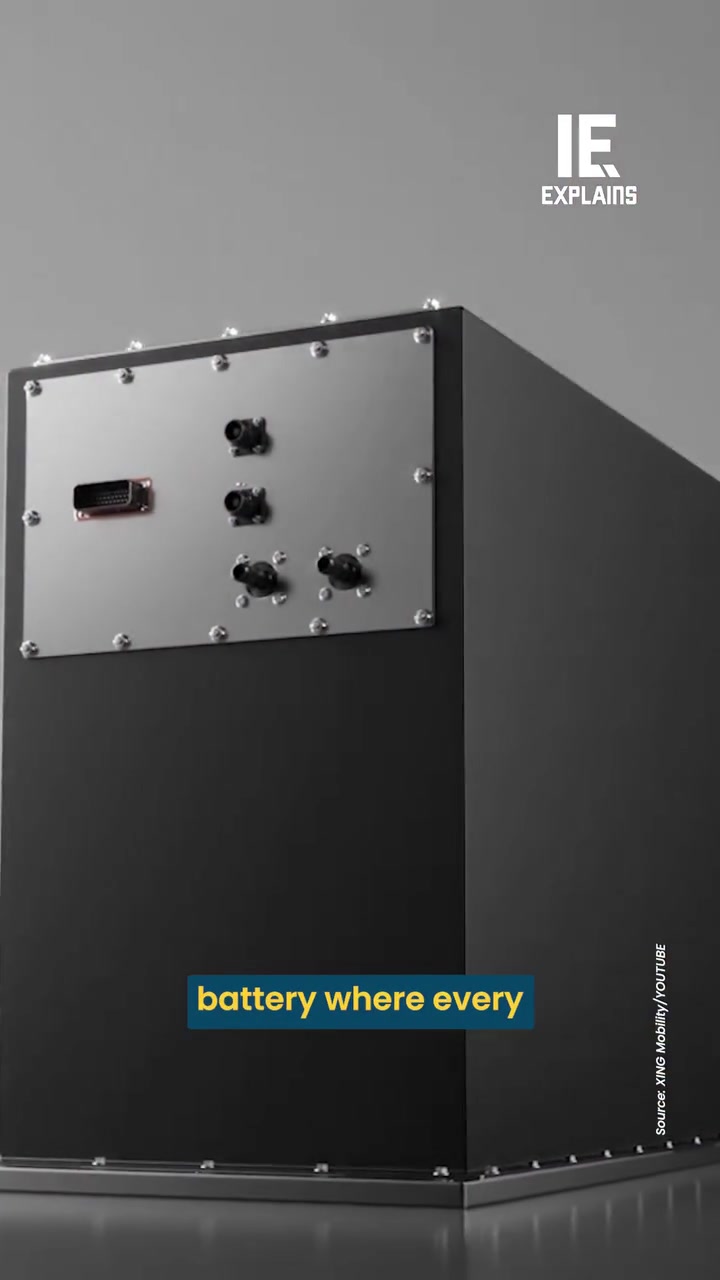
A Taiwanese company designed a liquid-cooled battery system for ships that can pack cells twice as tightly as conventional batteries. Xing Mobility's system allows mariners to reach new goals but will need further certification. Ships, especially electric ones, place immense demands on their powertrains. The unpredictability of ocean conditions makes traditional land-based solutions risky for maritime use. A Taiwanese company, Xing Mobility, developed a new battery system that brings high-performance operation to electric vessels. Their Immersio CTP system is a modular battery pack where every cell is submerged in a liquid coolant, cooling the cells uniformly instead of from the outside only, allowing for higher energy density. Xing Mobility exhibits a specific type of battery cooling in their Immersio CTP battery system: dielectric fluid. This fluid does not conduct electricity. Used in Xing Mobility's submarine battery, it can touch live cells directly, absorbing heat where it forms to prevent thermal runaway. It's only when heat dissipation becomes the limiting factor for power density that fluid-cooled batteries can outperform conventional ones. The maritime setting demands a system that can handle extreme conditions and sudden failures. Xing Mobility's Immersio CTP is designed to address these exact issues, making it ideal for electric maritime vessels.
Packing uniformity with coolant heat
Instead of relying on a cooling system that draws heat from the outside alone, Xing Mobility's design bathes its battery cells in a coolant liquid. This heat conduction system can improve efficiency and optimize power output compared to air-cooled or plate-cooled cells. Xing Mobility's solution carries several advantages for ships. At sea, a power cell that overheats poses a greater danger than on land. If one cell tips into thermal runaway, there's no opportunity for a marine vessel to "pull over" and reassess the damage. The coolant in the Xing Mobility system absorbs the heat where it starts and stops the fire jumping cell to cell, allowing mariners to avoid a power failure at sea. Managing heat is vital because once it stops being a limiting factor, cells can be packed much more densely.
Groundbreaking Energy Density
The Immersio CTP system has two times the energy density of a typical marine battery, whether measured by weight or volume. Xing Mobility's innovation allows for a 3C continuous discharge rate, making it well-suited for fast-moving vessels. The potential applications for the Immersio CTP span from small ships to large, energy-intensive vessels. The Porima P11 is a vessel already using Xing's technologies and the Smart IQ, another vessel currently undergoing testing, relies on the same battery packs. Currently, Xing's system scales up from 60 to 400 kilowatt hours, providing ample power for both small and more significant applications. Its large-scale battery packs can now be mounted on submarines, ships, and even power plants.
Launched at the SMM Shipping Show in Hamburg
Xing Mobility introduced their Immersio CTP battery system at the SMM Shipping Show in Hamburg. The event showcases the company's progress and the importance of their innovation in maritime technology. The modular system debut is an impressive addition to the offshore and marine power industry, showcasing Xing Mobility's prowess in the field. Xing Mobility's immersion cooling technology, launched at SMM Shipping Show in Hamburg, made a big impact on the industry. The technology promises to reshape the way the maritime industry looks at electric power. The company shows their Immersio CTP system does have the capability to power much larger vessels.
Safety, Certification and Energy Density
One of the primary aspects of any battery system is safety. Xing Mobility's diesel coolant solution is designed to prevent thermal runaway. The coolant absorbs heat from each cell and mitigates the risk of fire. Xing Mobility's system improves safety by removing the risk of overheating. One catch is DNV certification is still underway, and Xing has not published a raw watt-hours per kilogram number. For now, the comparison is its own. This means that while the design has shown promise, there is still work to be done in verifying the energy efficiency of their system. It will be interesting to see how Xing Mobility continues to build on this, and how the maritime industry responds to the promise shown by their innovation.
Making maritime energy safer with Xing's Battery Packs
Electrifying maritime vessels is not as simple as plugging in a new power source—electric ships must meet different demands. The Immersio CTP battery system from Xing Mobility, a Taiwanese company, offers a modular solution to the challenges faced by maritime vessels. The company's immersion cooled pack is safer, more efficient, and more powerful than conventional batteries, with an improved energy density and a continuous discharge rate. The next time you see a battery on a ship, it might be from Xing Mobility.
Questions readers ask
What exactly is Xing Mobility's Immersio CTP battery system and how does it differ from conventional batteries?
The Immersio CTP system is a modular battery pack designed by Xing Mobility, where each cell is submerged in a liquid coolant. This allows for uniform cooling, unlike conventional batteries that cool from the outside. The result is a higher energy density, packing twice the power of conventional batteries.
How does the liquid coolant in Xing Mobility's battery system prevent thermal runaway?
The liquid coolant used in Xing Mobility's system is a dielectric fluid that doesn't conduct electricity. It absorbs heat directly from the cells, preventing thermal runaway by stopping the fire from jumping from cell to cell.
What are the benefits of using a liquid-cooled battery system in maritime applications?
The maritime setting demands a system that can handle extreme conditions and sudden failures. Xing Mobility's Immersio CTP system addresses these issues by providing uniform cooling and preventing thermal runaway, making it ideal for electric maritime vessels. It also allows for higher energy density, which is crucial for fast-moving vessels.
Which vessels are currently using the Immersio CTP battery system, and how scalable is it?
The Porima P11 is already using Xing's technologies, and the Smart IQ, another vessel currently undergoing testing, relies on the same battery packs. The system scales from 60 to 400 kilowatt hours, making it suitable for both small and large vessels, including submarines, ships, and even power plants.
How does the Immersio CTP system's energy density compare to typical marine batteries?
The Immersio CTP system has two times the energy density of a typical marine battery, whether measured by weight or volume. This high energy density is achieved through the use of a liquid coolant that allows for higher cell packing density. It also supports a 3C continuous discharge rate, making it well-suited for fast-moving vessels.
What is the significance of Xing Mobility introducing their Immersio CTP battery system at the SMM Shipping Show in Hamburg?
The SMM Shipping Show in Hamburg is a significant event in the maritime industry. By introducing the Immersio CTP system there, Xing Mobility showcased their progress and the potential of their battery system to a wide audience of industry professionals. This event highlights the company's commitment to advancing electric maritime technology.
What challenges might Xing Mobility face in getting their battery system certified for use on ships?
Although the Immersio CTP system offers a lot of promise, it will need to go through the certification process. This may involve proving the safety and reliability of the system in maritime conditions and ensuring it meets all relevant regulations. It could be a lengthy process with no guarantees of success.
Related deep dives
Similar reads based on topic and creator.


Recent articles
Fresh deep dives from the latest Reels we unpacked.



Comments
Be the first to comment.