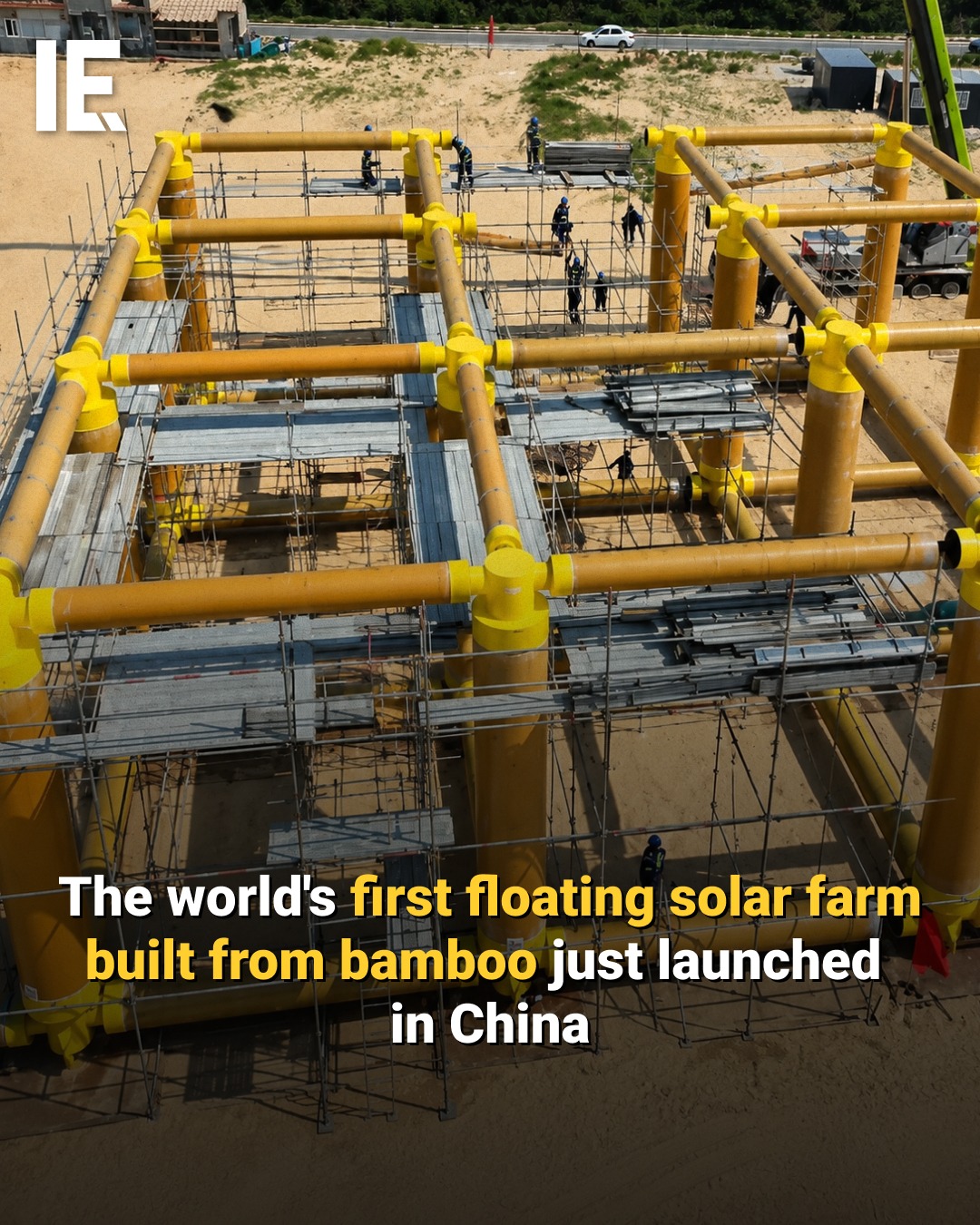
Just Offshore, the First Bamboo Solar Farm Floats in China:
High above the still blue of a reservoir, a forest of bamboo poles supports glass solar panels. These are the only floating solar farms of their kind in the world. They sit on the water, soaking up the sun. This is now a reality in China, where the large, interconnected network looms over a lake or reservoir.
Fishing and generating power
A floating solar farm is exactly what it sounds like: a solar farm that sits on water. There are many established solar farms on land, but China is now building a system using bamboo that can generate the same power while saving space and water — using a renewable material. It's a compact system. Each solar panel is balanced on a small bamboo platform. The open water beneath allows the farm to regulate its temperature and increase power output. In the first example, the bamboo building the platform is lightweight and has an inherent strength. Bamboo is a natural material that grows quickly and abundantly. Together with the solar panels, the bamboo structure can be customized to fit different landscape locations. The bamboo can be sustainably harvested without harming the environment. On a lake or reservoir, solar panels can be built without disrupting natural habitats or competing for land use.
What bamboo tackling water scarcity looks like
Local demand for water and land in China is growing. The population needs homes, agriculture, and water to thrive. Solar farms are optimal because they use land efficiently. The two most intense parts of human expansion are land use for solar farms and water use in the region. With over 60% of China's population living in freshwater scarcity areas, the bamboo solar farms are a major step forward. The bamboo frame will reduce further strain to water in the region by utilizing already existing bodies of water. Increasing urbanization also increases the need for power. This is especially relevant in China, where urbanization alone creates a demand of 3.5% per year. Bamboo solar farms can support this. The most basic reason why the water-connected bamboo solar farms are an amazing feat of modern renewable energy is because they use the lake and do not need to disrupt the flow of the water.
Why bamboo?
The bamboo solar farm is a structural solution. The leveling off of a system means that the design uses mounting structures that are lower to the water level to pack more solar panels. Bamboo solar farms therefore do not require a stable soil base. The mounting structure for bamboo wood is assessable and available in China. Local bamboo forests provide a sustainable source of bamboo without any competition and transport costs. The bamboo can grow sustainably and can be harvested without harming the environment. The bamboo structure avoids any fragmentation of the landscape by building the panels on water. Experts stress that one of the main advantages of the bamboo building is that it is flexible. The inherent flexibility of bamboo creates a dampening action that helps the solar panels adapt to the elements. Bamboo extends the solar panels' lifetime by flexing. Flexing allows the structure to withstand changes in temperature and avoid stress fractures by diffusing the energy of the wind. Bamboo is also very resilient and flexible which makes the bamboo solar farm a reliable solar farm. Its natural durability and ability to withstand the wind and rain are one step closer to a fully renewable energy supply that withstands the elements.
The logistics
China is a fast-growing country, and urbanization is increasing the demand for power. The bamboo solar farm is a complete system that can be built to support the urbanization of the country by providing an abundant renewable power supply. With over 60% of China's population living in freshwater scarcity areas, every unit of this renewable power is more important. The bamboo solar farm will also help reduce land use from lakes and reservoirs. The bamboo solar farm will help reduce land use from lakes and reservoirs. It is a sustainable way to provide power to people living in freshwater scarcity areas. The bamboo solar farm is a way to provide power to people living in freshwater scarcity areas without using up their land and water. Building infrastructure away from the land in China reduces flooding. It also provides an abundance of clean water for the people living in freshwater scarcity areas. Water is the largest natural resource in China, and by using nature for generating energy we can use the world. Bamboo solar panels are a great example of how renewable energy can be integrated into the natural world. The solar panels are built on water, and the bamboo structure creates a natural habitat for fish and other wildlife. The solar panels are built on water, and the bamboo structure creates a natural habitat for fish and other wildlife.
100% Renewable Power Production
The bamboo floating farm is not only a renewable energy source, but it also creates a natural habitat for fish and other wildlife. The floating solar farm is a sustainable way to provide power to people living in freshwater scarcity areas. The solar panels are powered by bamboo and built on water, and the bamboo structure creates a natural habitat for fish and other wildlife. The panels are built on water, which means that they do not need to be built on land. This reduces the need for land use and the impact on the environment. The bamboo structure creates a natural habitat for fish and other wildlife, and the solar panels are built on water. The solar panels are built on water, and the bamboo structure creates a natural habitat for fish and other wildlife. The solar panels are built on water, and the bamboo structure creates a natural habitat for fish and other wildlife.
Planning for location
China is a country with a large population and a high demand for power and water. The bamboo solar farms are a great way to provide power to people living in freshwater scarcity areas. The bamboo structure creates a natural habitat for fish and other wildlife, and the solar panels are built on water.
Questions readers ask
What makes China's bamboo floating solar farms unique?
China's bamboo floating solar farms are unique because they are the first of their kind in the world. Unlike traditional solar farms that require large land areas, these farms float on water bodies like lakes and reservoirs, utilizing bamboo poles to support solar panels. This design not only saves space but also addresses water scarcity issues by using existing water bodies without disrupting natural habitats.
How does the bamboo structure benefit the solar panels?
The bamboo structure benefits the solar panels in several ways. First, it provides a lightweight yet strong base that can adapt to different landscape locations. Second, the open water beneath the panels helps regulate their temperature, which increases power output. Additionally, bamboo's inherent flexibility allows the panels to flex and adapt to the elements, extending their lifespan.
What are the main advantages of using bamboo for these solar farms?
Using bamboo for these solar farms offers several advantages. Bamboo is a sustainable and renewable resource that grows quickly and abundantly. It can be harvested without harming the environment, making it an eco-friendly choice. Additionally, bamboo's flexibility helps the solar panels adapt to the elements, extending their lifespan. The use of bamboo also avoids fragmentation of the landscape by building the panels on water.
How do these bamboo solar farms address China's water scarcity issues?
Bamboo solar farms address China's water scarcity issues by utilizing existing water bodies like lakes and reservoirs. This approach does not disrupt natural habitats or compete for land use. By using already existing bodies of water, the farms reduce further strain on water resources in regions where over 60% of the population lives in freshwater scarcity areas.
Related deep dives
Similar reads based on topic and creator.


Recent articles
Fresh deep dives from the latest Reels we unpacked.



Comments
Be the first to comment.